

Optical Imaging in Biology: Basics and Applications
639
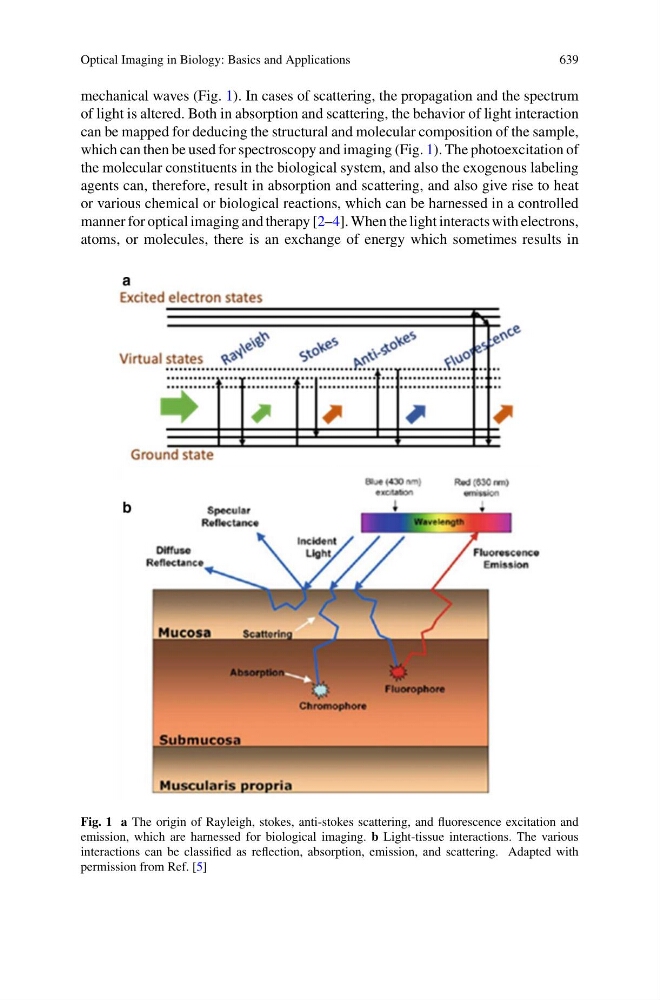
mechanical waves (Fig. 1). In cases of scattering, the propagation and the spectrum
of light is altered. Both in absorption and scattering, the behavior of light interaction
can be mapped for deducing the structural and molecular composition of the sample,
which can then be used for spectroscopy and imaging (Fig. 1). The photoexcitation of
the molecular constituents in the biological system, and also the exogenous labeling
agents can, therefore, result in absorption and scattering, and also give rise to heat
or various chemical or biological reactions, which can be harnessed in a controlled
manner for optical imaging and therapy [2–4]. When the light interacts with electrons,
atoms, or molecules, there is an exchange of energy which sometimes results in
Fig. 1 a The origin of Rayleigh, stokes, anti-stokes scattering, and fluorescence excitation and
emission, which are harnessed for biological imaging. b Light-tissue interactions. The various
interactions can be classified as reflection, absorption, emission, and scattering. Adapted with
permission from Ref. [5]