

Two Dimensional Infrared Spectroscopy …
47
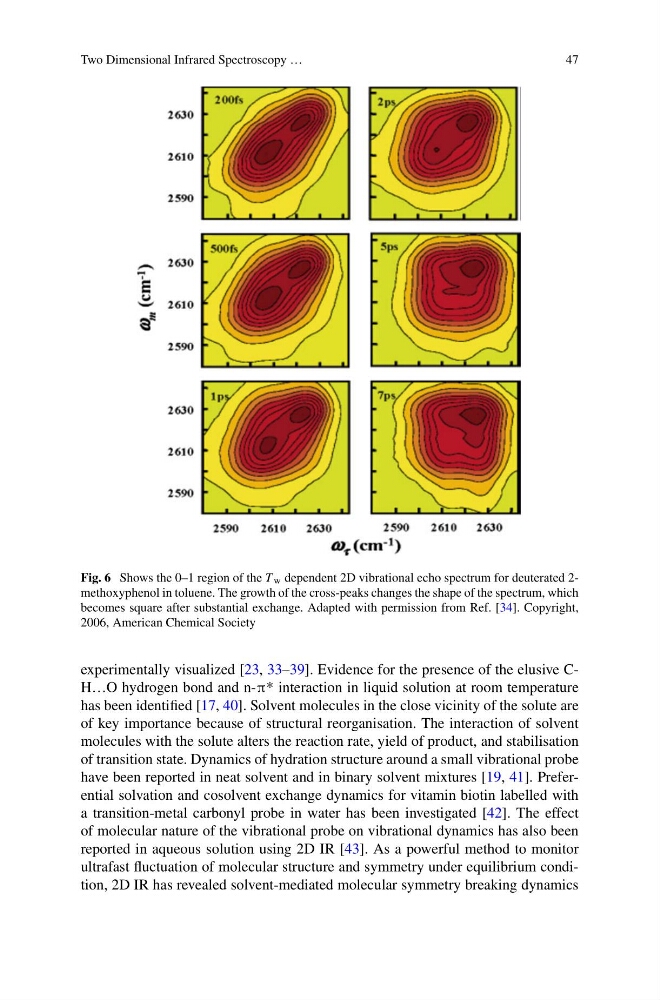
Fig. 6 Shows the 0–1 region of the T w dependent 2D vibrational echo spectrum for deuterated 2methoxyphenol in toluene. The growth of the cross-peaks changes the shape of the spectrum, which
becomes square after substantial exchange. Adapted with permission from Ref. [34]. Copyright,
2006, American Chemical Society
experimentally visualized [23, 33–39]. Evidence for the presence of the elusive CH…O hydrogen bond and n-π* interaction in liquid solution at room temperature
has been identified [17, 40]. Solvent molecules in the close vicinity of the solute are
of key importance because of structural reorganisation. The interaction of solvent
molecules with the solute alters the reaction rate, yield of product, and stabilisation
of transition state. Dynamics of hydration structure around a small vibrational probe
have been reported in neat solvent and in binary solvent mixtures [19, 41]. Preferential solvation and cosolvent exchange dynamics for vitamin biotin labelled with
a transition-metal carbonyl probe in water has been investigated [42]. The effect
of molecular nature of the vibrational probe on vibrational dynamics has also been
reported in aqueous solution using 2D IR [43]. As a powerful method to monitor
ultrafast fluctuation of molecular structure and symmetry under equilibrium condition, 2D IR has revealed solvent-mediated molecular symmetry breaking dynamics
47
Fig. 6 Shows the 0–1 region of the T w dependent 2D vibrational echo spectrum for deuterated 2methoxyphenol in toluene. The growth of the cross-peaks changes the shape of the spectrum, which
becomes square after substantial exchange. Adapted with permission from Ref. [34]. Copyright,
2006, American Chemical Society
experimentally visualized [23, 33–39]. Evidence for the presence of the elusive CH…O hydrogen bond and n-π* interaction in liquid solution at room temperature
has been identified [17, 40]. Solvent molecules in the close vicinity of the solute are
of key importance because of structural reorganisation. The interaction of solvent
molecules with the solute alters the reaction rate, yield of product, and stabilisation
of transition state. Dynamics of hydration structure around a small vibrational probe
have been reported in neat solvent and in binary solvent mixtures [19, 41]. Preferential solvation and cosolvent exchange dynamics for vitamin biotin labelled with
a transition-metal carbonyl probe in water has been investigated [42]. The effect
of molecular nature of the vibrational probe on vibrational dynamics has also been
reported in aqueous solution using 2D IR [43]. As a powerful method to monitor
ultrafast fluctuation of molecular structure and symmetry under equilibrium condition, 2D IR has revealed solvent-mediated molecular symmetry breaking dynamics