

Fundamentals of ATR-FTIR Spectroscopy and Its Role …
33
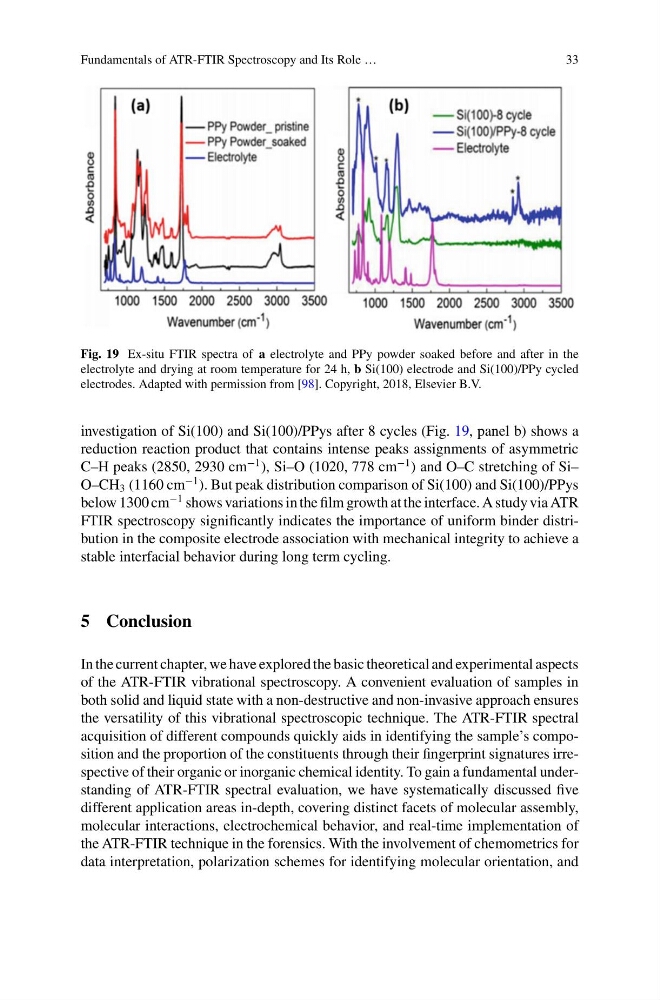
Fig. 19 Ex-situ FTIR spectra of a electrolyte and PPy powder soaked before and after in the
electrolyte and drying at room temperature for 24 h, b Si(100) electrode and Si(100)/PPy cycled
electrodes. Adapted with permission from [98]. Copyright, 2018, Elsevier B.V.
investigation of Si(100) and Si(100)/PPys after 8 cycles (Fig. 19, panel b) shows a
reduction reaction product that contains intense peaks assignments of asymmetric
C–H peaks (2850, 2930 cm
−1 ), Si–O (1020, 778 cm
−1 ) and O–C stretching of Si–
O–CH 3 (1160 cm
−1 ). But peak distribution comparison of Si(100) and Si(100)/PPys
below 1300 cm
−1 shows variations in the film growth at the interface. A study via ATR
FTIR spectroscopy significantly indicates the importance of uniform binder distribution in the composite electrode association with mechanical integrity to achieve a
stable interfacial behavior during long term cycling.
5 Conclusion
In the current chapter, we have explored the basic theoretical and experimental aspects
of the ATR-FTIR vibrational spectroscopy. A convenient evaluation of samples in
both solid and liquid state with a non-destructive and non-invasive approach ensures
the versatility of this vibrational spectroscopic technique. The ATR-FTIR spectral
acquisition of different compounds quickly aids in identifying the sample’s composition and the proportion of the constituents through their fingerprint signatures irrespective of their organic or inorganic chemical identity. To gain a fundamental understanding of ATR-FTIR spectral evaluation, we have systematically discussed five
different application areas in-depth, covering distinct facets of molecular assembly,
molecular interactions, electrochemical behavior, and real-time implementation of
the ATR-FTIR technique in the forensics. With the involvement of chemometrics for
data interpretation, polarization schemes for identifying molecular orientation, and
33
Fig. 19 Ex-situ FTIR spectra of a electrolyte and PPy powder soaked before and after in the
electrolyte and drying at room temperature for 24 h, b Si(100) electrode and Si(100)/PPy cycled
electrodes. Adapted with permission from [98]. Copyright, 2018, Elsevier B.V.
investigation of Si(100) and Si(100)/PPys after 8 cycles (Fig. 19, panel b) shows a
reduction reaction product that contains intense peaks assignments of asymmetric
C–H peaks (2850, 2930 cm
−1 ), Si–O (1020, 778 cm
−1 ) and O–C stretching of Si–
O–CH 3 (1160 cm
−1 ). But peak distribution comparison of Si(100) and Si(100)/PPys
below 1300 cm
−1 shows variations in the film growth at the interface. A study via ATR
FTIR spectroscopy significantly indicates the importance of uniform binder distribution in the composite electrode association with mechanical integrity to achieve a
stable interfacial behavior during long term cycling.
5 Conclusion
In the current chapter, we have explored the basic theoretical and experimental aspects
of the ATR-FTIR vibrational spectroscopy. A convenient evaluation of samples in
both solid and liquid state with a non-destructive and non-invasive approach ensures
the versatility of this vibrational spectroscopic technique. The ATR-FTIR spectral
acquisition of different compounds quickly aids in identifying the sample’s composition and the proportion of the constituents through their fingerprint signatures irrespective of their organic or inorganic chemical identity. To gain a fundamental understanding of ATR-FTIR spectral evaluation, we have systematically discussed five
different application areas in-depth, covering distinct facets of molecular assembly,
molecular interactions, electrochemical behavior, and real-time implementation of
the ATR-FTIR technique in the forensics. With the involvement of chemometrics for
data interpretation, polarization schemes for identifying molecular orientation, and