

Fundamentals of ATR-FTIR Spectroscopy and Its Role …
29
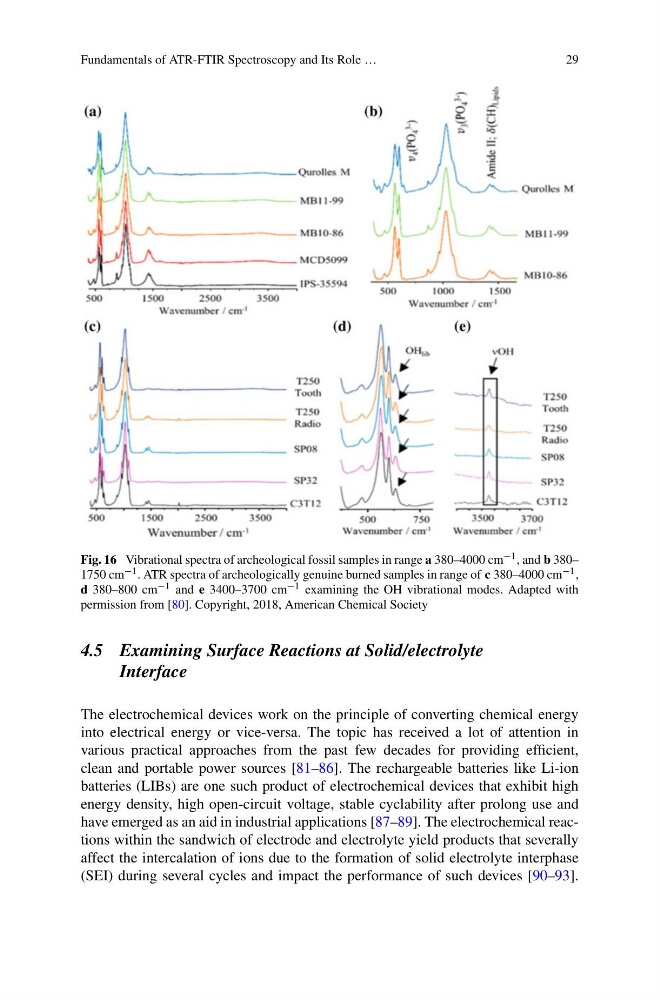
Fig. 16 Vibrational spectra of archeological fossil samples in range a 380–4000 cm −1 , and b 380–
1750 cm −1 . ATR spectra of archeologically genuine burned samples in range of c 380–4000 cm −1 ,
d 380–800 cm −1 and e 3400–3700 cm −1 examining the OH vibrational modes. Adapted with
permission from [80]. Copyright, 2018, American Chemical Society
4.5 Examining Surface Reactions at Solid/electrolyte
Interface
The electrochemical devices work on the principle of converting chemical energy
into electrical energy or vice-versa. The topic has received a lot of attention in
various practical approaches from the past few decades for providing efficient,
clean and portable power sources [81–86]. The rechargeable batteries like Li-ion
batteries (LIBs) are one such product of electrochemical devices that exhibit high
energy density, high open-circuit voltage, stable cyclability after prolong use and
have emerged as an aid in industrial applications [87–89]. The electrochemical reactions within the sandwich of electrode and electrolyte yield products that severally
affect the intercalation of ions due to the formation of solid electrolyte interphase
(SEI) during several cycles and impact the performance of such devices [90–93].
29
Fig. 16 Vibrational spectra of archeological fossil samples in range a 380–4000 cm −1 , and b 380–
1750 cm −1 . ATR spectra of archeologically genuine burned samples in range of c 380–4000 cm −1 ,
d 380–800 cm −1 and e 3400–3700 cm −1 examining the OH vibrational modes. Adapted with
permission from [80]. Copyright, 2018, American Chemical Society
4.5 Examining Surface Reactions at Solid/electrolyte
Interface
The electrochemical devices work on the principle of converting chemical energy
into electrical energy or vice-versa. The topic has received a lot of attention in
various practical approaches from the past few decades for providing efficient,
clean and portable power sources [81–86]. The rechargeable batteries like Li-ion
batteries (LIBs) are one such product of electrochemical devices that exhibit high
energy density, high open-circuit voltage, stable cyclability after prolong use and
have emerged as an aid in industrial applications [87–89]. The electrochemical reactions within the sandwich of electrode and electrolyte yield products that severally
affect the intercalation of ions due to the formation of solid electrolyte interphase
(SEI) during several cycles and impact the performance of such devices [90–93].