

Application of X-Ray Photoelectron Spectroscopy in Materials …
425
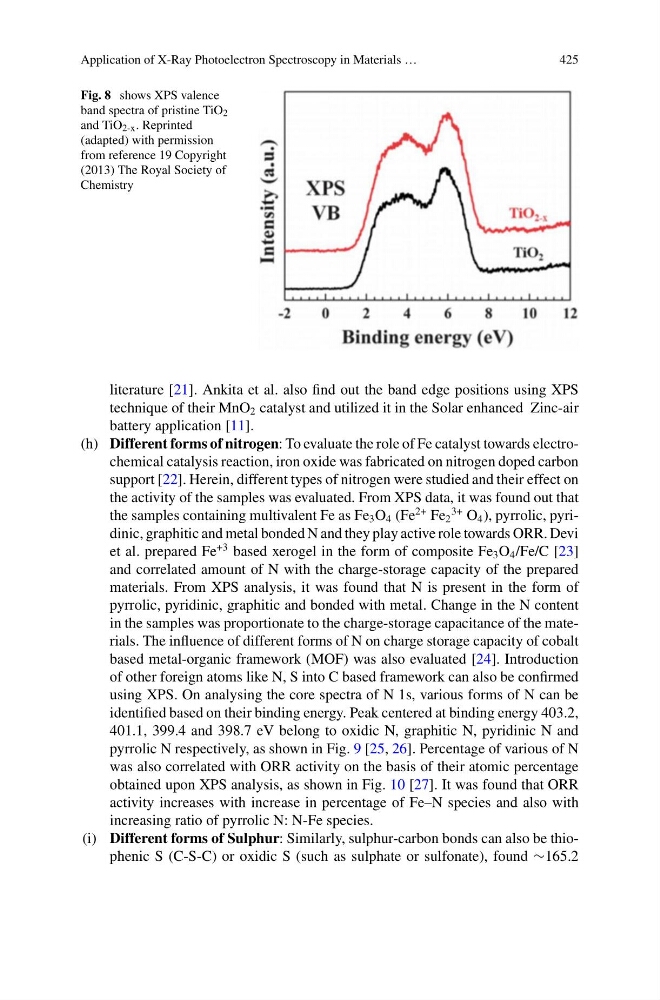
Fig. 8 shows XPS valence
band spectra of pristine TiO 2
and TiO 2-x . Reprinted
(adapted) with permission
from reference 19 Copyright
(2013) The Royal Society of
Chemistry
literature [21]. Ankita et al. also find out the band edge positions using XPS
technique of their MnO 2 catalyst and utilized it in the Solar enhanced Zinc-air
battery application [11].
(h) Different forms of nitrogen: To evaluate the role of Fe catalyst towards electrochemical catalysis reaction, iron oxide was fabricated on nitrogen doped carbon
support [22]. Herein, different types of nitrogen were studied and their effect on
the activity of the samples was evaluated. From XPS data, it was found out that
the samples containing multivalent Fe as Fe 3 O 4 (Fe
2+ Fe 2
3+ O 4 ), pyrrolic, pyridinic, graphitic and metal bonded N and they play active role towards ORR. Devi
et al. prepared Fe
+3 based xerogel in the form of composite Fe 3 O 4 /Fe/C [23]
and correlated amount of N with the charge-storage capacity of the prepared
materials. From XPS analysis, it was found that N is present in the form of
pyrrolic, pyridinic, graphitic and bonded with metal. Change in the N content
in the samples was proportionate to the charge-storage capacitance of the materials. The influence of different forms of N on charge storage capacity of cobalt
based metal-organic framework (MOF) was also evaluated [24]. Introduction
of other foreign atoms like N, S into C based framework can also be confirmed
using XPS. On analysing the core spectra of N 1s, various forms of N can be
identified based on their binding energy. Peak centered at binding energy 403.2,
401.1, 399.4 and 398.7 eV belong to oxidic N, graphitic N, pyridinic N and
pyrrolic N respectively, as shown in Fig. 9 [25, 26]. Percentage of various of N
was also correlated with ORR activity on the basis of their atomic percentage
obtained upon XPS analysis, as shown in Fig. 10 [27]. It was found that ORR
activity increases with increase in percentage of Fe–N species and also with
increasing ratio of pyrrolic N: N-Fe species.
(i) Different forms of Sulphur: Similarly, sulphur-carbon bonds can also be thiophenic S (C-S-C) or oxidic S (such as sulphate or sulfonate), found ∼165.2
425
Fig. 8 shows XPS valence
band spectra of pristine TiO 2
and TiO 2-x . Reprinted
(adapted) with permission
from reference 19 Copyright
(2013) The Royal Society of
Chemistry
literature [21]. Ankita et al. also find out the band edge positions using XPS
technique of their MnO 2 catalyst and utilized it in the Solar enhanced Zinc-air
battery application [11].
(h) Different forms of nitrogen: To evaluate the role of Fe catalyst towards electrochemical catalysis reaction, iron oxide was fabricated on nitrogen doped carbon
support [22]. Herein, different types of nitrogen were studied and their effect on
the activity of the samples was evaluated. From XPS data, it was found out that
the samples containing multivalent Fe as Fe 3 O 4 (Fe
2+ Fe 2
3+ O 4 ), pyrrolic, pyridinic, graphitic and metal bonded N and they play active role towards ORR. Devi
et al. prepared Fe
+3 based xerogel in the form of composite Fe 3 O 4 /Fe/C [23]
and correlated amount of N with the charge-storage capacity of the prepared
materials. From XPS analysis, it was found that N is present in the form of
pyrrolic, pyridinic, graphitic and bonded with metal. Change in the N content
in the samples was proportionate to the charge-storage capacitance of the materials. The influence of different forms of N on charge storage capacity of cobalt
based metal-organic framework (MOF) was also evaluated [24]. Introduction
of other foreign atoms like N, S into C based framework can also be confirmed
using XPS. On analysing the core spectra of N 1s, various forms of N can be
identified based on their binding energy. Peak centered at binding energy 403.2,
401.1, 399.4 and 398.7 eV belong to oxidic N, graphitic N, pyridinic N and
pyrrolic N respectively, as shown in Fig. 9 [25, 26]. Percentage of various of N
was also correlated with ORR activity on the basis of their atomic percentage
obtained upon XPS analysis, as shown in Fig. 10 [27]. It was found that ORR
activity increases with increase in percentage of Fe–N species and also with
increasing ratio of pyrrolic N: N-Fe species.
(i) Different forms of Sulphur: Similarly, sulphur-carbon bonds can also be thiophenic S (C-S-C) or oxidic S (such as sulphate or sulfonate), found ∼165.2