

394
P. Singh et al.
1.3 Upconversion Mechanism Based on Triplet–Triplet
Annihilation (TTA)
Upconversion luminescence mechanism based on TTA was first introduced by Parker
and colleagues in 1962 [23]. In TTA based UC process, molecules based chromophors
act as sensitizers (energy donor) and annihilators (energy acceptor). The mechanism
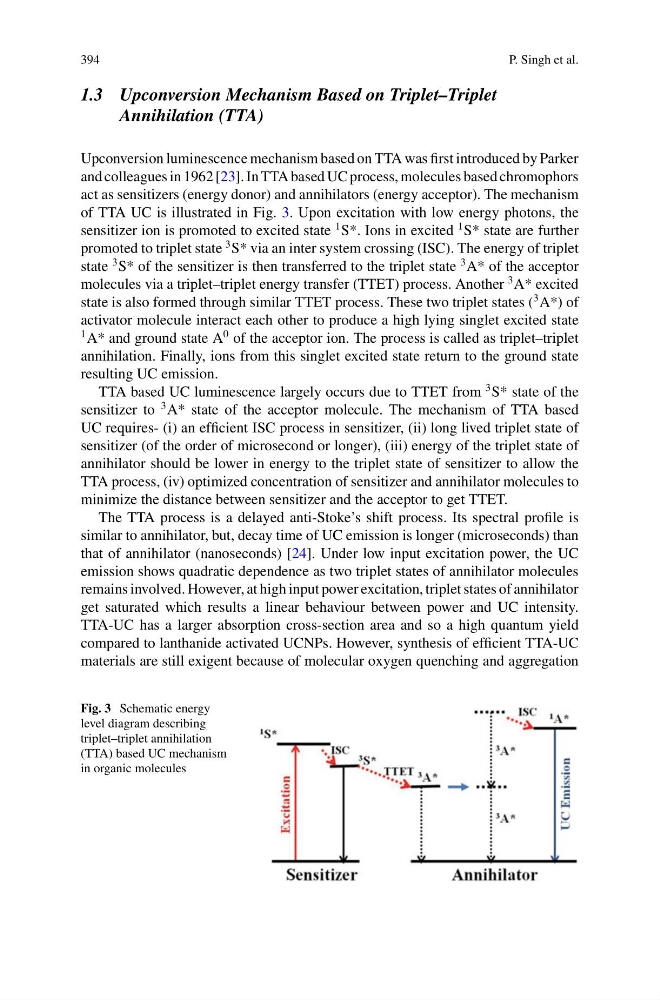
of TTA UC is illustrated in Fig. 3. Upon excitation with low energy photons, the
sensitizer ion is promoted to excited state
1 S*. Ions in excited
1 S* state are further
promoted to triplet state
3 S* via an inter system crossing (ISC). The energy of triplet
state
3 S* of the sensitizer is then transferred to the triplet state
3 A* of the acceptor
molecules via a triplet–triplet energy transfer (TTET) process. Another
3 A* excited
state is also formed through similar TTET process. These two triplet states (
3 A*) of
activator molecule interact each other to produce a high lying singlet excited state
1 A* and ground state A
0 of the acceptor ion. The process is called as triplet–triplet
annihilation. Finally, ions from this singlet excited state return to the ground state
resulting UC emission.
TTA based UC luminescence largely occurs due to TTET from
3 S* state of the
sensitizer to
3 A* state of the acceptor molecule. The mechanism of TTA based
UC requires- (i) an efficient ISC process in sensitizer, (ii) long lived triplet state of
sensitizer (of the order of microsecond or longer), (iii) energy of the triplet state of
annihilator should be lower in energy to the triplet state of sensitizer to allow the
TTA process, (iv) optimized concentration of sensitizer and annihilator molecules to
minimize the distance between sensitizer and the acceptor to get TTET.
The TTA process is a delayed anti-Stoke’s shift process. Its spectral profile is
similar to annihilator, but, decay time of UC emission is longer (microseconds) than
that of annihilator (nanoseconds) [24]. Under low input excitation power, the UC
emission shows quadratic dependence as two triplet states of annihilator molecules
remains involved. However, at high input power excitation, triplet states of annihilator
get saturated which results a linear behaviour between power and UC intensity.
TTA-UC has a larger absorption cross-section area and so a high quantum yield
compared to lanthanide activated UCNPs. However, synthesis of efficient TTA-UC
materials are still exigent because of molecular oxygen quenching and aggregation
Fig. 3 Schematic energy
level diagram describing
triplet–triplet annihilation
(TTA) based UC mechanism
in organic molecules
P. Singh et al.
1.3 Upconversion Mechanism Based on Triplet–Triplet
Annihilation (TTA)
Upconversion luminescence mechanism based on TTA was first introduced by Parker
and colleagues in 1962 [23]. In TTA based UC process, molecules based chromophors
act as sensitizers (energy donor) and annihilators (energy acceptor). The mechanism
of TTA UC is illustrated in Fig. 3. Upon excitation with low energy photons, the
sensitizer ion is promoted to excited state
1 S*. Ions in excited
1 S* state are further
promoted to triplet state
3 S* via an inter system crossing (ISC). The energy of triplet
state
3 S* of the sensitizer is then transferred to the triplet state
3 A* of the acceptor
molecules via a triplet–triplet energy transfer (TTET) process. Another
3 A* excited
state is also formed through similar TTET process. These two triplet states (
3 A*) of
activator molecule interact each other to produce a high lying singlet excited state
1 A* and ground state A
0 of the acceptor ion. The process is called as triplet–triplet
annihilation. Finally, ions from this singlet excited state return to the ground state
resulting UC emission.
TTA based UC luminescence largely occurs due to TTET from
3 S* state of the
sensitizer to
3 A* state of the acceptor molecule. The mechanism of TTA based
UC requires- (i) an efficient ISC process in sensitizer, (ii) long lived triplet state of
sensitizer (of the order of microsecond or longer), (iii) energy of the triplet state of
annihilator should be lower in energy to the triplet state of sensitizer to allow the
TTA process, (iv) optimized concentration of sensitizer and annihilator molecules to
minimize the distance between sensitizer and the acceptor to get TTET.
The TTA process is a delayed anti-Stoke’s shift process. Its spectral profile is
similar to annihilator, but, decay time of UC emission is longer (microseconds) than
that of annihilator (nanoseconds) [24]. Under low input excitation power, the UC
emission shows quadratic dependence as two triplet states of annihilator molecules
remains involved. However, at high input power excitation, triplet states of annihilator
get saturated which results a linear behaviour between power and UC intensity.
TTA-UC has a larger absorption cross-section area and so a high quantum yield
compared to lanthanide activated UCNPs. However, synthesis of efficient TTA-UC
materials are still exigent because of molecular oxygen quenching and aggregation
Fig. 3 Schematic energy
level diagram describing
triplet–triplet annihilation
(TTA) based UC mechanism
in organic molecules