

390
P. Singh et al.
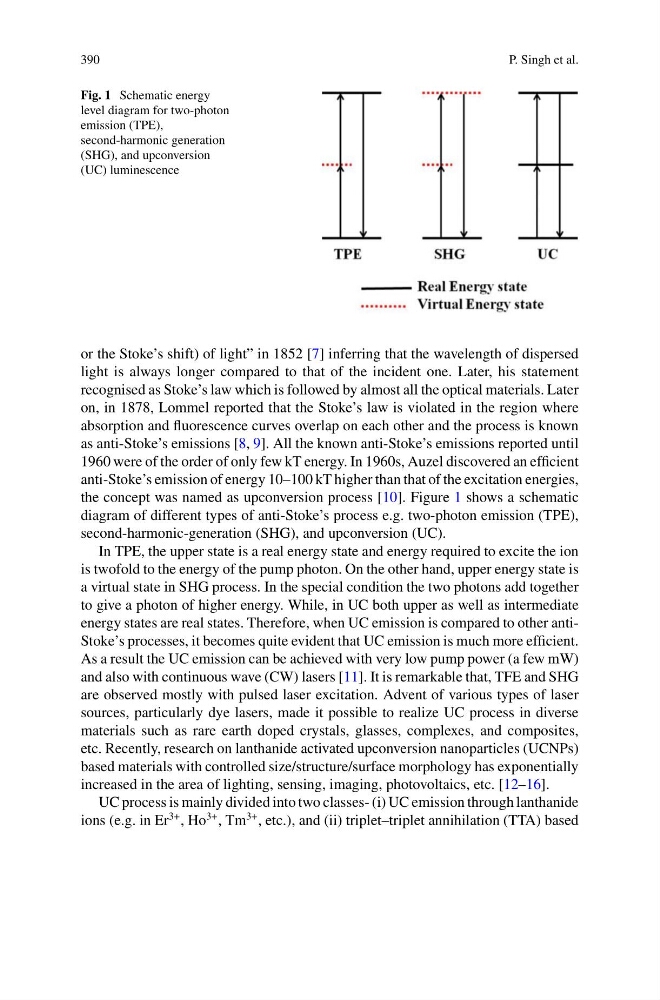
Fig. 1 Schematic energy
level diagram for two-photon
emission (TPE),
second-harmonic generation
(SHG), and upconversion
(UC) luminescence
or the Stoke’s shift) of light” in 1852 [7] inferring that the wavelength of dispersed
light is always longer compared to that of the incident one. Later, his statement
recognised as Stoke’s law which is followed by almost all the optical materials. Later
on, in 1878, Lommel reported that the Stoke’s law is violated in the region where
absorption and fluorescence curves overlap on each other and the process is known
as anti-Stoke’s emissions [8, 9]. All the known anti-Stoke’s emissions reported until
1960 were of the order of only few kT energy. In 1960s, Auzel discovered an efficient
anti-Stoke’s emission of energy 10–100 kT higher than that of the excitation energies,
the concept was named as upconversion process [10]. Figure 1 shows a schematic
diagram of different types of anti-Stoke’s process e.g. two-photon emission (TPE),
second-harmonic-generation (SHG), and upconversion (UC).
In TPE, the upper state is a real energy state and energy required to excite the ion
is twofold to the energy of the pump photon. On the other hand, upper energy state is
a virtual state in SHG process. In the special condition the two photons add together
to give a photon of higher energy. While, in UC both upper as well as intermediate
energy states are real states. Therefore, when UC emission is compared to other antiStoke’s processes, it becomes quite evident that UC emission is much more efficient.
As a result the UC emission can be achieved with very low pump power (a few mW)
and also with continuous wave (CW) lasers [11]. It is remarkable that, TFE and SHG
are observed mostly with pulsed laser excitation. Advent of various types of laser
sources, particularly dye lasers, made it possible to realize UC process in diverse
materials such as rare earth doped crystals, glasses, complexes, and composites,
etc. Recently, research on lanthanide activated upconversion nanoparticles (UCNPs)
based materials with controlled size/structure/surface morphology has exponentially
increased in the area of lighting, sensing, imaging, photovoltaics, etc. [12–16].
UC process is mainly divided into two classes- (i) UC emission through lanthanide
ions (e.g. in Er
3+ , Ho
3+ , Tm
3+ , etc.), and (ii) triplet–triplet annihilation (TTA) based
P. Singh et al.
Fig. 1 Schematic energy
level diagram for two-photon
emission (TPE),
second-harmonic generation
(SHG), and upconversion
(UC) luminescence
or the Stoke’s shift) of light” in 1852 [7] inferring that the wavelength of dispersed
light is always longer compared to that of the incident one. Later, his statement
recognised as Stoke’s law which is followed by almost all the optical materials. Later
on, in 1878, Lommel reported that the Stoke’s law is violated in the region where
absorption and fluorescence curves overlap on each other and the process is known
as anti-Stoke’s emissions [8, 9]. All the known anti-Stoke’s emissions reported until
1960 were of the order of only few kT energy. In 1960s, Auzel discovered an efficient
anti-Stoke’s emission of energy 10–100 kT higher than that of the excitation energies,
the concept was named as upconversion process [10]. Figure 1 shows a schematic
diagram of different types of anti-Stoke’s process e.g. two-photon emission (TPE),
second-harmonic-generation (SHG), and upconversion (UC).
In TPE, the upper state is a real energy state and energy required to excite the ion
is twofold to the energy of the pump photon. On the other hand, upper energy state is
a virtual state in SHG process. In the special condition the two photons add together
to give a photon of higher energy. While, in UC both upper as well as intermediate
energy states are real states. Therefore, when UC emission is compared to other antiStoke’s processes, it becomes quite evident that UC emission is much more efficient.
As a result the UC emission can be achieved with very low pump power (a few mW)
and also with continuous wave (CW) lasers [11]. It is remarkable that, TFE and SHG
are observed mostly with pulsed laser excitation. Advent of various types of laser
sources, particularly dye lasers, made it possible to realize UC process in diverse
materials such as rare earth doped crystals, glasses, complexes, and composites,
etc. Recently, research on lanthanide activated upconversion nanoparticles (UCNPs)
based materials with controlled size/structure/surface morphology has exponentially
increased in the area of lighting, sensing, imaging, photovoltaics, etc. [12–16].
UC process is mainly divided into two classes- (i) UC emission through lanthanide
ions (e.g. in Er
3+ , Ho
3+ , Tm
3+ , etc.), and (ii) triplet–triplet annihilation (TTA) based