

382
M. Pal and M. Pradhan
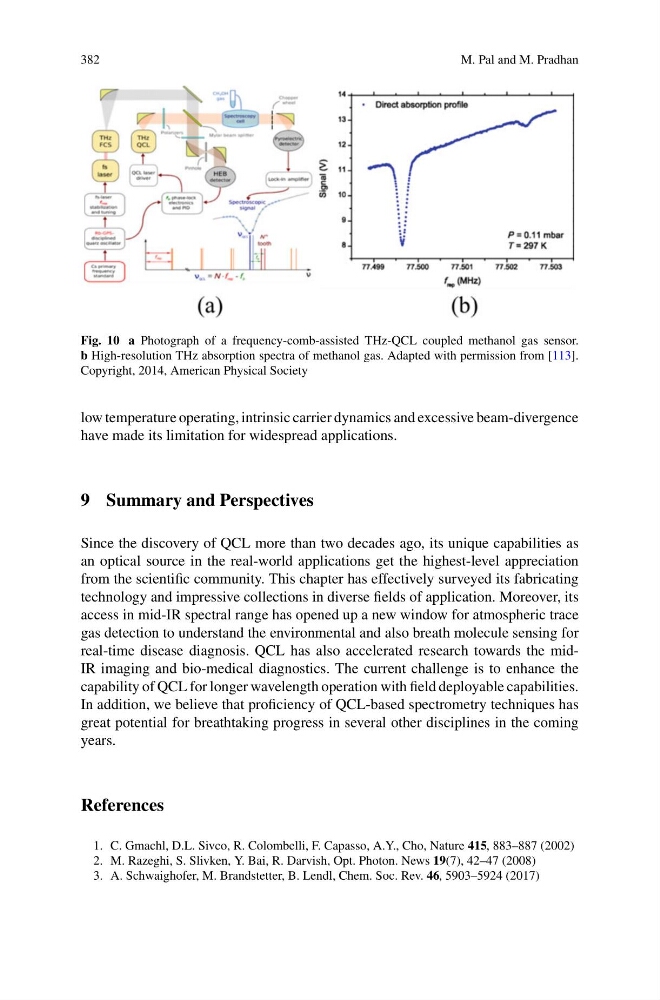
Fig. 10 a Photograph of a frequency-comb-assisted THz-QCL coupled methanol gas sensor.
b High-resolution THz absorption spectra of methanol gas. Adapted with permission from [113].
Copyright, 2014, American Physical Society
low temperature operating, intrinsic carrier dynamics and excessive beam-divergence
have made its limitation for widespread applications.
9 Summary and Perspectives
Since the discovery of QCL more than two decades ago, its unique capabilities as
an optical source in the real-world applications get the highest-level appreciation
from the scientific community. This chapter has effectively surveyed its fabricating
technology and impressive collections in diverse fields of application. Moreover, its
access in mid-IR spectral range has opened up a new window for atmospheric trace
gas detection to understand the environmental and also breath molecule sensing for
real-time disease diagnosis. QCL has also accelerated research towards the midIR imaging and bio-medical diagnostics. The current challenge is to enhance the
capability of QCL for longer wavelength operation with field deployable capabilities.
In addition, we believe that proficiency of QCL-based spectrometry techniques has
great potential for breathtaking progress in several other disciplines in the coming
years.
References
1. C. Gmachl, D.L. Sivco, R. Colombelli, F. Capasso, A.Y., Cho, Nature 415, 883–887 (2002)
2. M. Razeghi, S. Slivken, Y. Bai, R. Darvish, Opt. Photon. News 19(7), 42–47 (2008)
3. A. Schwaighofer, M. Brandstetter, B. Lendl, Chem. Soc. Rev. 46, 5903–5924 (2017)
M. Pal and M. Pradhan
Fig. 10 a Photograph of a frequency-comb-assisted THz-QCL coupled methanol gas sensor.
b High-resolution THz absorption spectra of methanol gas. Adapted with permission from [113].
Copyright, 2014, American Physical Society
low temperature operating, intrinsic carrier dynamics and excessive beam-divergence
have made its limitation for widespread applications.
9 Summary and Perspectives
Since the discovery of QCL more than two decades ago, its unique capabilities as
an optical source in the real-world applications get the highest-level appreciation
from the scientific community. This chapter has effectively surveyed its fabricating
technology and impressive collections in diverse fields of application. Moreover, its
access in mid-IR spectral range has opened up a new window for atmospheric trace
gas detection to understand the environmental and also breath molecule sensing for
real-time disease diagnosis. QCL has also accelerated research towards the midIR imaging and bio-medical diagnostics. The current challenge is to enhance the
capability of QCL for longer wavelength operation with field deployable capabilities.
In addition, we believe that proficiency of QCL-based spectrometry techniques has
great potential for breathtaking progress in several other disciplines in the coming
years.
References
1. C. Gmachl, D.L. Sivco, R. Colombelli, F. Capasso, A.Y., Cho, Nature 415, 883–887 (2002)
2. M. Razeghi, S. Slivken, Y. Bai, R. Darvish, Opt. Photon. News 19(7), 42–47 (2008)
3. A. Schwaighofer, M. Brandstetter, B. Lendl, Chem. Soc. Rev. 46, 5903–5924 (2017)