

378
M. Pal and M. Pradhan
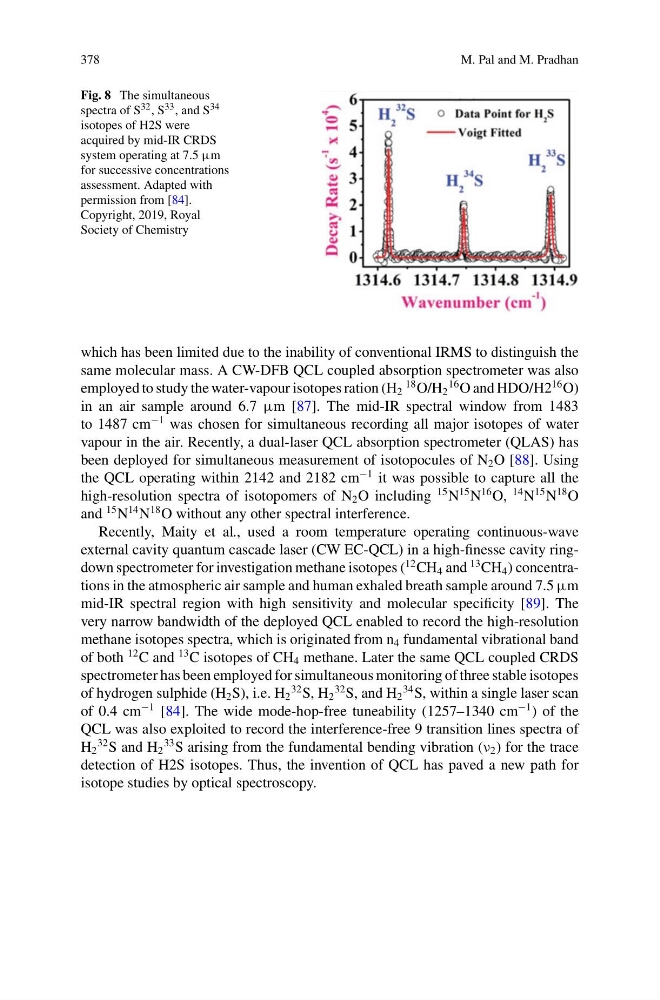
Fig. 8 The simultaneous
spectra of S 32 , S 33 , and S 34
isotopes of H2S were
acquired by mid-IR CRDS
system operating at 7.5 μm
for successive concentrations
assessment. Adapted with
permission from [84].
Copyright, 2019, Royal
Society of Chemistry
which has been limited due to the inability of conventional IRMS to distinguish the
same molecular mass. A CW-DFB QCL coupled absorption spectrometer was also
employed to study the water-vapour isotopes ration (H 2
18 O/H 2
16 O and HDO/H2
16 O)
in an air sample around 6.7 μm [87]. The mid-IR spectral window from 1483
to 1487 cm
−1 was chosen for simultaneous recording all major isotopes of water
vapour in the air. Recently, a dual-laser QCL absorption spectrometer (QLAS) has
been deployed for simultaneous measurement of isotopocules of N 2 O [88]. Using
the QCL operating within 2142 and 2182 cm
−1 it was possible to capture all the
high-resolution spectra of isotopomers of N 2 O including
15 N
15 N
16 O,
14 N
15 N
18 O
and
15 N
14 N
18 O without any other spectral interference.
Recently, Maity et al., used a room temperature operating continuous-wave
external cavity quantum cascade laser (CW EC-QCL) in a high-finesse cavity ringdown spectrometer for investigation methane isotopes (
12 CH 4 and
13 CH 4 ) concentrations in the atmospheric air sample and human exhaled breath sample around 7.5 μm
mid-IR spectral region with high sensitivity and molecular specificity [89]. The
very narrow bandwidth of the deployed QCL enabled to record the high-resolution
methane isotopes spectra, which is originated from n 4 fundamental vibrational band
of both
12 C and
13 C isotopes of CH 4 methane. Later the same QCL coupled CRDS
spectrometer has been employed for simultaneous monitoring of three stable isotopes
of hydrogen sulphide (H 2 S), i.e. H 2
32 S, H 2
32 S, and H 2
34 S, within a single laser scan
of 0.4 cm
−1 [84]. The wide mode-hop-free tuneability (1257–1340 cm
−1 ) of the
QCL was also exploited to record the interference-free 9 transition lines spectra of
H 2
32 S and H 2
33 S arising from the fundamental bending vibration (ν 2 ) for the trace
detection of H2S isotopes. Thus, the invention of QCL has paved a new path for
isotope studies by optical spectroscopy.
M. Pal and M. Pradhan
Fig. 8 The simultaneous
spectra of S 32 , S 33 , and S 34
isotopes of H2S were
acquired by mid-IR CRDS
system operating at 7.5 μm
for successive concentrations
assessment. Adapted with
permission from [84].
Copyright, 2019, Royal
Society of Chemistry
which has been limited due to the inability of conventional IRMS to distinguish the
same molecular mass. A CW-DFB QCL coupled absorption spectrometer was also
employed to study the water-vapour isotopes ration (H 2
18 O/H 2
16 O and HDO/H2
16 O)
in an air sample around 6.7 μm [87]. The mid-IR spectral window from 1483
to 1487 cm
−1 was chosen for simultaneous recording all major isotopes of water
vapour in the air. Recently, a dual-laser QCL absorption spectrometer (QLAS) has
been deployed for simultaneous measurement of isotopocules of N 2 O [88]. Using
the QCL operating within 2142 and 2182 cm
−1 it was possible to capture all the
high-resolution spectra of isotopomers of N 2 O including
15 N
15 N
16 O,
14 N
15 N
18 O
and
15 N
14 N
18 O without any other spectral interference.
Recently, Maity et al., used a room temperature operating continuous-wave
external cavity quantum cascade laser (CW EC-QCL) in a high-finesse cavity ringdown spectrometer for investigation methane isotopes (
12 CH 4 and
13 CH 4 ) concentrations in the atmospheric air sample and human exhaled breath sample around 7.5 μm
mid-IR spectral region with high sensitivity and molecular specificity [89]. The
very narrow bandwidth of the deployed QCL enabled to record the high-resolution
methane isotopes spectra, which is originated from n 4 fundamental vibrational band
of both
12 C and
13 C isotopes of CH 4 methane. Later the same QCL coupled CRDS
spectrometer has been employed for simultaneous monitoring of three stable isotopes
of hydrogen sulphide (H 2 S), i.e. H 2
32 S, H 2
32 S, and H 2
34 S, within a single laser scan
of 0.4 cm
−1 [84]. The wide mode-hop-free tuneability (1257–1340 cm
−1 ) of the
QCL was also exploited to record the interference-free 9 transition lines spectra of
H 2
32 S and H 2
33 S arising from the fundamental bending vibration (ν 2 ) for the trace
detection of H2S isotopes. Thus, the invention of QCL has paved a new path for
isotope studies by optical spectroscopy.