

374
M. Pal and M. Pradhan
et al. introduced a QCL based cavity enhance absorption spectrometer (CEAS) for
simultaneous exhaled breath NO and OCS monitoring [68]. A room-temperature
operated QCL probed the strong absorption band of both OCS and NO simultaneously near 5.26 μm to obtain the concentration. Furthermore, the research group
of Joanne H. Shorter demonstrated the multi-species detection in human exhaled
breath using dual-QCL based mid-IR gas sensors [69]. Two room-temperature operated pulsed QCLs working at two different mid-IR spectral region were exploited
in this prototype sensor. One of the QCL probed NO and CO 2 absorption band near
1900 cm
−1 and another QC laser probed the CO and N 2 O near 2190 cm
−1 for their
quantitative estimation in exhaled breath. Recently, Sumon et al. demonstrated the
efficacy of widely tuneable EC-QCL based CRD spectrometer for non-invasive diagnosis by monitoring breath NO concentration [70]. They measured the breath NO
concentration of the H. pylori infected subjects, who are suffering from peptic ulcer
disease and non-ulcerous dyspepsia (NUD) by probing the R(12.5) rotational line in
the fundamental vibrational band near 1912 cm
−1 . Later, Pal et al. demonstrated a
bio-medical application of a mid-IR continuous wave CRDS system to monitor the
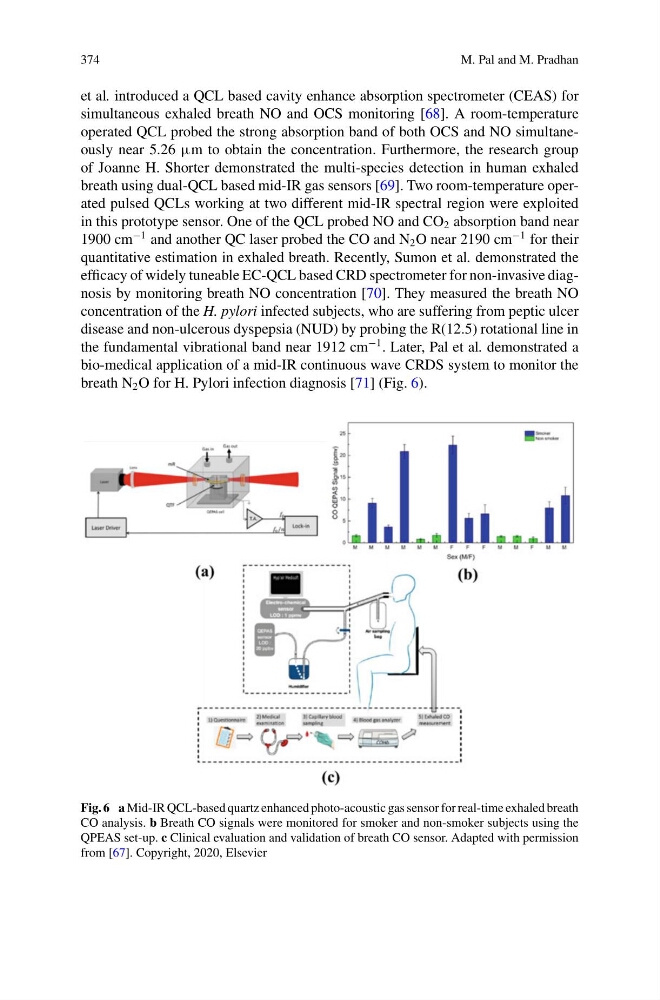
breath N 2 O for H. Pylori infection diagnosis [71] (Fig. 6).
Fig. 6 a Mid-IR QCL-based quartz enhanced photo-acoustic gas sensor for real-time exhaled breath
CO analysis. b Breath CO signals were monitored for smoker and non-smoker subjects using the
QPEAS set-up. c Clinical evaluation and validation of breath CO sensor. Adapted with permission
from [67]. Copyright, 2020, Elsevier
M. Pal and M. Pradhan
et al. introduced a QCL based cavity enhance absorption spectrometer (CEAS) for
simultaneous exhaled breath NO and OCS monitoring [68]. A room-temperature
operated QCL probed the strong absorption band of both OCS and NO simultaneously near 5.26 μm to obtain the concentration. Furthermore, the research group
of Joanne H. Shorter demonstrated the multi-species detection in human exhaled
breath using dual-QCL based mid-IR gas sensors [69]. Two room-temperature operated pulsed QCLs working at two different mid-IR spectral region were exploited
in this prototype sensor. One of the QCL probed NO and CO 2 absorption band near
1900 cm
−1 and another QC laser probed the CO and N 2 O near 2190 cm
−1 for their
quantitative estimation in exhaled breath. Recently, Sumon et al. demonstrated the
efficacy of widely tuneable EC-QCL based CRD spectrometer for non-invasive diagnosis by monitoring breath NO concentration [70]. They measured the breath NO
concentration of the H. pylori infected subjects, who are suffering from peptic ulcer
disease and non-ulcerous dyspepsia (NUD) by probing the R(12.5) rotational line in
the fundamental vibrational band near 1912 cm
−1 . Later, Pal et al. demonstrated a
bio-medical application of a mid-IR continuous wave CRDS system to monitor the
breath N 2 O for H. Pylori infection diagnosis [71] (Fig. 6).
Fig. 6 a Mid-IR QCL-based quartz enhanced photo-acoustic gas sensor for real-time exhaled breath
CO analysis. b Breath CO signals were monitored for smoker and non-smoker subjects using the
QPEAS set-up. c Clinical evaluation and validation of breath CO sensor. Adapted with permission
from [67]. Copyright, 2020, Elsevier