

Quantum Cascade Laser Spectroscopy
365
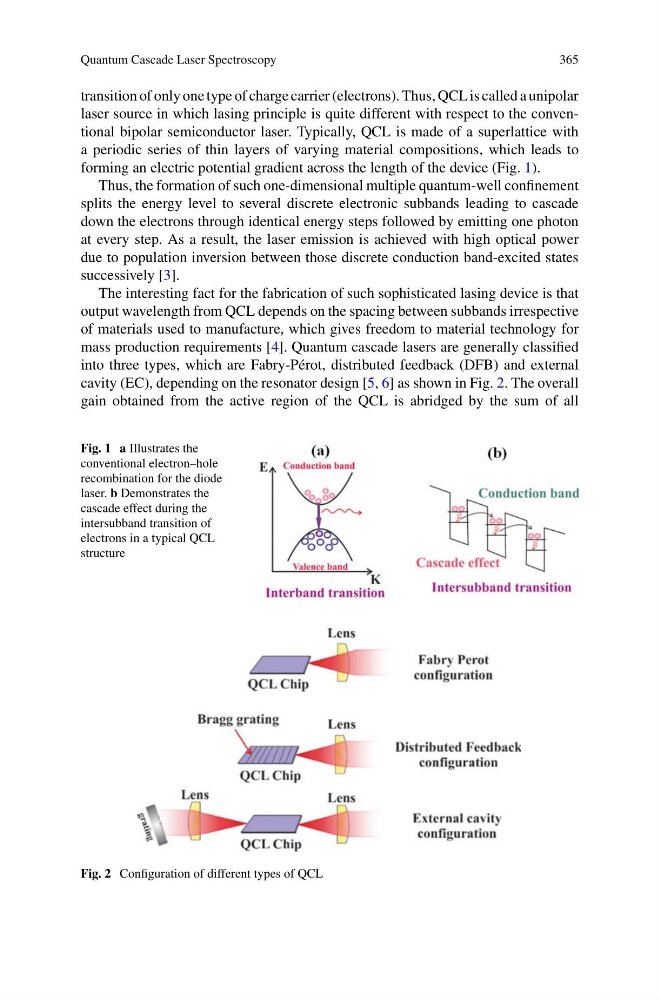
transition of only one type of charge carrier (electrons). Thus, QCL is called a unipolar
laser source in which lasing principle is quite different with respect to the conventional bipolar semiconductor laser. Typically, QCL is made of a superlattice with
a periodic series of thin layers of varying material compositions, which leads to
forming an electric potential gradient across the length of the device (Fig. 1).
Thus, the formation of such one-dimensional multiple quantum-well confinement
splits the energy level to several discrete electronic subbands leading to cascade
down the electrons through identical energy steps followed by emitting one photon
at every step. As a result, the laser emission is achieved with high optical power
due to population inversion between those discrete conduction band-excited states
successively [3].
The interesting fact for the fabrication of such sophisticated lasing device is that
output wavelength from QCL depends on the spacing between subbands irrespective
of materials used to manufacture, which gives freedom to material technology for
mass production requirements [4]. Quantum cascade lasers are generally classified
into three types, which are Fabry-Pérot, distributed feedback (DFB) and external
cavity (EC), depending on the resonator design [5, 6] as shown in Fig. 2. The overall
gain obtained from the active region of the QCL is abridged by the sum of all
Fig. 1 a Illustrates the
conventional electron–hole
recombination for the diode
laser. b Demonstrates the
cascade effect during the
intersubband transition of
electrons in a typical QCL
structure
Fig. 2 Configuration of different types of QCL
365
transition of only one type of charge carrier (electrons). Thus, QCL is called a unipolar
laser source in which lasing principle is quite different with respect to the conventional bipolar semiconductor laser. Typically, QCL is made of a superlattice with
a periodic series of thin layers of varying material compositions, which leads to
forming an electric potential gradient across the length of the device (Fig. 1).
Thus, the formation of such one-dimensional multiple quantum-well confinement
splits the energy level to several discrete electronic subbands leading to cascade
down the electrons through identical energy steps followed by emitting one photon
at every step. As a result, the laser emission is achieved with high optical power
due to population inversion between those discrete conduction band-excited states
successively [3].
The interesting fact for the fabrication of such sophisticated lasing device is that
output wavelength from QCL depends on the spacing between subbands irrespective
of materials used to manufacture, which gives freedom to material technology for
mass production requirements [4]. Quantum cascade lasers are generally classified
into three types, which are Fabry-Pérot, distributed feedback (DFB) and external
cavity (EC), depending on the resonator design [5, 6] as shown in Fig. 2. The overall
gain obtained from the active region of the QCL is abridged by the sum of all
Fig. 1 a Illustrates the
conventional electron–hole
recombination for the diode
laser. b Demonstrates the
cascade effect during the
intersubband transition of
electrons in a typical QCL
structure
Fig. 2 Configuration of different types of QCL