

324
A. L. Chakraborty and A. Roy
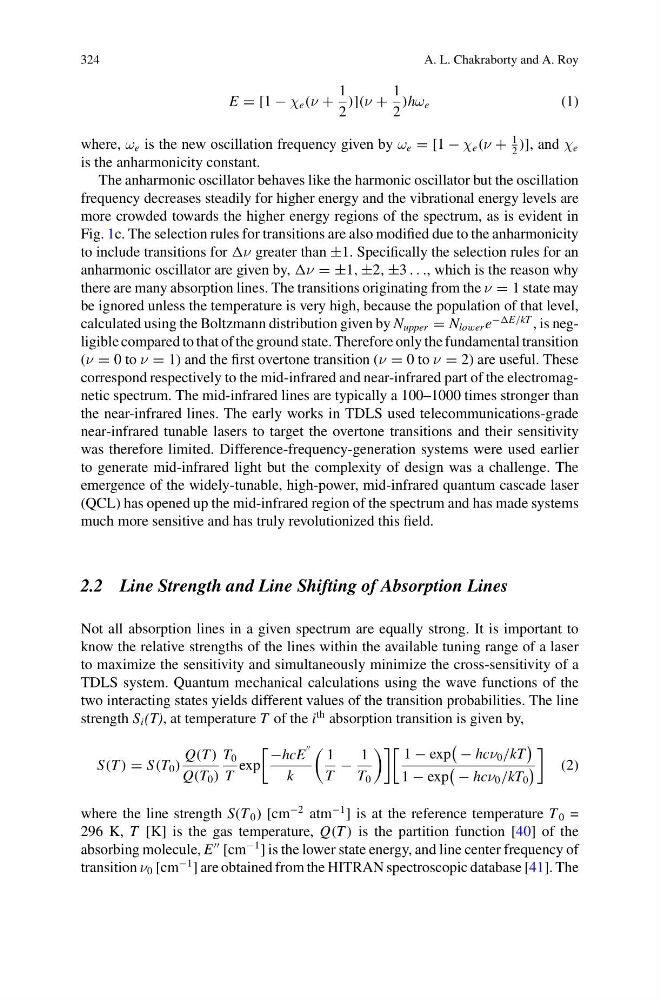
E = [1 − χ e (ν +
1
2
)](ν +
1
2
)hω e
(1)
where, ω e is the new oscillation frequency given by ω e = [1 − χ e (ν +
1
2
)], and χ e
is the anharmonicity constant.
The anharmonic oscillator behaves like the harmonic oscillator but the oscillation
frequency decreases steadily for higher energy and the vibrational energy levels are
more crowded towards the higher energy regions of the spectrum, as is evident in
Fig. 1c. The selection rules for transitions are also modified due to the anharmonicity
to include transitions for ν greater than ±1. Specifically the selection rules for an
anharmonic oscillator are given by, ν = ±1, ±2, ±3 . . ., which is the reason why
there are many absorption lines. The transitions originating from the ν = 1 state may
be ignored unless the temperature is very high, because the population of that level,
calculated using the Boltzmann distribution given by N upper = N lower e
−E/kT , is negligible compared to that of the ground state. Therefore only the fundamental transition
(ν = 0 to ν = 1) and the first overtone transition (ν = 0 to ν = 2) are useful. These
correspond respectively to the mid-infrared and near-infrared part of the electromagnetic spectrum. The mid-infrared lines are typically a 100–1000 times stronger than
the near-infrared lines. The early works in TDLS used telecommunications-grade
near-infrared tunable lasers to target the overtone transitions and their sensitivity
was therefore limited. Difference-frequency-generation systems were used earlier
to generate mid-infrared light but the complexity of design was a challenge. The
emergence of the widely-tunable, high-power, mid-infrared quantum cascade laser
(QCL) has opened up the mid-infrared region of the spectrum and has made systems
much more sensitive and has truly revolutionized this field.
2.2 Line Strength and Line Shifting of Absorption Lines
Not all absorption lines in a given spectrum are equally strong. It is important to
know the relative strengths of the lines within the available tuning range of a laser
to maximize the sensitivity and simultaneously minimize the cross-sensitivity of a
TDLS system. Quantum mechanical calculations using the wave functions of the
two interacting states yields different values of the transition probabilities. The line
strength S i (T), at temperature T of the i
th absorption transition is given by,
S(T ) = S(T 0 )
Q(T )
Q(T 0 )
T 0
T
exp
−hcE
k
1
T
−
1
T 0
1 − exp
− hcν 0 /kT
1 − exp
− hcν 0 /kT 0
(2)
where the line strength S(T 0 ) [cm
−2 atm
−1 ] is at the reference temperature T 0 =
296 K, T [K] is the gas temperature, Q(T ) is the partition function [40] of the
absorbing molecule, E
[cm
−1 ] is the lower state energy, and line center frequency of
transition ν 0 [cm
−1 ] are obtained from the HITRAN spectroscopic database [41]. The
A. L. Chakraborty and A. Roy
E = [1 − χ e (ν +
1
2
)](ν +
1
2
)hω e
(1)
where, ω e is the new oscillation frequency given by ω e = [1 − χ e (ν +
1
2
)], and χ e
is the anharmonicity constant.
The anharmonic oscillator behaves like the harmonic oscillator but the oscillation
frequency decreases steadily for higher energy and the vibrational energy levels are
more crowded towards the higher energy regions of the spectrum, as is evident in
Fig. 1c. The selection rules for transitions are also modified due to the anharmonicity
to include transitions for ν greater than ±1. Specifically the selection rules for an
anharmonic oscillator are given by, ν = ±1, ±2, ±3 . . ., which is the reason why
there are many absorption lines. The transitions originating from the ν = 1 state may
be ignored unless the temperature is very high, because the population of that level,
calculated using the Boltzmann distribution given by N upper = N lower e
−E/kT , is negligible compared to that of the ground state. Therefore only the fundamental transition
(ν = 0 to ν = 1) and the first overtone transition (ν = 0 to ν = 2) are useful. These
correspond respectively to the mid-infrared and near-infrared part of the electromagnetic spectrum. The mid-infrared lines are typically a 100–1000 times stronger than
the near-infrared lines. The early works in TDLS used telecommunications-grade
near-infrared tunable lasers to target the overtone transitions and their sensitivity
was therefore limited. Difference-frequency-generation systems were used earlier
to generate mid-infrared light but the complexity of design was a challenge. The
emergence of the widely-tunable, high-power, mid-infrared quantum cascade laser
(QCL) has opened up the mid-infrared region of the spectrum and has made systems
much more sensitive and has truly revolutionized this field.
2.2 Line Strength and Line Shifting of Absorption Lines
Not all absorption lines in a given spectrum are equally strong. It is important to
know the relative strengths of the lines within the available tuning range of a laser
to maximize the sensitivity and simultaneously minimize the cross-sensitivity of a
TDLS system. Quantum mechanical calculations using the wave functions of the
two interacting states yields different values of the transition probabilities. The line
strength S i (T), at temperature T of the i
th absorption transition is given by,
S(T ) = S(T 0 )
Q(T )
Q(T 0 )
T 0
T
exp
−hcE
k
1
T
−
1
T 0
1 − exp
− hcν 0 /kT
1 − exp
− hcν 0 /kT 0
(2)
where the line strength S(T 0 ) [cm
−2 atm
−1 ] is at the reference temperature T 0 =
296 K, T [K] is the gas temperature, Q(T ) is the partition function [40] of the
absorbing molecule, E
[cm
−1 ] is the lower state energy, and line center frequency of
transition ν 0 [cm
−1 ] are obtained from the HITRAN spectroscopic database [41]. The