

Fundamentals of ATR-FTIR Spectroscopy and Its Role …
17
Here, A q , q represents the amplitude, half-width at half maxima of the absorbance
peak with ω q as the wavenumber of the qth resonant mode.
The ATR-FTIR spectroscopy can also be utilized as a structural probe to get the
information of the sample by having polarized light as an incident IR radiation [34].
The use of polarized light as an incident IR radiation provides the selectivity to
collect the vibrational spectrum of a sample with different components of an electric
field directed in the different planes i.e., perpendicular (electric field of s-polarized
IR radiation) and parallel (electric field of p-polarized IR radiation) to the plane
of incidence, respectively (Fig. 5, panel b). Here, we will explain the efficacy of
polarized ATR-FTIR spectroscopy in the calculation of the orientation tilt angle of
the molecules at the ATR crystal/sample interface, and the corresponding theoretical
model is well adopted in literature as presented below [1, 34]. We can calculate the
electric field components of s- and p-polarized lights at the interface as follows [1,
34]:
E x =
2
sin
2
θ − n
2
31
cos θ
1 − n
2
31
1 + n
2
31
sin
2
θ − n
2
31
(25)
E y =
2 cos θ
1 − n
2
31
(26)
E z =
2n
2
32 sin θ cos θ
1 − n
2
31
1 + n
2
31
sin
2
θ − n
2
31
(27)
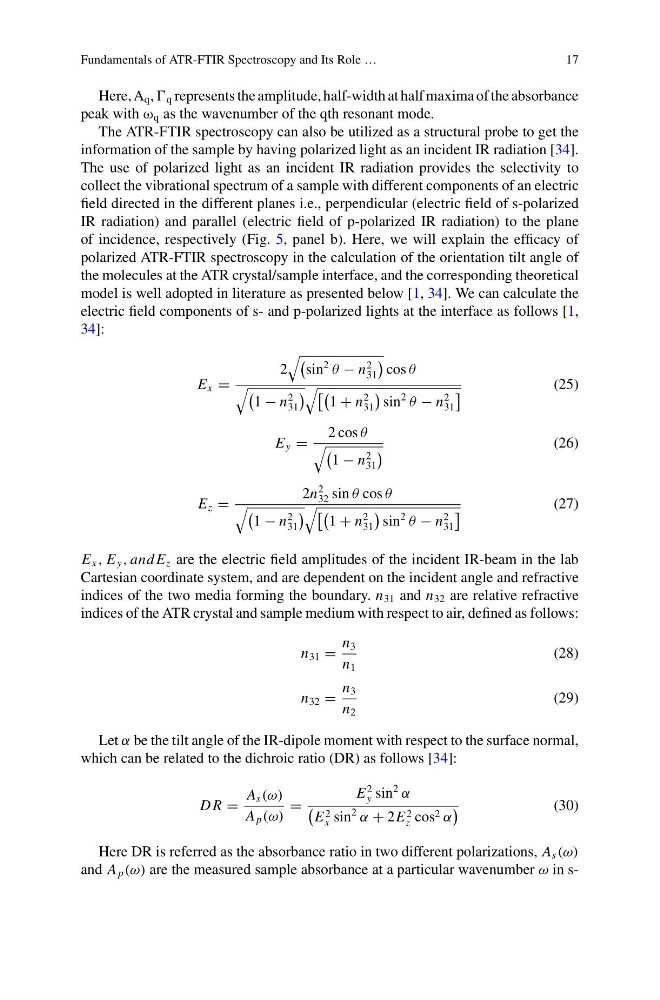
E x , E y , and E z are the electric field amplitudes of the incident IR-beam in the lab
Cartesian coordinate system, and are dependent on the incident angle and refractive
indices of the two media forming the boundary. n 31 and n 32 are relative refractive
indices of the ATR crystal and sample medium with respect to air, defined as follows:
n 31 =
n 3
n 1
(28)
n 32 =
n 3
n 2
(29)
Let α be the tilt angle of the IR-dipole moment with respect to the surface normal,
which can be related to the dichroic ratio (DR) as follows [34]:
D R =
A s (ω)
A p (ω)
=
E
2
y sin
2
α
E 2
x sin
2
α + 2E 2
z cos 2 α
(30)
Here DR is referred as the absorbance ratio in two different polarizations, A s (ω)
and A p (ω) are the measured sample absorbance at a particular wavenumber ω in s-
17
Here, A q , q represents the amplitude, half-width at half maxima of the absorbance
peak with ω q as the wavenumber of the qth resonant mode.
The ATR-FTIR spectroscopy can also be utilized as a structural probe to get the
information of the sample by having polarized light as an incident IR radiation [34].
The use of polarized light as an incident IR radiation provides the selectivity to
collect the vibrational spectrum of a sample with different components of an electric
field directed in the different planes i.e., perpendicular (electric field of s-polarized
IR radiation) and parallel (electric field of p-polarized IR radiation) to the plane
of incidence, respectively (Fig. 5, panel b). Here, we will explain the efficacy of
polarized ATR-FTIR spectroscopy in the calculation of the orientation tilt angle of
the molecules at the ATR crystal/sample interface, and the corresponding theoretical
model is well adopted in literature as presented below [1, 34]. We can calculate the
electric field components of s- and p-polarized lights at the interface as follows [1,
34]:
E x =
2
sin
2
θ − n
2
31
cos θ
1 − n
2
31
1 + n
2
31
sin
2
θ − n
2
31
(25)
E y =
2 cos θ
1 − n
2
31
(26)
E z =
2n
2
32 sin θ cos θ
1 − n
2
31
1 + n
2
31
sin
2
θ − n
2
31
(27)
E x , E y , and E z are the electric field amplitudes of the incident IR-beam in the lab
Cartesian coordinate system, and are dependent on the incident angle and refractive
indices of the two media forming the boundary. n 31 and n 32 are relative refractive
indices of the ATR crystal and sample medium with respect to air, defined as follows:
n 31 =
n 3
n 1
(28)
n 32 =
n 3
n 2
(29)
Let α be the tilt angle of the IR-dipole moment with respect to the surface normal,
which can be related to the dichroic ratio (DR) as follows [34]:
D R =
A s (ω)
A p (ω)
=
E
2
y sin
2
α
E 2
x sin
2
α + 2E 2
z cos 2 α
(30)
Here DR is referred as the absorbance ratio in two different polarizations, A s (ω)
and A p (ω) are the measured sample absorbance at a particular wavenumber ω in s-