

310
R. Das et al.
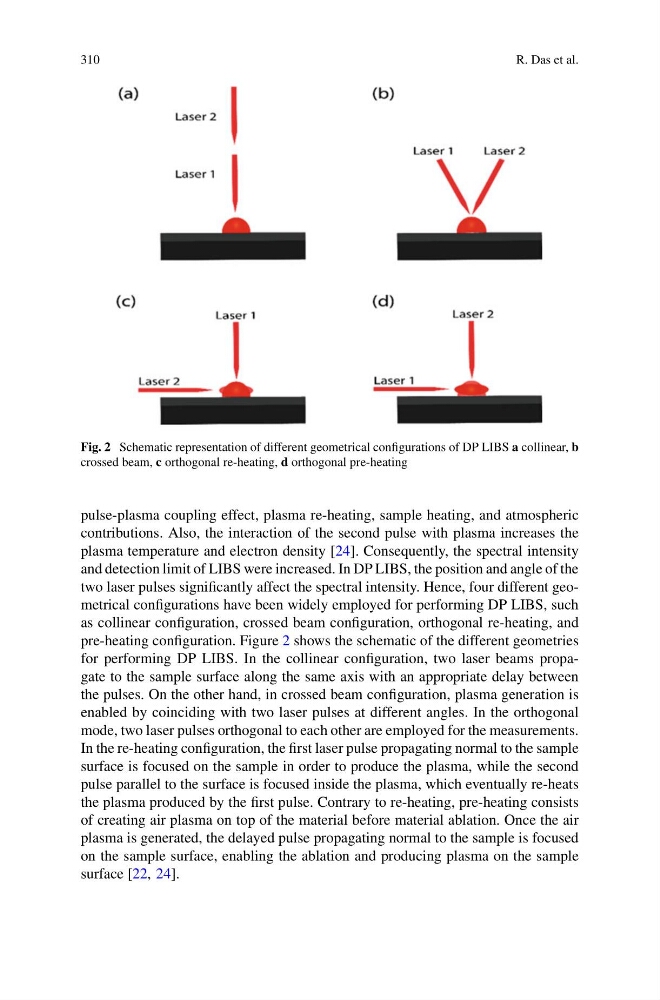
Fig. 2 Schematic representation of different geometrical configurations of DP LIBS a collinear, b
crossed beam, c orthogonal re-heating, d orthogonal pre-heating
pulse-plasma coupling effect, plasma re-heating, sample heating, and atmospheric
contributions. Also, the interaction of the second pulse with plasma increases the
plasma temperature and electron density [24]. Consequently, the spectral intensity
and detection limit of LIBS were increased. In DP LIBS, the position and angle of the
two laser pulses significantly affect the spectral intensity. Hence, four different geometrical configurations have been widely employed for performing DP LIBS, such
as collinear configuration, crossed beam configuration, orthogonal re-heating, and
pre-heating configuration. Figure 2 shows the schematic of the different geometries
for performing DP LIBS. In the collinear configuration, two laser beams propagate to the sample surface along the same axis with an appropriate delay between
the pulses. On the other hand, in crossed beam configuration, plasma generation is
enabled by coinciding with two laser pulses at different angles. In the orthogonal
mode, two laser pulses orthogonal to each other are employed for the measurements.
In the re-heating configuration, the first laser pulse propagating normal to the sample
surface is focused on the sample in order to produce the plasma, while the second
pulse parallel to the surface is focused inside the plasma, which eventually re-heats
the plasma produced by the first pulse. Contrary to re-heating, pre-heating consists
of creating air plasma on top of the material before material ablation. Once the air
plasma is generated, the delayed pulse propagating normal to the sample is focused
on the sample surface, enabling the ablation and producing plasma on the sample
surface [22, 24].
R. Das et al.
Fig. 2 Schematic representation of different geometrical configurations of DP LIBS a collinear, b
crossed beam, c orthogonal re-heating, d orthogonal pre-heating
pulse-plasma coupling effect, plasma re-heating, sample heating, and atmospheric
contributions. Also, the interaction of the second pulse with plasma increases the
plasma temperature and electron density [24]. Consequently, the spectral intensity
and detection limit of LIBS were increased. In DP LIBS, the position and angle of the
two laser pulses significantly affect the spectral intensity. Hence, four different geometrical configurations have been widely employed for performing DP LIBS, such
as collinear configuration, crossed beam configuration, orthogonal re-heating, and
pre-heating configuration. Figure 2 shows the schematic of the different geometries
for performing DP LIBS. In the collinear configuration, two laser beams propagate to the sample surface along the same axis with an appropriate delay between
the pulses. On the other hand, in crossed beam configuration, plasma generation is
enabled by coinciding with two laser pulses at different angles. In the orthogonal
mode, two laser pulses orthogonal to each other are employed for the measurements.
In the re-heating configuration, the first laser pulse propagating normal to the sample
surface is focused on the sample in order to produce the plasma, while the second
pulse parallel to the surface is focused inside the plasma, which eventually re-heats
the plasma produced by the first pulse. Contrary to re-heating, pre-heating consists
of creating air plasma on top of the material before material ablation. Once the air
plasma is generated, the delayed pulse propagating normal to the sample is focused
on the sample surface, enabling the ablation and producing plasma on the sample
surface [22, 24].