

308
R. Das et al.
configurations, minimal sample preparation, and standoff capabilities [1, 2]. In general, LIBS employs energetic laser pulses focusing on the sample surface to create
an expanding transient micro-plasma with high temperature and pressure [3–5]. The
laser produced weakly-ionized plasma decays very fast (both temperature and pressure drop) and emits radiations which are characteristic of the elements present in the
sample. The elemental identification and their chemical abundance can be estimated
by detecting and analyzing the light from the transient plasma at a particular time
delay after plasma formation. Nearly all elements, including light elements, can be
detected simultaneously from any physical phase and any challenging environmental
conditions like atmospheric conditions to extra-terrestrial environmental conditions
[6, 7].
Some of the key advantages of LIBS over other popular analytical emission spectroscopy (AES) techniques such as AAS, XRF, ICP-AES, LA-ICP-MS, etc. are the
simple instrumental configuration and the online in-situ multi-elemental analysis.
Basically, LIBS consists of four major components – a light source for creating the
plasma by ablating a small portion of the target, focusing and collection optics, a
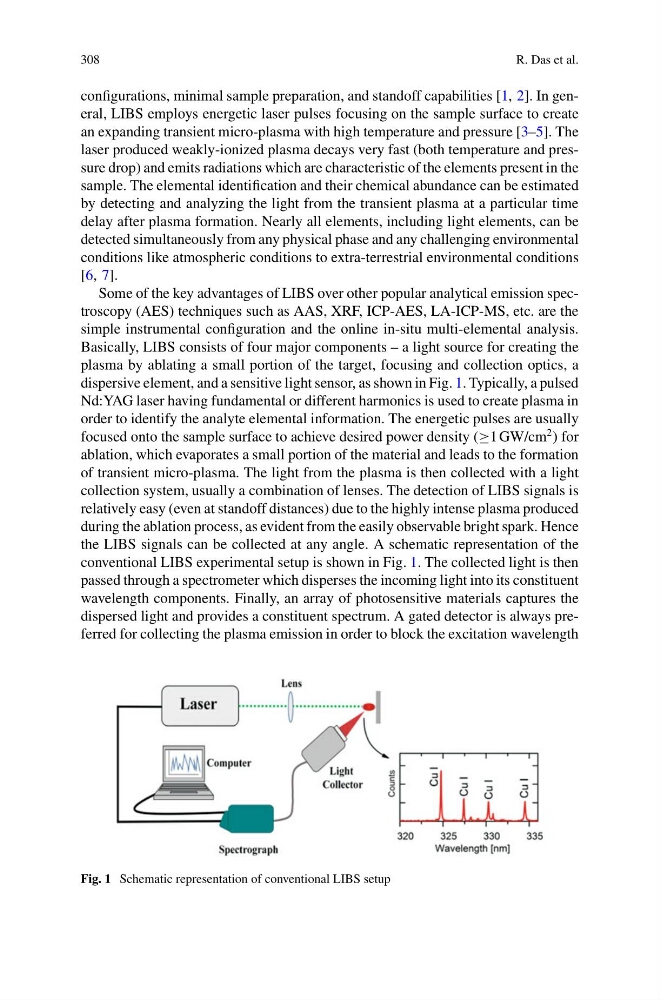
dispersive element, and a sensitive light sensor, as shown in Fig. 1. Typically, a pulsed
Nd:YAG laser having fundamental or different harmonics is used to create plasma in
order to identify the analyte elemental information. The energetic pulses are usually
focused onto the sample surface to achieve desired power density (≥1 GW/cm
2 ) for
ablation, which evaporates a small portion of the material and leads to the formation
of transient micro-plasma. The light from the plasma is then collected with a light
collection system, usually a combination of lenses. The detection of LIBS signals is
relatively easy (even at standoff distances) due to the highly intense plasma produced
during the ablation process, as evident from the easily observable bright spark. Hence
the LIBS signals can be collected at any angle. A schematic representation of the
conventional LIBS experimental setup is shown in Fig. 1. The collected light is then
passed through a spectrometer which disperses the incoming light into its constituent
wavelength components. Finally, an array of photosensitive materials captures the
dispersed light and provides a constituent spectrum. A gated detector is always preferred for collecting the plasma emission in order to block the excitation wavelength
Fig. 1 Schematic representation of conventional LIBS setup
R. Das et al.
configurations, minimal sample preparation, and standoff capabilities [1, 2]. In general, LIBS employs energetic laser pulses focusing on the sample surface to create
an expanding transient micro-plasma with high temperature and pressure [3–5]. The
laser produced weakly-ionized plasma decays very fast (both temperature and pressure drop) and emits radiations which are characteristic of the elements present in the
sample. The elemental identification and their chemical abundance can be estimated
by detecting and analyzing the light from the transient plasma at a particular time
delay after plasma formation. Nearly all elements, including light elements, can be
detected simultaneously from any physical phase and any challenging environmental
conditions like atmospheric conditions to extra-terrestrial environmental conditions
[6, 7].
Some of the key advantages of LIBS over other popular analytical emission spectroscopy (AES) techniques such as AAS, XRF, ICP-AES, LA-ICP-MS, etc. are the
simple instrumental configuration and the online in-situ multi-elemental analysis.
Basically, LIBS consists of four major components – a light source for creating the
plasma by ablating a small portion of the target, focusing and collection optics, a
dispersive element, and a sensitive light sensor, as shown in Fig. 1. Typically, a pulsed
Nd:YAG laser having fundamental or different harmonics is used to create plasma in
order to identify the analyte elemental information. The energetic pulses are usually
focused onto the sample surface to achieve desired power density (≥1 GW/cm
2 ) for
ablation, which evaporates a small portion of the material and leads to the formation
of transient micro-plasma. The light from the plasma is then collected with a light
collection system, usually a combination of lenses. The detection of LIBS signals is
relatively easy (even at standoff distances) due to the highly intense plasma produced
during the ablation process, as evident from the easily observable bright spark. Hence
the LIBS signals can be collected at any angle. A schematic representation of the
conventional LIBS experimental setup is shown in Fig. 1. The collected light is then
passed through a spectrometer which disperses the incoming light into its constituent
wavelength components. Finally, an array of photosensitive materials captures the
dispersed light and provides a constituent spectrum. A gated detector is always preferred for collecting the plasma emission in order to block the excitation wavelength
Fig. 1 Schematic representation of conventional LIBS setup