

Cavity Ring-Down Spectroscopy
299
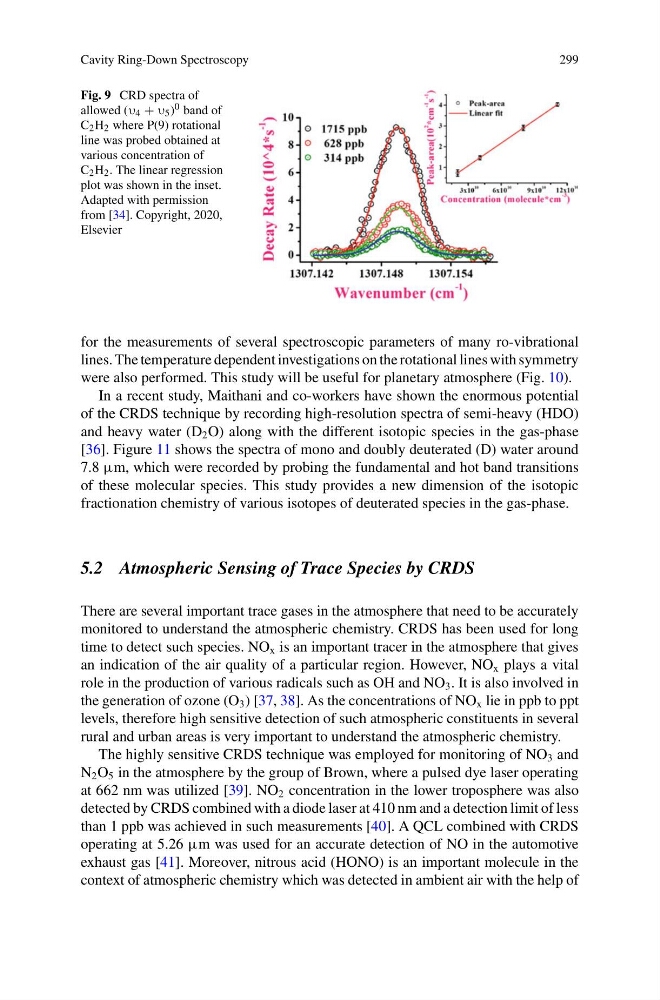
Fig. 9 CRD spectra of
allowed (υ 4 + υ 5 ) 0 band of
C 2 H 2 where P(9) rotational
line was probed obtained at
various concentration of
C 2 H 2 . The linear regression
plot was shown in the inset.
Adapted with permission
from [34]. Copyright, 2020,
Elsevier
for the measurements of several spectroscopic parameters of many ro-vibrational
lines. The temperature dependent investigations on the rotational lines with symmetry
were also performed. This study will be useful for planetary atmosphere (Fig. 10).
In a recent study, Maithani and co-workers have shown the enormous potential
of the CRDS technique by recording high-resolution spectra of semi-heavy (HDO)
and heavy water (D 2 O) along with the different isotopic species in the gas-phase
[36]. Figure 11 shows the spectra of mono and doubly deuterated (D) water around
7.8 μm, which were recorded by probing the fundamental and hot band transitions
of these molecular species. This study provides a new dimension of the isotopic
fractionation chemistry of various isotopes of deuterated species in the gas-phase.
5.2 Atmospheric Sensing of Trace Species by CRDS
There are several important trace gases in the atmosphere that need to be accurately
monitored to understand the atmospheric chemistry. CRDS has been used for long
time to detect such species. NO x is an important tracer in the atmosphere that gives
an indication of the air quality of a particular region. However, NO x plays a vital
role in the production of various radicals such as OH and NO 3 . It is also involved in
the generation of ozone (O 3 ) [37, 38]. As the concentrations of NO x lie in ppb to ppt
levels, therefore high sensitive detection of such atmospheric constituents in several
rural and urban areas is very important to understand the atmospheric chemistry.
The highly sensitive CRDS technique was employed for monitoring of NO 3 and
N 2 O 5 in the atmosphere by the group of Brown, where a pulsed dye laser operating
at 662 nm was utilized [39]. NO 2 concentration in the lower troposphere was also
detected by CRDS combined with a diode laser at 410 nm and a detection limit of less
than 1 ppb was achieved in such measurements [40]. A QCL combined with CRDS
operating at 5.26 μm was used for an accurate detection of NO in the automotive
exhaust gas [41]. Moreover, nitrous acid (HONO) is an important molecule in the
context of atmospheric chemistry which was detected in ambient air with the help of
299
Fig. 9 CRD spectra of
allowed (υ 4 + υ 5 ) 0 band of
C 2 H 2 where P(9) rotational
line was probed obtained at
various concentration of
C 2 H 2 . The linear regression
plot was shown in the inset.
Adapted with permission
from [34]. Copyright, 2020,
Elsevier
for the measurements of several spectroscopic parameters of many ro-vibrational
lines. The temperature dependent investigations on the rotational lines with symmetry
were also performed. This study will be useful for planetary atmosphere (Fig. 10).
In a recent study, Maithani and co-workers have shown the enormous potential
of the CRDS technique by recording high-resolution spectra of semi-heavy (HDO)
and heavy water (D 2 O) along with the different isotopic species in the gas-phase
[36]. Figure 11 shows the spectra of mono and doubly deuterated (D) water around
7.8 μm, which were recorded by probing the fundamental and hot band transitions
of these molecular species. This study provides a new dimension of the isotopic
fractionation chemistry of various isotopes of deuterated species in the gas-phase.
5.2 Atmospheric Sensing of Trace Species by CRDS
There are several important trace gases in the atmosphere that need to be accurately
monitored to understand the atmospheric chemistry. CRDS has been used for long
time to detect such species. NO x is an important tracer in the atmosphere that gives
an indication of the air quality of a particular region. However, NO x plays a vital
role in the production of various radicals such as OH and NO 3 . It is also involved in
the generation of ozone (O 3 ) [37, 38]. As the concentrations of NO x lie in ppb to ppt
levels, therefore high sensitive detection of such atmospheric constituents in several
rural and urban areas is very important to understand the atmospheric chemistry.
The highly sensitive CRDS technique was employed for monitoring of NO 3 and
N 2 O 5 in the atmosphere by the group of Brown, where a pulsed dye laser operating
at 662 nm was utilized [39]. NO 2 concentration in the lower troposphere was also
detected by CRDS combined with a diode laser at 410 nm and a detection limit of less
than 1 ppb was achieved in such measurements [40]. A QCL combined with CRDS
operating at 5.26 μm was used for an accurate detection of NO in the automotive
exhaust gas [41]. Moreover, nitrous acid (HONO) is an important molecule in the
context of atmospheric chemistry which was detected in ambient air with the help of