

Modern Experimental Techniques in Ultrafast Atomic …
275
T = t s + t D =
−
p z
m
±
p z
m
2
+ 2.s.
qE s
m
qE s
m
+
D
p z
m
2
+ 2.
qE s
m
.s
.
(14)
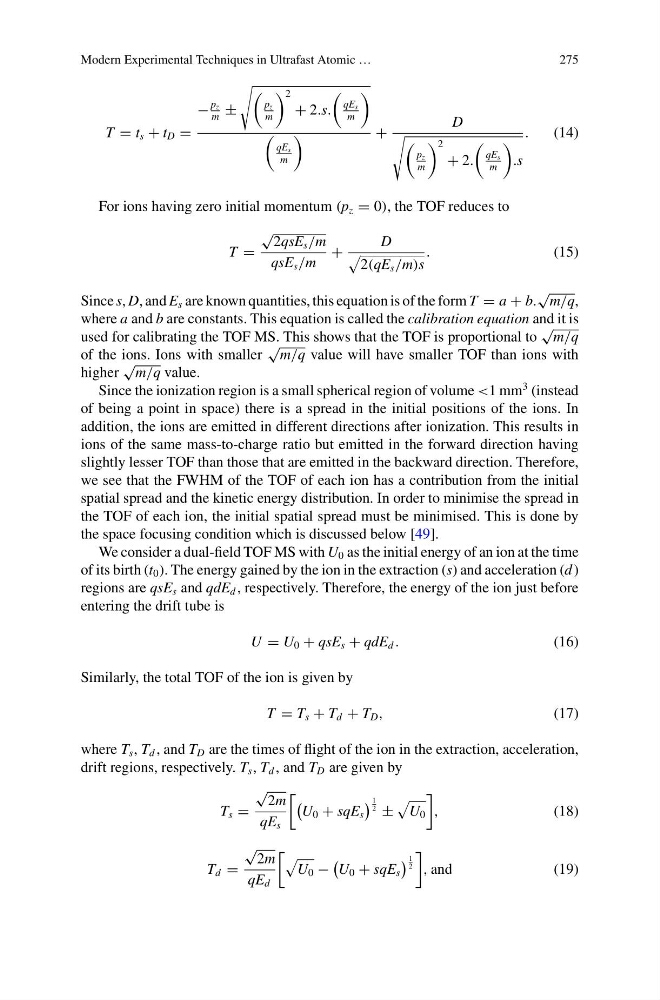
For ions having zero initial momentum (p z = 0), the TOF reduces to
T =
√
2qsE s /m
qsE s /m
+
D
2(qE s /m)s
.
(15)
Since s, D, and E s are known quantities, this equation is of the form T = a + b.
√
m/q,
where a and b are constants. This equation is called the calibration equation and it is
used for calibrating the TOF MS. This shows that the TOF is proportional to
√
m/q
of the ions. Ions with smaller
√
m/q value will have smaller TOF than ions with
higher
√
m/q value.
Since the ionization region is a small spherical region of volume <1 mm
3 (instead
of being a point in space) there is a spread in the initial positions of the ions. In
addition, the ions are emitted in different directions after ionization. This results in
ions of the same mass-to-charge ratio but emitted in the forward direction having
slightly lesser TOF than those that are emitted in the backward direction. Therefore,
we see that the FWHM of the TOF of each ion has a contribution from the initial
spatial spread and the kinetic energy distribution. In order to minimise the spread in
the TOF of each ion, the initial spatial spread must be minimised. This is done by
the space focusing condition which is discussed below [49].
We consider a dual-field TOF MS with U 0 as the initial energy of an ion at the time
of its birth (t 0 ). The energy gained by the ion in the extraction (s) and acceleration (d )
regions are qsE s and qdE d , respectively. Therefore, the energy of the ion just before
entering the drift tube is
U = U 0 + qsE s + qdE d .
(16)
Similarly, the total TOF of the ion is given by
T = T s + T d + T D ,
(17)
where T s , T d , and T D are the times of flight of the ion in the extraction, acceleration,
drift regions, respectively. T s , T d , and T D are given by
T s =
√
2m
qE s
U 0 + sqE s
1
2
±
U 0
,
(18)
T d =
√
2m
qE d
U 0 −
U 0 + sqE s
1
2
, and
(19)
275
T = t s + t D =
−
p z
m
±
p z
m
2
+ 2.s.
qE s
m
qE s
m
+
D
p z
m
2
+ 2.
qE s
m
.s
.
(14)
For ions having zero initial momentum (p z = 0), the TOF reduces to
T =
√
2qsE s /m
qsE s /m
+
D
2(qE s /m)s
.
(15)
Since s, D, and E s are known quantities, this equation is of the form T = a + b.
√
m/q,
where a and b are constants. This equation is called the calibration equation and it is
used for calibrating the TOF MS. This shows that the TOF is proportional to
√
m/q
of the ions. Ions with smaller
√
m/q value will have smaller TOF than ions with
higher
√
m/q value.
Since the ionization region is a small spherical region of volume <1 mm
3 (instead
of being a point in space) there is a spread in the initial positions of the ions. In
addition, the ions are emitted in different directions after ionization. This results in
ions of the same mass-to-charge ratio but emitted in the forward direction having
slightly lesser TOF than those that are emitted in the backward direction. Therefore,
we see that the FWHM of the TOF of each ion has a contribution from the initial
spatial spread and the kinetic energy distribution. In order to minimise the spread in
the TOF of each ion, the initial spatial spread must be minimised. This is done by
the space focusing condition which is discussed below [49].
We consider a dual-field TOF MS with U 0 as the initial energy of an ion at the time
of its birth (t 0 ). The energy gained by the ion in the extraction (s) and acceleration (d )
regions are qsE s and qdE d , respectively. Therefore, the energy of the ion just before
entering the drift tube is
U = U 0 + qsE s + qdE d .
(16)
Similarly, the total TOF of the ion is given by
T = T s + T d + T D ,
(17)
where T s , T d , and T D are the times of flight of the ion in the extraction, acceleration,
drift regions, respectively. T s , T d , and T D are given by
T s =
√
2m
qE s
U 0 + sqE s
1
2
±
U 0
,
(18)
T d =
√
2m
qE d
U 0 −
U 0 + sqE s
1
2
, and
(19)