

8
H. Kaur et al.
Table 1 Description of common IRE or ATR crystal materials used in the ATR accessory for
obtaining the IR spectrum in the Mid-IR range [22, 24, 25]
IRE material
Refractive index
(n 1 ) at
1000 cm −1
Working spectral
range (cm −1 )
Penetration depth
(d p ) in μm at
1000 cm −1 , θ =
45°, n 2 (sample) =
1.4
Effective
working pH
range
KRS-5 (Thallium
bromide/Thallium
iodide)
2.37
17,900–400
1.73
5–8
Zinc selenide
(ZnSe)
2.40
20,000–630
1.66
5–9
Diamond
2.40
45,000–10
1.66
1–14
AMTIR (Se/As/Ge
glass)
2.50
20,000–350
1.46
1–9
Silicon (Si)
3.40
8300–1500
0.84
1–12
Germanium (Ge)
4.00
5500–780
0.65
1–14
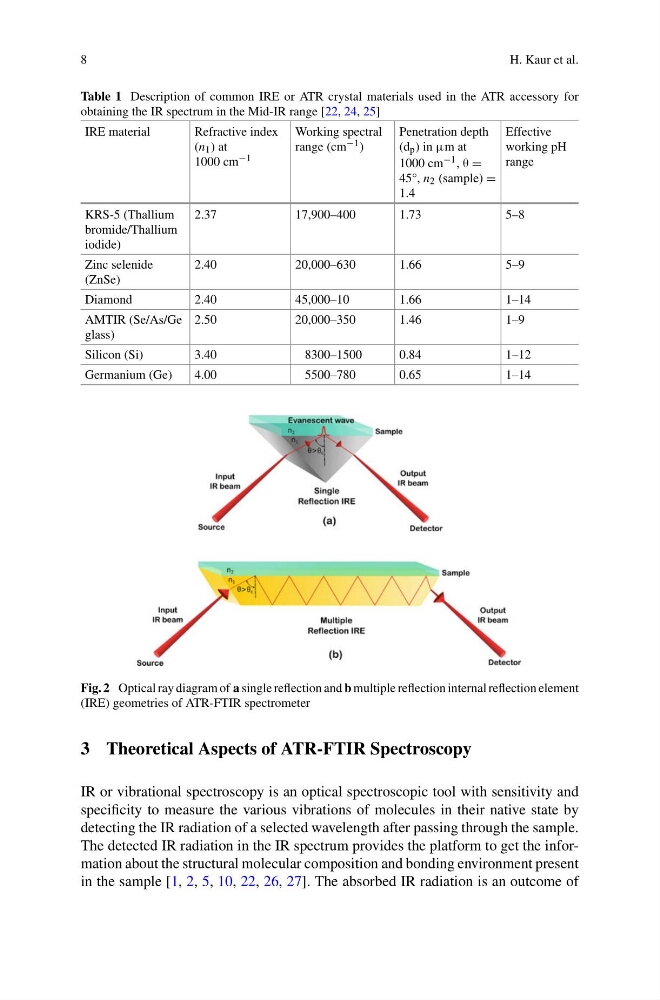
Fig. 2 Optical ray diagram of a single reflection and b multiple reflection internal reflection element
(IRE) geometries of ATR-FTIR spectrometer
3 Theoretical Aspects of ATR-FTIR Spectroscopy
IR or vibrational spectroscopy is an optical spectroscopic tool with sensitivity and
specificity to measure the various vibrations of molecules in their native state by
detecting the IR radiation of a selected wavelength after passing through the sample.
The detected IR radiation in the IR spectrum provides the platform to get the information about the structural molecular composition and bonding environment present
in the sample [1, 2, 5, 10, 22, 26, 27]. The absorbed IR radiation is an outcome of
H. Kaur et al.
Table 1 Description of common IRE or ATR crystal materials used in the ATR accessory for
obtaining the IR spectrum in the Mid-IR range [22, 24, 25]
IRE material
Refractive index
(n 1 ) at
1000 cm −1
Working spectral
range (cm −1 )
Penetration depth
(d p ) in μm at
1000 cm −1 , θ =
45°, n 2 (sample) =
1.4
Effective
working pH
range
KRS-5 (Thallium
bromide/Thallium
iodide)
2.37
17,900–400
1.73
5–8
Zinc selenide
(ZnSe)
2.40
20,000–630
1.66
5–9
Diamond
2.40
45,000–10
1.66
1–14
AMTIR (Se/As/Ge
glass)
2.50
20,000–350
1.46
1–9
Silicon (Si)
3.40
8300–1500
0.84
1–12
Germanium (Ge)
4.00
5500–780
0.65
1–14
Fig. 2 Optical ray diagram of a single reflection and b multiple reflection internal reflection element
(IRE) geometries of ATR-FTIR spectrometer
3 Theoretical Aspects of ATR-FTIR Spectroscopy
IR or vibrational spectroscopy is an optical spectroscopic tool with sensitivity and
specificity to measure the various vibrations of molecules in their native state by
detecting the IR radiation of a selected wavelength after passing through the sample.
The detected IR radiation in the IR spectrum provides the platform to get the information about the structural molecular composition and bonding environment present
in the sample [1, 2, 5, 10, 22, 26, 27]. The absorbed IR radiation is an outcome of