

220
T. Umakoshi and P. Verma
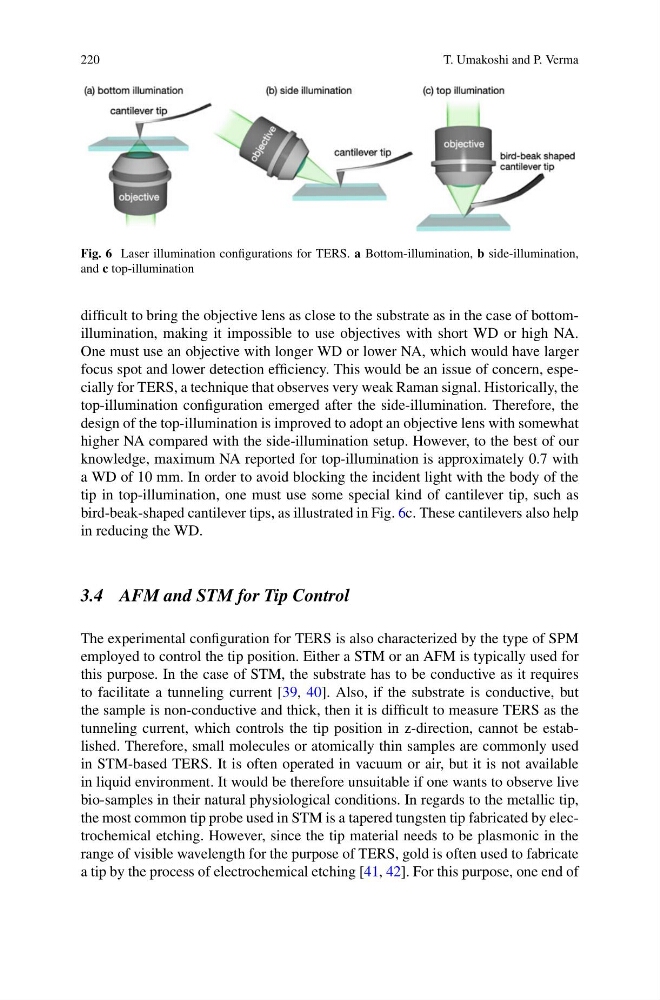
Fig. 6 Laser illumination configurations for TERS. a Bottom-illumination, b side-illumination,
and c top-illumination
difficult to bring the objective lens as close to the substrate as in the case of bottomillumination, making it impossible to use objectives with short WD or high NA.
One must use an objective with longer WD or lower NA, which would have larger
focus spot and lower detection efficiency. This would be an issue of concern, especially for TERS, a technique that observes very weak Raman signal. Historically, the
top-illumination configuration emerged after the side-illumination. Therefore, the
design of the top-illumination is improved to adopt an objective lens with somewhat
higher NA compared with the side-illumination setup. However, to the best of our
knowledge, maximum NA reported for top-illumination is approximately 0.7 with
a WD of 10 mm. In order to avoid blocking the incident light with the body of the
tip in top-illumination, one must use some special kind of cantilever tip, such as
bird-beak-shaped cantilever tips, as illustrated in Fig. 6c. These cantilevers also help
in reducing the WD.
3.4 AFM and STM for Tip Control
The experimental configuration for TERS is also characterized by the type of SPM
employed to control the tip position. Either a STM or an AFM is typically used for
this purpose. In the case of STM, the substrate has to be conductive as it requires
to facilitate a tunneling current [39, 40]. Also, if the substrate is conductive, but
the sample is non-conductive and thick, then it is difficult to measure TERS as the
tunneling current, which controls the tip position in z-direction, cannot be established. Therefore, small molecules or atomically thin samples are commonly used
in STM-based TERS. It is often operated in vacuum or air, but it is not available
in liquid environment. It would be therefore unsuitable if one wants to observe live
bio-samples in their natural physiological conditions. In regards to the metallic tip,
the most common tip probe used in STM is a tapered tungsten tip fabricated by electrochemical etching. However, since the tip material needs to be plasmonic in the
range of visible wavelength for the purpose of TERS, gold is often used to fabricate
a tip by the process of electrochemical etching [41, 42]. For this purpose, one end of
T. Umakoshi and P. Verma
Fig. 6 Laser illumination configurations for TERS. a Bottom-illumination, b side-illumination,
and c top-illumination
difficult to bring the objective lens as close to the substrate as in the case of bottomillumination, making it impossible to use objectives with short WD or high NA.
One must use an objective with longer WD or lower NA, which would have larger
focus spot and lower detection efficiency. This would be an issue of concern, especially for TERS, a technique that observes very weak Raman signal. Historically, the
top-illumination configuration emerged after the side-illumination. Therefore, the
design of the top-illumination is improved to adopt an objective lens with somewhat
higher NA compared with the side-illumination setup. However, to the best of our
knowledge, maximum NA reported for top-illumination is approximately 0.7 with
a WD of 10 mm. In order to avoid blocking the incident light with the body of the
tip in top-illumination, one must use some special kind of cantilever tip, such as
bird-beak-shaped cantilever tips, as illustrated in Fig. 6c. These cantilevers also help
in reducing the WD.
3.4 AFM and STM for Tip Control
The experimental configuration for TERS is also characterized by the type of SPM
employed to control the tip position. Either a STM or an AFM is typically used for
this purpose. In the case of STM, the substrate has to be conductive as it requires
to facilitate a tunneling current [39, 40]. Also, if the substrate is conductive, but
the sample is non-conductive and thick, then it is difficult to measure TERS as the
tunneling current, which controls the tip position in z-direction, cannot be established. Therefore, small molecules or atomically thin samples are commonly used
in STM-based TERS. It is often operated in vacuum or air, but it is not available
in liquid environment. It would be therefore unsuitable if one wants to observe live
bio-samples in their natural physiological conditions. In regards to the metallic tip,
the most common tip probe used in STM is a tapered tungsten tip fabricated by electrochemical etching. However, since the tip material needs to be plasmonic in the
range of visible wavelength for the purpose of TERS, gold is often used to fabricate
a tip by the process of electrochemical etching [41, 42]. For this purpose, one end of