

212
T. Umakoshi and P. Verma
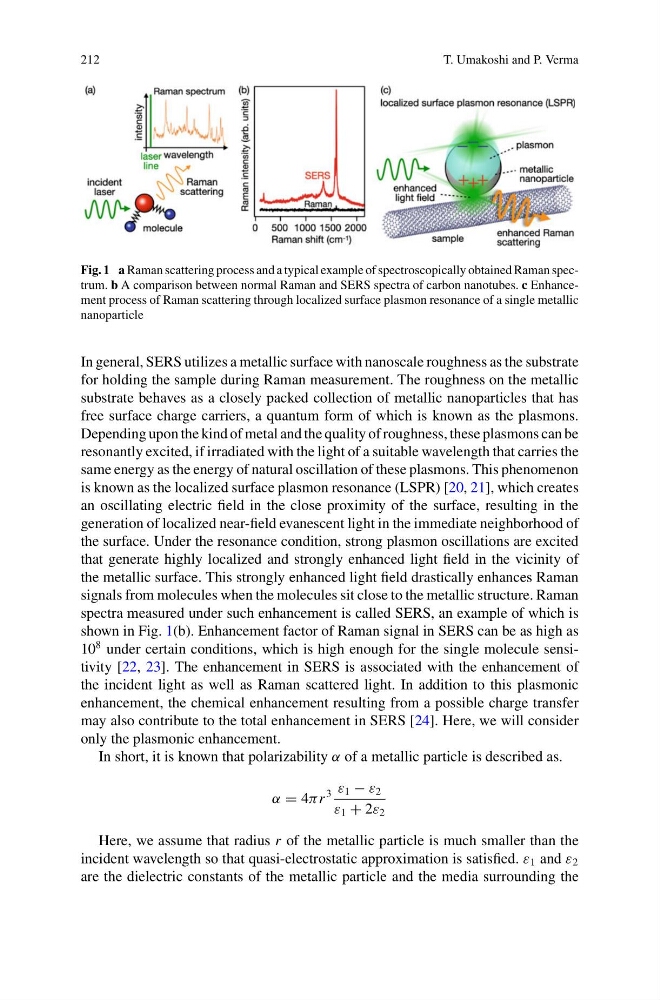
Fig. 1 a Raman scattering process and a typical example of spectroscopically obtained Raman spectrum. b A comparison between normal Raman and SERS spectra of carbon nanotubes. c Enhancement process of Raman scattering through localized surface plasmon resonance of a single metallic
nanoparticle
In general, SERS utilizes a metallic surface with nanoscale roughness as the substrate
for holding the sample during Raman measurement. The roughness on the metallic
substrate behaves as a closely packed collection of metallic nanoparticles that has
free surface charge carriers, a quantum form of which is known as the plasmons.
Depending upon the kind of metal and the quality of roughness, these plasmons can be
resonantly excited, if irradiated with the light of a suitable wavelength that carries the
same energy as the energy of natural oscillation of these plasmons. This phenomenon
is known as the localized surface plasmon resonance (LSPR) [20, 21], which creates
an oscillating electric field in the close proximity of the surface, resulting in the
generation of localized near-field evanescent light in the immediate neighborhood of
the surface. Under the resonance condition, strong plasmon oscillations are excited
that generate highly localized and strongly enhanced light field in the vicinity of
the metallic surface. This strongly enhanced light field drastically enhances Raman
signals from molecules when the molecules sit close to the metallic structure. Raman
spectra measured under such enhancement is called SERS, an example of which is
shown in Fig. 1(b). Enhancement factor of Raman signal in SERS can be as high as
10
8 under certain conditions, which is high enough for the single molecule sensitivity [22, 23]. The enhancement in SERS is associated with the enhancement of
the incident light as well as Raman scattered light. In addition to this plasmonic
enhancement, the chemical enhancement resulting from a possible charge transfer
may also contribute to the total enhancement in SERS [24]. Here, we will consider
only the plasmonic enhancement.
In short, it is known that polarizability α of a metallic particle is described as.
α = 4πr
3 ε 1 − ε 2
ε 1 + 2ε 2
Here, we assume that radius r of the metallic particle is much smaller than the
incident wavelength so that quasi-electrostatic approximation is satisfied. ε 1 and ε 2
are the dielectric constants of the metallic particle and the media surrounding the
T. Umakoshi and P. Verma
Fig. 1 a Raman scattering process and a typical example of spectroscopically obtained Raman spectrum. b A comparison between normal Raman and SERS spectra of carbon nanotubes. c Enhancement process of Raman scattering through localized surface plasmon resonance of a single metallic
nanoparticle
In general, SERS utilizes a metallic surface with nanoscale roughness as the substrate
for holding the sample during Raman measurement. The roughness on the metallic
substrate behaves as a closely packed collection of metallic nanoparticles that has
free surface charge carriers, a quantum form of which is known as the plasmons.
Depending upon the kind of metal and the quality of roughness, these plasmons can be
resonantly excited, if irradiated with the light of a suitable wavelength that carries the
same energy as the energy of natural oscillation of these plasmons. This phenomenon
is known as the localized surface plasmon resonance (LSPR) [20, 21], which creates
an oscillating electric field in the close proximity of the surface, resulting in the
generation of localized near-field evanescent light in the immediate neighborhood of
the surface. Under the resonance condition, strong plasmon oscillations are excited
that generate highly localized and strongly enhanced light field in the vicinity of
the metallic surface. This strongly enhanced light field drastically enhances Raman
signals from molecules when the molecules sit close to the metallic structure. Raman
spectra measured under such enhancement is called SERS, an example of which is
shown in Fig. 1(b). Enhancement factor of Raman signal in SERS can be as high as
10
8 under certain conditions, which is high enough for the single molecule sensitivity [22, 23]. The enhancement in SERS is associated with the enhancement of
the incident light as well as Raman scattered light. In addition to this plasmonic
enhancement, the chemical enhancement resulting from a possible charge transfer
may also contribute to the total enhancement in SERS [24]. Here, we will consider
only the plasmonic enhancement.
In short, it is known that polarizability α of a metallic particle is described as.
α = 4πr
3 ε 1 − ε 2
ε 1 + 2ε 2
Here, we assume that radius r of the metallic particle is much smaller than the
incident wavelength so that quasi-electrostatic approximation is satisfied. ε 1 and ε 2
are the dielectric constants of the metallic particle and the media surrounding the