

Fundamentals and Applications of Surface Enhanced Raman …
197
to conduction edge charge transfer (at ω = ω I C ) or the valance band edge to the
LUMO level (at ω = ω VK .).
B-Term and C-Term:
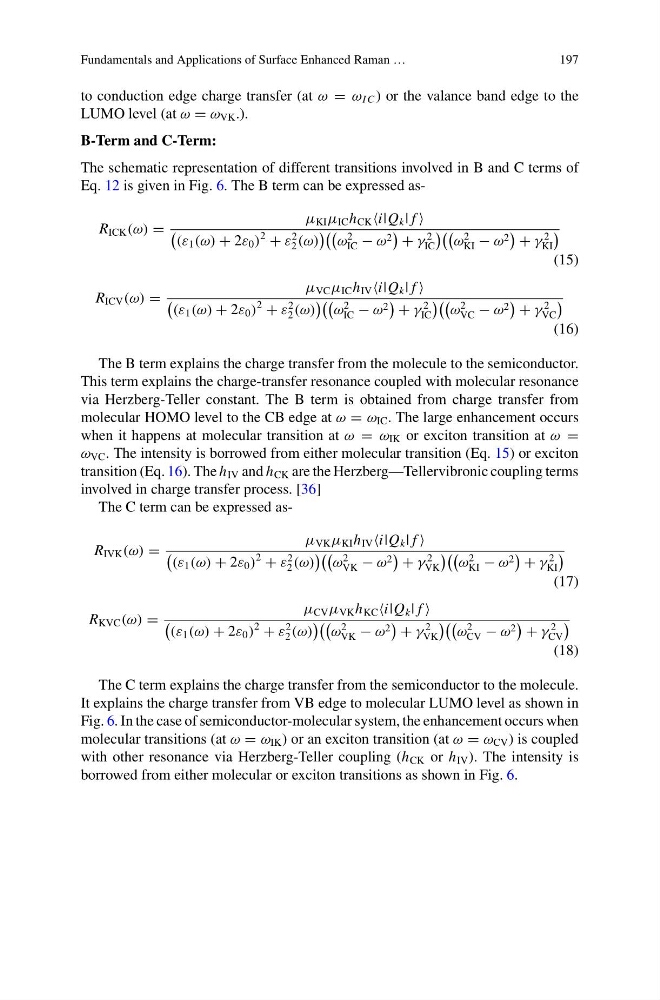
The schematic representation of different transitions involved in B and C terms of
Eq. 12 is given in Fig. 6. The B term can be expressed asR ICK (ω) =
μ KI μ IC h CK i|Q k | f
(ε 1 (ω) + 2ε 0 )
2
+ ε
2
2 (ω)
ω
2
IC − ω 2
+ γ
2
IC
ω
2
KI − ω 2
+ γ
2
KI
(15)
R ICV (ω) =
μ VC μ IC h IV i|Q k | f
(ε 1 (ω) + 2ε 0 )
2
+ ε
2
2 (ω)
ω
2
IC − ω 2
+ γ
2
IC
ω
2
VC − ω 2
+ γ
2
VC
(16)
The B term explains the charge transfer from the molecule to the semiconductor.
This term explains the charge-transfer resonance coupled with molecular resonance
via Herzberg-Teller constant. The B term is obtained from charge transfer from
molecular HOMO level to the CB edge at ω = ω IC . The large enhancement occurs
when it happens at molecular transition at ω = ω IK or exciton transition at ω =
ω VC . The intensity is borrowed from either molecular transition (Eq. 15) or exciton
transition (Eq. 16). The h IV and h CK are the Herzberg—Tellervibronic coupling terms
involved in charge transfer process. [36]
The C term can be expressed asR IVK (ω) =
μ VK μ KI h IV i|Q k | f
(ε 1 (ω) + 2ε 0 )
2
+ ε
2
2 (ω)
ω
2
VK − ω 2
+ γ
2
VK
ω
2
KI − ω 2
+ γ
2
KI
(17)
R KVC (ω) =
μ CV μ VK h KC i|Q k | f
(ε 1 (ω) + 2ε 0 )
2
+ ε
2
2 (ω)
ω
2
VK − ω 2
+ γ
2
VK
ω
2
CV − ω 2
+ γ
2
CV
(18)
The C term explains the charge transfer from the semiconductor to the molecule.
It explains the charge transfer from VB edge to molecular LUMO level as shown in
Fig. 6. In the case of semiconductor-molecular system, the enhancement occurs when
molecular transitions (at ω = ω IK ) or an exciton transition (at ω = ω CV ) is coupled
with other resonance via Herzberg-Teller coupling (h CK or h IV ). The intensity is
borrowed from either molecular or exciton transitions as shown in Fig. 6.
197
to conduction edge charge transfer (at ω = ω I C ) or the valance band edge to the
LUMO level (at ω = ω VK .).
B-Term and C-Term:
The schematic representation of different transitions involved in B and C terms of
Eq. 12 is given in Fig. 6. The B term can be expressed asR ICK (ω) =
μ KI μ IC h CK i|Q k | f
(ε 1 (ω) + 2ε 0 )
2
+ ε
2
2 (ω)
ω
2
IC − ω 2
+ γ
2
IC
ω
2
KI − ω 2
+ γ
2
KI
(15)
R ICV (ω) =
μ VC μ IC h IV i|Q k | f
(ε 1 (ω) + 2ε 0 )
2
+ ε
2
2 (ω)
ω
2
IC − ω 2
+ γ
2
IC
ω
2
VC − ω 2
+ γ
2
VC
(16)
The B term explains the charge transfer from the molecule to the semiconductor.
This term explains the charge-transfer resonance coupled with molecular resonance
via Herzberg-Teller constant. The B term is obtained from charge transfer from
molecular HOMO level to the CB edge at ω = ω IC . The large enhancement occurs
when it happens at molecular transition at ω = ω IK or exciton transition at ω =
ω VC . The intensity is borrowed from either molecular transition (Eq. 15) or exciton
transition (Eq. 16). The h IV and h CK are the Herzberg—Tellervibronic coupling terms
involved in charge transfer process. [36]
The C term can be expressed asR IVK (ω) =
μ VK μ KI h IV i|Q k | f
(ε 1 (ω) + 2ε 0 )
2
+ ε
2
2 (ω)
ω
2
VK − ω 2
+ γ
2
VK
ω
2
KI − ω 2
+ γ
2
KI
(17)
R KVC (ω) =
μ CV μ VK h KC i|Q k | f
(ε 1 (ω) + 2ε 0 )
2
+ ε
2
2 (ω)
ω
2
VK − ω 2
+ γ
2
VK
ω
2
CV − ω 2
+ γ
2
CV
(18)
The C term explains the charge transfer from the semiconductor to the molecule.
It explains the charge transfer from VB edge to molecular LUMO level as shown in
Fig. 6. In the case of semiconductor-molecular system, the enhancement occurs when
molecular transitions (at ω = ω IK ) or an exciton transition (at ω = ω CV ) is coupled
with other resonance via Herzberg-Teller coupling (h CK or h IV ). The intensity is
borrowed from either molecular or exciton transitions as shown in Fig. 6.