

Overview of Raman Spectroscopy: Fundamental to Applications
169
deliberately, or naturally. This situation has made food safety a major global concern
today and urged the need for innovative technologies that can deal with food contaminant detections as effectively as possible. Due to their importance as food resources,
the quality and sustainability of dairy products have always been major concerns of
ordinary people, authorities, and researchers. Raman spectroscopy is, therefore, an
efficient, accurate, simple, practical technique for the detection of different contaminants in food products. Recently, in combination with multivariate analysis, Genis
et al. recorded Raman spectra to determine the origins of fats in margarine, corn,
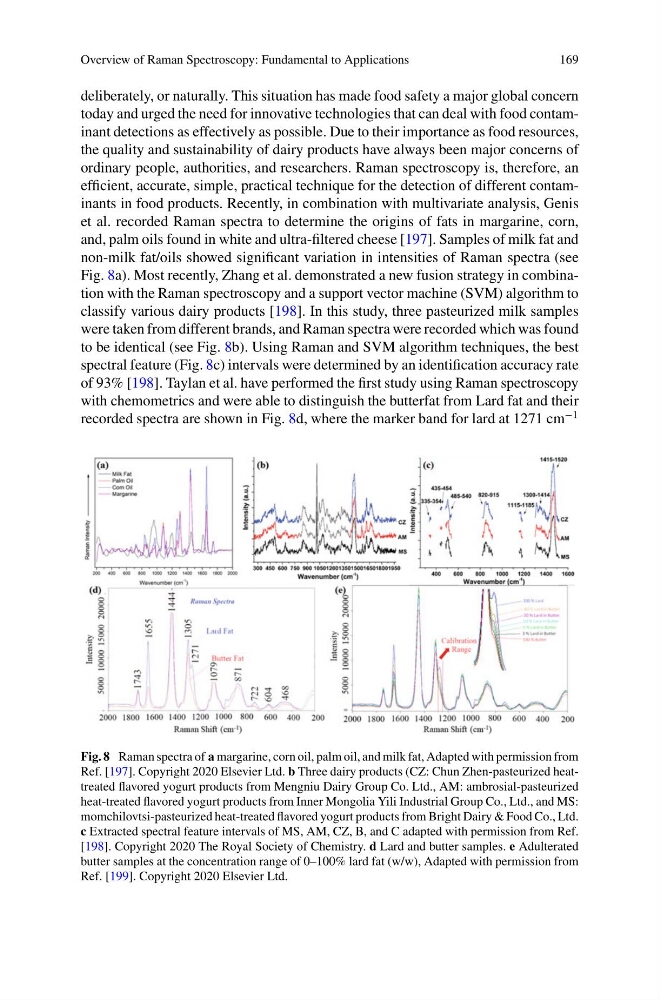
and, palm oils found in white and ultra-filtered cheese [197]. Samples of milk fat and
non-milk fat/oils showed significant variation in intensities of Raman spectra (see
Fig. 8a). Most recently, Zhang et al. demonstrated a new fusion strategy in combination with the Raman spectroscopy and a support vector machine (SVM) algorithm to
classify various dairy products [198]. In this study, three pasteurized milk samples
were taken from different brands, and Raman spectra were recorded which was found
to be identical (see Fig. 8b). Using Raman and SVM algorithm techniques, the best
spectral feature (Fig. 8c) intervals were determined by an identification accuracy rate
of 93% [198]. Taylan et al. have performed the first study using Raman spectroscopy
with chemometrics and were able to distinguish the butterfat from Lard fat and their
recorded spectra are shown in Fig. 8d, where the marker band for lard at 1271 cm
−1
Fig. 8 Raman spectra of a margarine, corn oil, palm oil, and milk fat, Adapted with permission from
Ref. [197]. Copyright 2020 Elsevier Ltd. b Three dairy products (CZ: Chun Zhen-pasteurized heattreated flavored yogurt products from Mengniu Dairy Group Co. Ltd., AM: ambrosial-pasteurized
heat-treated flavored yogurt products from Inner Mongolia Yili Industrial Group Co., Ltd., and MS:
momchilovtsi-pasteurized heat-treated flavored yogurt products from Bright Dairy & Food Co., Ltd.
c Extracted spectral feature intervals of MS, AM, CZ, B, and C adapted with permission from Ref.
[198]. Copyright 2020 The Royal Society of Chemistry. d Lard and butter samples. e Adulterated
butter samples at the concentration range of 0–100% lard fat (w/w), Adapted with permission from
Ref. [199]. Copyright 2020 Elsevier Ltd.
169
deliberately, or naturally. This situation has made food safety a major global concern
today and urged the need for innovative technologies that can deal with food contaminant detections as effectively as possible. Due to their importance as food resources,
the quality and sustainability of dairy products have always been major concerns of
ordinary people, authorities, and researchers. Raman spectroscopy is, therefore, an
efficient, accurate, simple, practical technique for the detection of different contaminants in food products. Recently, in combination with multivariate analysis, Genis
et al. recorded Raman spectra to determine the origins of fats in margarine, corn,
and, palm oils found in white and ultra-filtered cheese [197]. Samples of milk fat and
non-milk fat/oils showed significant variation in intensities of Raman spectra (see
Fig. 8a). Most recently, Zhang et al. demonstrated a new fusion strategy in combination with the Raman spectroscopy and a support vector machine (SVM) algorithm to
classify various dairy products [198]. In this study, three pasteurized milk samples
were taken from different brands, and Raman spectra were recorded which was found
to be identical (see Fig. 8b). Using Raman and SVM algorithm techniques, the best
spectral feature (Fig. 8c) intervals were determined by an identification accuracy rate
of 93% [198]. Taylan et al. have performed the first study using Raman spectroscopy
with chemometrics and were able to distinguish the butterfat from Lard fat and their
recorded spectra are shown in Fig. 8d, where the marker band for lard at 1271 cm
−1
Fig. 8 Raman spectra of a margarine, corn oil, palm oil, and milk fat, Adapted with permission from
Ref. [197]. Copyright 2020 Elsevier Ltd. b Three dairy products (CZ: Chun Zhen-pasteurized heattreated flavored yogurt products from Mengniu Dairy Group Co. Ltd., AM: ambrosial-pasteurized
heat-treated flavored yogurt products from Inner Mongolia Yili Industrial Group Co., Ltd., and MS:
momchilovtsi-pasteurized heat-treated flavored yogurt products from Bright Dairy & Food Co., Ltd.
c Extracted spectral feature intervals of MS, AM, CZ, B, and C adapted with permission from Ref.
[198]. Copyright 2020 The Royal Society of Chemistry. d Lard and butter samples. e Adulterated
butter samples at the concentration range of 0–100% lard fat (w/w), Adapted with permission from
Ref. [199]. Copyright 2020 Elsevier Ltd.