

Broadband Terahertz Spectroscopy
125
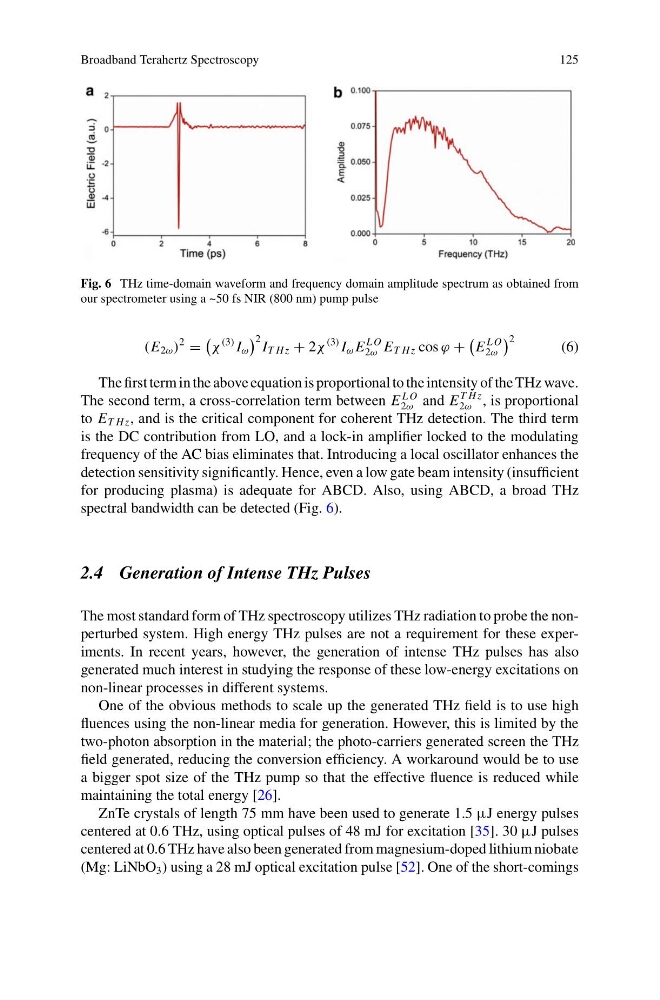
Fig. 6 THz time-domain waveform and frequency domain amplitude spectrum as obtained from
our spectrometer using a ~50 fs NIR (800 nm) pump pulse
(E 2ω )
2
=
χ
(3) I ω
2 I T Hz + 2χ
(3) I ω E
L O
2ω E T Hz cos ϕ +
E
L O
2ω
2
(6)
The first term in the above equation is proportional to the intensity of the THz wave.
The second term, a cross-correlation term between E
L O
2ω and E
T Hz
2ω , is proportional
to E T Hz , and is the critical component for coherent THz detection. The third term
is the DC contribution from LO, and a lock-in amplifier locked to the modulating
frequency of the AC bias eliminates that. Introducing a local oscillator enhances the
detection sensitivity significantly. Hence, even a low gate beam intensity (insufficient
for producing plasma) is adequate for ABCD. Also, using ABCD, a broad THz
spectral bandwidth can be detected (Fig. 6).
2.4 Generation of Intense THz Pulses
The most standard form of THz spectroscopy utilizes THz radiation to probe the nonperturbed system. High energy THz pulses are not a requirement for these experiments. In recent years, however, the generation of intense THz pulses has also
generated much interest in studying the response of these low-energy excitations on
non-linear processes in different systems.
One of the obvious methods to scale up the generated THz field is to use high
fluences using the non-linear media for generation. However, this is limited by the
two-photon absorption in the material; the photo-carriers generated screen the THz
field generated, reducing the conversion efficiency. A workaround would be to use
a bigger spot size of the THz pump so that the effective fluence is reduced while
maintaining the total energy [26].
ZnTe crystals of length 75 mm have been used to generate 1.5 μJ energy pulses
centered at 0.6 THz, using optical pulses of 48 mJ for excitation [35]. 30 μJ pulses
centered at 0.6 THz have also been generated from magnesium-doped lithium niobate
(Mg: LiNbO 3 ) using a 28 mJ optical excitation pulse [52]. One of the short-comings
125
Fig. 6 THz time-domain waveform and frequency domain amplitude spectrum as obtained from
our spectrometer using a ~50 fs NIR (800 nm) pump pulse
(E 2ω )
2
=
χ
(3) I ω
2 I T Hz + 2χ
(3) I ω E
L O
2ω E T Hz cos ϕ +
E
L O
2ω
2
(6)
The first term in the above equation is proportional to the intensity of the THz wave.
The second term, a cross-correlation term between E
L O
2ω and E
T Hz
2ω , is proportional
to E T Hz , and is the critical component for coherent THz detection. The third term
is the DC contribution from LO, and a lock-in amplifier locked to the modulating
frequency of the AC bias eliminates that. Introducing a local oscillator enhances the
detection sensitivity significantly. Hence, even a low gate beam intensity (insufficient
for producing plasma) is adequate for ABCD. Also, using ABCD, a broad THz
spectral bandwidth can be detected (Fig. 6).
2.4 Generation of Intense THz Pulses
The most standard form of THz spectroscopy utilizes THz radiation to probe the nonperturbed system. High energy THz pulses are not a requirement for these experiments. In recent years, however, the generation of intense THz pulses has also
generated much interest in studying the response of these low-energy excitations on
non-linear processes in different systems.
One of the obvious methods to scale up the generated THz field is to use high
fluences using the non-linear media for generation. However, this is limited by the
two-photon absorption in the material; the photo-carriers generated screen the THz
field generated, reducing the conversion efficiency. A workaround would be to use
a bigger spot size of the THz pump so that the effective fluence is reduced while
maintaining the total energy [26].
ZnTe crystals of length 75 mm have been used to generate 1.5 μJ energy pulses
centered at 0.6 THz, using optical pulses of 48 mJ for excitation [35]. 30 μJ pulses
centered at 0.6 THz have also been generated from magnesium-doped lithium niobate
(Mg: LiNbO 3 ) using a 28 mJ optical excitation pulse [52]. One of the short-comings