

118
S. Banerjee et al.
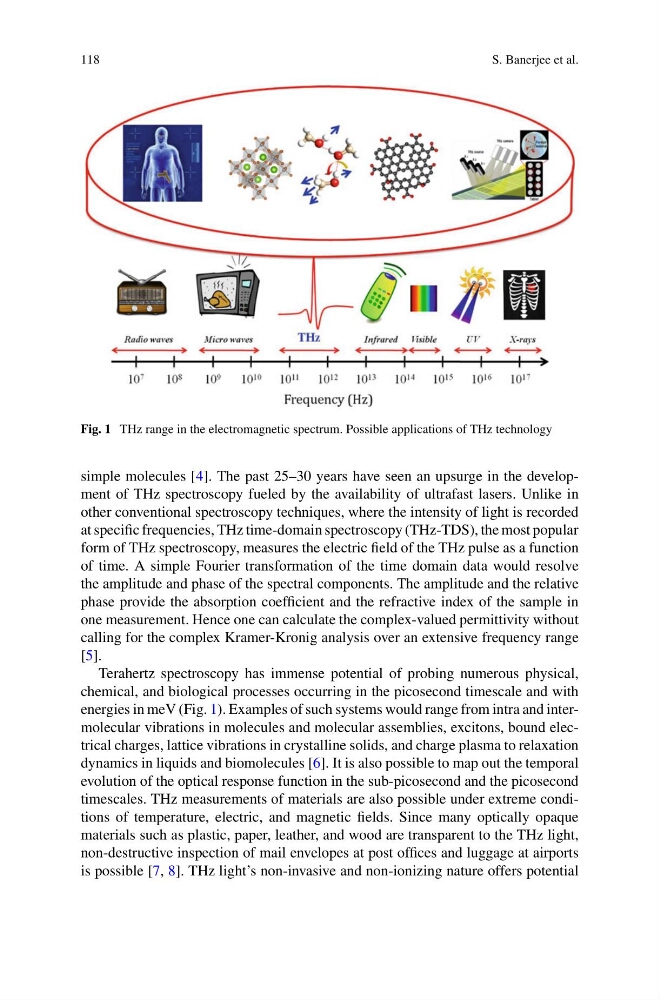
Fig. 1 THz range in the electromagnetic spectrum. Possible applications of THz technology
simple molecules [4]. The past 25–30 years have seen an upsurge in the development of THz spectroscopy fueled by the availability of ultrafast lasers. Unlike in
other conventional spectroscopy techniques, where the intensity of light is recorded
at specific frequencies, THz time-domain spectroscopy (THz-TDS), the most popular
form of THz spectroscopy, measures the electric field of the THz pulse as a function
of time. A simple Fourier transformation of the time domain data would resolve
the amplitude and phase of the spectral components. The amplitude and the relative
phase provide the absorption coefficient and the refractive index of the sample in
one measurement. Hence one can calculate the complex-valued permittivity without
calling for the complex Kramer-Kronig analysis over an extensive frequency range
[5].
Terahertz spectroscopy has immense potential of probing numerous physical,
chemical, and biological processes occurring in the picosecond timescale and with
energies in meV (Fig. 1). Examples of such systems would range from intra and intermolecular vibrations in molecules and molecular assemblies, excitons, bound electrical charges, lattice vibrations in crystalline solids, and charge plasma to relaxation
dynamics in liquids and biomolecules [6]. It is also possible to map out the temporal
evolution of the optical response function in the sub-picosecond and the picosecond
timescales. THz measurements of materials are also possible under extreme conditions of temperature, electric, and magnetic fields. Since many optically opaque
materials such as plastic, paper, leather, and wood are transparent to the THz light,
non-destructive inspection of mail envelopes at post offices and luggage at airports
is possible [7, 8]. THz light’s non-invasive and non-ionizing nature offers potential
S. Banerjee et al.
Fig. 1 THz range in the electromagnetic spectrum. Possible applications of THz technology
simple molecules [4]. The past 25–30 years have seen an upsurge in the development of THz spectroscopy fueled by the availability of ultrafast lasers. Unlike in
other conventional spectroscopy techniques, where the intensity of light is recorded
at specific frequencies, THz time-domain spectroscopy (THz-TDS), the most popular
form of THz spectroscopy, measures the electric field of the THz pulse as a function
of time. A simple Fourier transformation of the time domain data would resolve
the amplitude and phase of the spectral components. The amplitude and the relative
phase provide the absorption coefficient and the refractive index of the sample in
one measurement. Hence one can calculate the complex-valued permittivity without
calling for the complex Kramer-Kronig analysis over an extensive frequency range
[5].
Terahertz spectroscopy has immense potential of probing numerous physical,
chemical, and biological processes occurring in the picosecond timescale and with
energies in meV (Fig. 1). Examples of such systems would range from intra and intermolecular vibrations in molecules and molecular assemblies, excitons, bound electrical charges, lattice vibrations in crystalline solids, and charge plasma to relaxation
dynamics in liquids and biomolecules [6]. It is also possible to map out the temporal
evolution of the optical response function in the sub-picosecond and the picosecond
timescales. THz measurements of materials are also possible under extreme conditions of temperature, electric, and magnetic fields. Since many optically opaque
materials such as plastic, paper, leather, and wood are transparent to the THz light,
non-destructive inspection of mail envelopes at post offices and luggage at airports
is possible [7, 8]. THz light’s non-invasive and non-ionizing nature offers potential