

Classical- and Heterodyne-Detected Vibrational Sum …
105
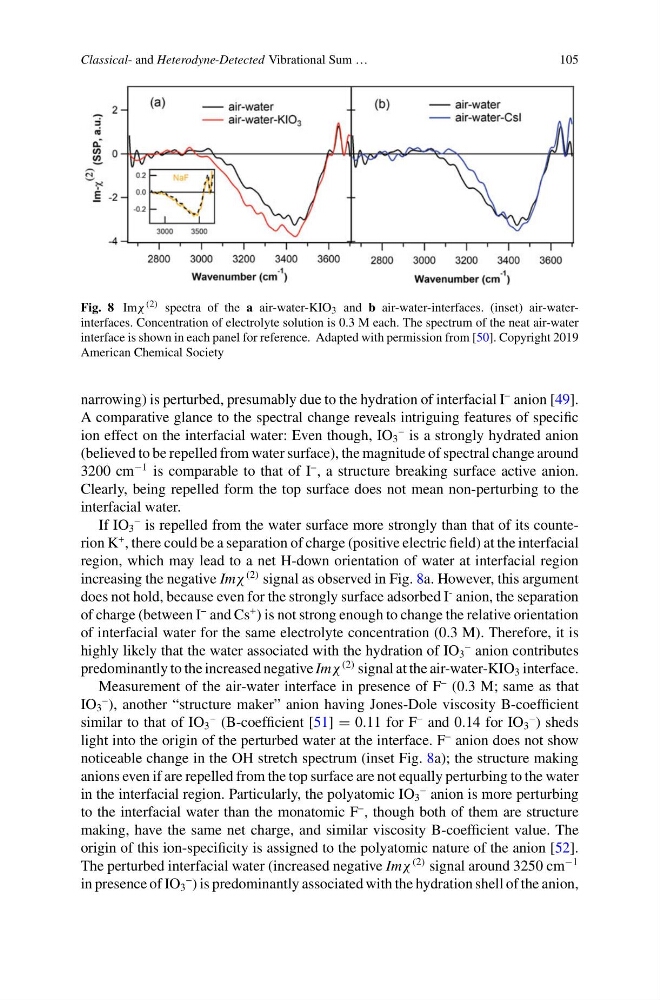
Fig. 8 Imχ (2) spectra of the a air-water-KIO 3 and b air-water-interfaces. (inset) air-waterinterfaces. Concentration of electrolyte solution is 0.3 M each. The spectrum of the neat air-water
interface is shown in each panel for reference. Adapted with permission from [50]. Copyright 2019
American Chemical Society
narrowing) is perturbed, presumably due to the hydration of interfacial I
– anion [49].
A comparative glance to the spectral change reveals intriguing features of specific
ion effect on the interfacial water: Even though, IO 3
– is a strongly hydrated anion
(believed to be repelled from water surface), the magnitude of spectral change around
3200 cm
−1 is comparable to that of I
– , a structure breaking surface active anion.
Clearly, being repelled form the top surface does not mean non-perturbing to the
interfacial water.
If IO 3
– is repelled from the water surface more strongly than that of its counterion K
+ , there could be a separation of charge (positive electric field) at the interfacial
region, which may lead to a net H-down orientation of water at interfacial region
increasing the negative Imχ
(2) signal as observed in Fig. 8a. However, this argument
does not hold, because even for the strongly surface adsorbed I
- anion, the separation
of charge (between I
– and Cs
+ ) is not strong enough to change the relative orientation
of interfacial water for the same electrolyte concentration (0.3 M). Therefore, it is
highly likely that the water associated with the hydration of IO 3
– anion contributes
predominantly to the increased negative Imχ
(2) signal at the air-water-KIO 3 interface.
Measurement of the air-water interface in presence of F
– (0.3 M; same as that
IO 3
– ), another “structure maker” anion having Jones-Dole viscosity B-coefficient
similar to that of IO 3
– (B-coefficient [51] = 0.11 for F
– and 0.14 for IO 3
– ) sheds
light into the origin of the perturbed water at the interface. F
– anion does not show
noticeable change in the OH stretch spectrum (inset Fig. 8a); the structure making
anions even if are repelled from the top surface are not equally perturbing to the water
in the interfacial region. Particularly, the polyatomic IO 3
– anion is more perturbing
to the interfacial water than the monatomic F
– , though both of them are structure
making, have the same net charge, and similar viscosity B-coefficient value. The
origin of this ion-specificity is assigned to the polyatomic nature of the anion [52].
The perturbed interfacial water (increased negative Imχ
(2) signal around 3250 cm
−1
in presence of IO 3
– ) is predominantly associated with the hydration shell of the anion,
105
Fig. 8 Imχ (2) spectra of the a air-water-KIO 3 and b air-water-interfaces. (inset) air-waterinterfaces. Concentration of electrolyte solution is 0.3 M each. The spectrum of the neat air-water
interface is shown in each panel for reference. Adapted with permission from [50]. Copyright 2019
American Chemical Society
narrowing) is perturbed, presumably due to the hydration of interfacial I
– anion [49].
A comparative glance to the spectral change reveals intriguing features of specific
ion effect on the interfacial water: Even though, IO 3
– is a strongly hydrated anion
(believed to be repelled from water surface), the magnitude of spectral change around
3200 cm
−1 is comparable to that of I
– , a structure breaking surface active anion.
Clearly, being repelled form the top surface does not mean non-perturbing to the
interfacial water.
If IO 3
– is repelled from the water surface more strongly than that of its counterion K
+ , there could be a separation of charge (positive electric field) at the interfacial
region, which may lead to a net H-down orientation of water at interfacial region
increasing the negative Imχ
(2) signal as observed in Fig. 8a. However, this argument
does not hold, because even for the strongly surface adsorbed I
- anion, the separation
of charge (between I
– and Cs
+ ) is not strong enough to change the relative orientation
of interfacial water for the same electrolyte concentration (0.3 M). Therefore, it is
highly likely that the water associated with the hydration of IO 3
– anion contributes
predominantly to the increased negative Imχ
(2) signal at the air-water-KIO 3 interface.
Measurement of the air-water interface in presence of F
– (0.3 M; same as that
IO 3
– ), another “structure maker” anion having Jones-Dole viscosity B-coefficient
similar to that of IO 3
– (B-coefficient [51] = 0.11 for F
– and 0.14 for IO 3
– ) sheds
light into the origin of the perturbed water at the interface. F
– anion does not show
noticeable change in the OH stretch spectrum (inset Fig. 8a); the structure making
anions even if are repelled from the top surface are not equally perturbing to the water
in the interfacial region. Particularly, the polyatomic IO 3
– anion is more perturbing
to the interfacial water than the monatomic F
– , though both of them are structure
making, have the same net charge, and similar viscosity B-coefficient value. The
origin of this ion-specificity is assigned to the polyatomic nature of the anion [52].
The perturbed interfacial water (increased negative Imχ
(2) signal around 3250 cm
−1
in presence of IO 3
– ) is predominantly associated with the hydration shell of the anion,