

Classical- and Heterodyne-Detected Vibrational Sum …
93
carried by Eulers’ angle transformation [10, 12, 13]. Non-zero components of β lmn
are associated with the vibrational modes of the molecules. The expression for β lmn ,
obtained from quantum mechanical perturbative treatment, [1, 14] is as follows,
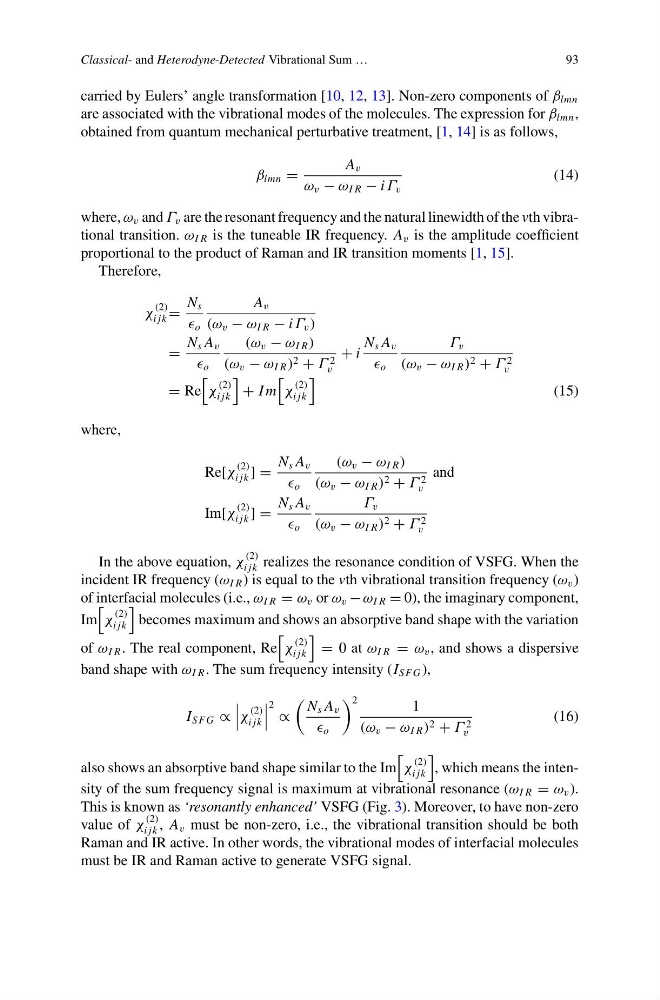
β lmn =
A v
ω v − ω I R − iΓ v
(14)
where, ω v and Γ v are the resonant frequency and the natural linewidth of the vth vibrational transition. ω I R is the tuneable IR frequency. A v is the amplitude coefficient
proportional to the product of Raman and IR transition moments [1, 15].
Therefore,
χ
(2)
i jk =
N s
o
A v
(ω v − ω I R − iΓ v )
=
N s A v
o
(ω v − ω I R )
(ω v − ω I R ) 2 + Γ 2
v
+ i
N s A v
o
Γ v
(ω v − ω I R ) 2 + Γ 2
v
= Re
χ
(2)
i jk
+ I m
χ
(2)
i jk
(15)
where,
Re[χ
(2)
i jk ] =
N s A v
o
(ω v − ω I R )
(ω v − ω I R ) 2 + Γ 2
v
and
Im[χ
(2)
i jk ] =
N s A v
o
Γ v
(ω v − ω I R ) 2 + Γ 2
v
In the above equation, χ
(2)
i jk realizes the resonance condition of VSFG. When the
incident IR frequency (ω I R ) is equal to the vth vibrational transition frequency (ω v )
of interfacial molecules (i.e., ω I R = ω v or ω v − ω I R = 0), the imaginary component,
Im
χ
(2)
i jk
becomes maximum and shows an absorptive band shape with the variation
of ω I R . The real component, Re
χ
(2)
i jk
= 0 at ω I R = ω v , and shows a dispersive
band shape with ω I R . The sum frequency intensity (I SFG ),
I SFG ∝
χ
(2)
i jk
2 ∝
N s A v
o
2
1
(ω v − ω I R ) 2 + Γ 2
v
(16)
also shows an absorptive band shape similar to the Im
χ
(2)
i jk
, which means the intensity of the sum frequency signal is maximum at vibrational resonance (ω I R = ω v ).
This is known as ‘resonantly enhanced’ VSFG (Fig. 3). Moreover, to have non-zero
value of χ
(2)
i jk , A v must be non-zero, i.e., the vibrational transition should be both
Raman and IR active. In other words, the vibrational modes of interfacial molecules
must be IR and Raman active to generate VSFG signal.
93
carried by Eulers’ angle transformation [10, 12, 13]. Non-zero components of β lmn
are associated with the vibrational modes of the molecules. The expression for β lmn ,
obtained from quantum mechanical perturbative treatment, [1, 14] is as follows,
β lmn =
A v
ω v − ω I R − iΓ v
(14)
where, ω v and Γ v are the resonant frequency and the natural linewidth of the vth vibrational transition. ω I R is the tuneable IR frequency. A v is the amplitude coefficient
proportional to the product of Raman and IR transition moments [1, 15].
Therefore,
χ
(2)
i jk =
N s
o
A v
(ω v − ω I R − iΓ v )
=
N s A v
o
(ω v − ω I R )
(ω v − ω I R ) 2 + Γ 2
v
+ i
N s A v
o
Γ v
(ω v − ω I R ) 2 + Γ 2
v
= Re
χ
(2)
i jk
+ I m
χ
(2)
i jk
(15)
where,
Re[χ
(2)
i jk ] =
N s A v
o
(ω v − ω I R )
(ω v − ω I R ) 2 + Γ 2
v
and
Im[χ
(2)
i jk ] =
N s A v
o
Γ v
(ω v − ω I R ) 2 + Γ 2
v
In the above equation, χ
(2)
i jk realizes the resonance condition of VSFG. When the
incident IR frequency (ω I R ) is equal to the vth vibrational transition frequency (ω v )
of interfacial molecules (i.e., ω I R = ω v or ω v − ω I R = 0), the imaginary component,
Im
χ
(2)
i jk
becomes maximum and shows an absorptive band shape with the variation
of ω I R . The real component, Re
χ
(2)
i jk
= 0 at ω I R = ω v , and shows a dispersive
band shape with ω I R . The sum frequency intensity (I SFG ),
I SFG ∝
χ
(2)
i jk
2 ∝
N s A v
o
2
1
(ω v − ω I R ) 2 + Γ 2
v
(16)
also shows an absorptive band shape similar to the Im
χ
(2)
i jk
, which means the intensity of the sum frequency signal is maximum at vibrational resonance (ω I R = ω v ).
This is known as ‘resonantly enhanced’ VSFG (Fig. 3). Moreover, to have non-zero
value of χ
(2)
i jk , A v must be non-zero, i.e., the vibrational transition should be both
Raman and IR active. In other words, the vibrational modes of interfacial molecules
must be IR and Raman active to generate VSFG signal.