

Approach
To develop and test wildlife warning systems, we selected three railway sections
(8, 11 and 23 km in length) with extreme WTC frequencies (“hotspots”) and two
other sections for practical reasons. All five sections will be fenced, using 2 m high
standard exclusion fences of a type also used along roads. These fences will be
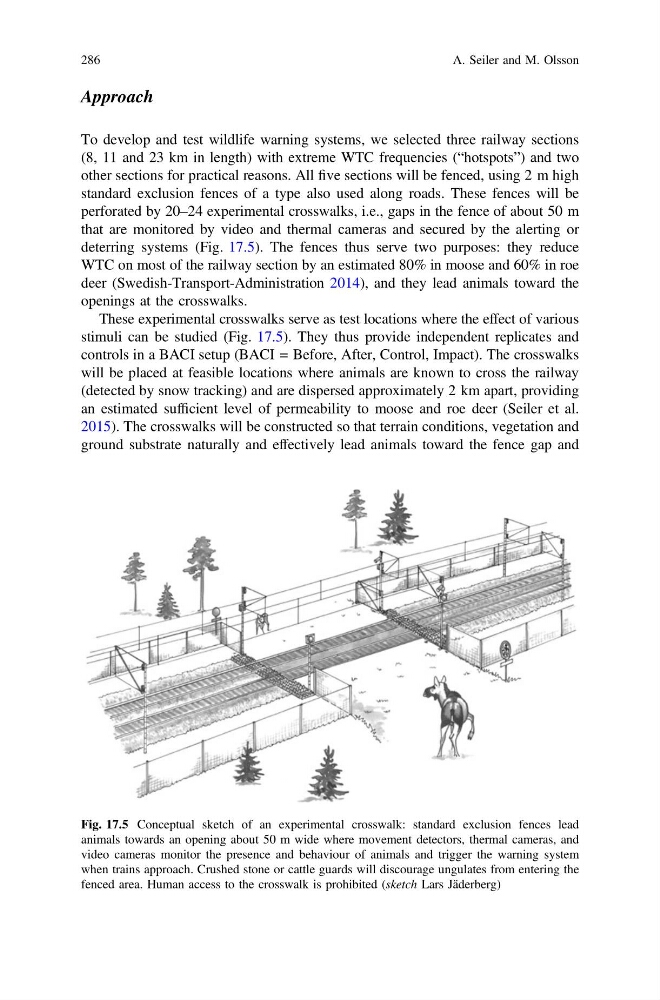
perforated by 20–24 experimental crosswalks, i.e., gaps in the fence of about 50 m
that are monitored by video and thermal cameras and secured by the alerting or
deterring systems (Fig. 17.5). The fences thus serve two purposes: they reduce
WTC on most of the railway section by an estimated 80% in moose and 60% in roe
deer (Swedish-Transport-Administration 2014), and they lead animals toward the
openings at the crosswalks.
These experimental crosswalks serve as test locations where the effect of various
stimuli can be studied (Fig. 17.5). They thus provide independent replicates and
controls in a BACI setup (BACI = Before, After, Control, Impact). The crosswalks
will be placed at feasible locations where animals are known to cross the railway
(detected by snow tracking) and are dispersed approximately 2 km apart, providing
an estimated sufficient level of permeability to moose and roe deer (Seiler et al.
2015). The crosswalks will be constructed so that terrain conditions, vegetation and
ground substrate naturally and effectively lead animals toward the fence gap and
Fig. 17.5 Conceptual sketch of an experimental crosswalk: standard exclusion fences lead
animals towards an opening about 50 m wide where movement detectors, thermal cameras, and
video cameras monitor the presence and behaviour of animals and trigger the warning system
when trains approach. Crushed stone or cattle guards will discourage ungulates from entering the
fenced area. Human access to the crosswalk is prohibited (sketch Lars Jäderberg)
286
A. Seiler and M. Olsson
To develop and test wildlife warning systems, we selected three railway sections
(8, 11 and 23 km in length) with extreme WTC frequencies (“hotspots”) and two
other sections for practical reasons. All five sections will be fenced, using 2 m high
standard exclusion fences of a type also used along roads. These fences will be
perforated by 20–24 experimental crosswalks, i.e., gaps in the fence of about 50 m
that are monitored by video and thermal cameras and secured by the alerting or
deterring systems (Fig. 17.5). The fences thus serve two purposes: they reduce
WTC on most of the railway section by an estimated 80% in moose and 60% in roe
deer (Swedish-Transport-Administration 2014), and they lead animals toward the
openings at the crosswalks.
These experimental crosswalks serve as test locations where the effect of various
stimuli can be studied (Fig. 17.5). They thus provide independent replicates and
controls in a BACI setup (BACI = Before, After, Control, Impact). The crosswalks
will be placed at feasible locations where animals are known to cross the railway
(detected by snow tracking) and are dispersed approximately 2 km apart, providing
an estimated sufficient level of permeability to moose and roe deer (Seiler et al.
2015). The crosswalks will be constructed so that terrain conditions, vegetation and
ground substrate naturally and effectively lead animals toward the fence gap and
Fig. 17.5 Conceptual sketch of an experimental crosswalk: standard exclusion fences lead
animals towards an opening about 50 m wide where movement detectors, thermal cameras, and
video cameras monitor the presence and behaviour of animals and trigger the warning system
when trains approach. Crushed stone or cattle guards will discourage ungulates from entering the
fenced area. Human access to the crosswalk is prohibited (sketch Lars Jäderberg)
286
A. Seiler and M. Olsson