

connectivity, at least between two railway breaks, which can represent large distances (e.g. more than 5 km in our study) (Penone et al. 2012).
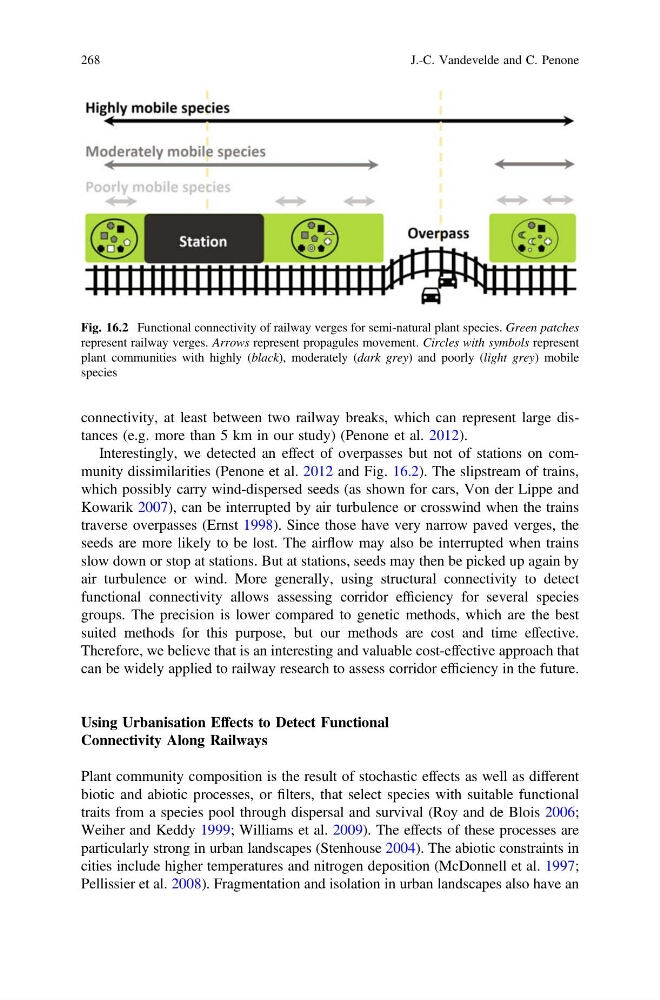
Interestingly, we detected an effect of overpasses but not of stations on community dissimilarities (Penone et al. 2012 and Fig. 16.2). The slipstream of trains,
which possibly carry wind-dispersed seeds (as shown for cars, Von der Lippe and
Kowarik 2007), can be interrupted by air turbulence or crosswind when the trains
traverse overpasses (Ernst 1998). Since those have very narrow paved verges, the
seeds are more likely to be lost. The airflow may also be interrupted when trains
slow down or stop at stations. But at stations, seeds may then be picked up again by
air turbulence or wind. More generally, using structural connectivity to detect
functional connectivity allows assessing corridor efficiency for several species
groups. The precision is lower compared to genetic methods, which are the best
suited methods for this purpose, but our methods are cost and time effective.
Therefore, we believe that is an interesting and valuable cost-effective approach that
can be widely applied to railway research to assess corridor efficiency in the future.
Using Urbanisation Effects to Detect Functional
Connectivity Along Railways
Plant community composition is the result of stochastic effects as well as different
biotic and abiotic processes, or filters, that select species with suitable functional
traits from a species pool through dispersal and survival (Roy and de Blois 2006;
Weiher and Keddy 1999; Williams et al. 2009). The effects of these processes are
particularly strong in urban landscapes (Stenhouse 2004). The abiotic constraints in
cities include higher temperatures and nitrogen deposition (McDonnell et al. 1997;
Pellissier et al. 2008). Fragmentation and isolation in urban landscapes also have an
Fig. 16.2 Functional connectivity of railway verges for semi-natural plant species. Green patches
represent railway verges. Arrows represent propagules movement. Circles with symbols represent
plant communities with highly (black), moderately (dark grey) and poorly (light grey) mobile
species
268
J.-C. Vandevelde and C. Penone
Interestingly, we detected an effect of overpasses but not of stations on community dissimilarities (Penone et al. 2012 and Fig. 16.2). The slipstream of trains,
which possibly carry wind-dispersed seeds (as shown for cars, Von der Lippe and
Kowarik 2007), can be interrupted by air turbulence or crosswind when the trains
traverse overpasses (Ernst 1998). Since those have very narrow paved verges, the
seeds are more likely to be lost. The airflow may also be interrupted when trains
slow down or stop at stations. But at stations, seeds may then be picked up again by
air turbulence or wind. More generally, using structural connectivity to detect
functional connectivity allows assessing corridor efficiency for several species
groups. The precision is lower compared to genetic methods, which are the best
suited methods for this purpose, but our methods are cost and time effective.
Therefore, we believe that is an interesting and valuable cost-effective approach that
can be widely applied to railway research to assess corridor efficiency in the future.
Using Urbanisation Effects to Detect Functional
Connectivity Along Railways
Plant community composition is the result of stochastic effects as well as different
biotic and abiotic processes, or filters, that select species with suitable functional
traits from a species pool through dispersal and survival (Roy and de Blois 2006;
Weiher and Keddy 1999; Williams et al. 2009). The effects of these processes are
particularly strong in urban landscapes (Stenhouse 2004). The abiotic constraints in
cities include higher temperatures and nitrogen deposition (McDonnell et al. 1997;
Pellissier et al. 2008). Fragmentation and isolation in urban landscapes also have an
Fig. 16.2 Functional connectivity of railway verges for semi-natural plant species. Green patches
represent railway verges. Arrows represent propagules movement. Circles with symbols represent
plant communities with highly (black), moderately (dark grey) and poorly (light grey) mobile
species
268
J.-C. Vandevelde and C. Penone