

Nonetheless, linear infrastructure verges can also have positive roles for a large
number of taxa (Hodkinson and Thompson 1997; Merriam and Lanoue 1990). They
can be substitution habitats for grassland plants and insects (Saarinen et al. 2005;
Wehling and Diekmann 2009), hence contribute to the conservation of indigenous
flora (O’Farrell and Milton 2006) and fauna (Ries et al. 2001). They can also ensure
structural and functional connectivity when they penetrate artificial areas such as
dense urban areas or agricultural-intensive landscapes (Tikka et al. 2001).
Among studies examining the effects of linear infrastructure verges, very few
focused on railway verges, the majority concerning roadside verges (Forman et al.
2002). Indeed, compared to roadside verges, railway verges occupy smaller surfaces. Nevertheless, railway verges have at least two peculiarities worth considering
when compared to roadside verges. First, their potential positive effects on biodiversity may be significant in human-dominated areas such as intensive agricultural
or urban landscapes due to their greater width margins and lower traffic intensity.
Second, railway lines of many European countries are managed by one unique
manager, allowing realistic biodiversity-friendly management (see discussion).
This chapter presents the results of five studies realised between 2009 and 2014
on the French railway network. We assessed three potential ecological roles for this
network: (1) habitat, (2) corridor/longitudinal connectivity along the railway and
(3) barrier/transversal connectivity across the railway.
General Context and Methodology
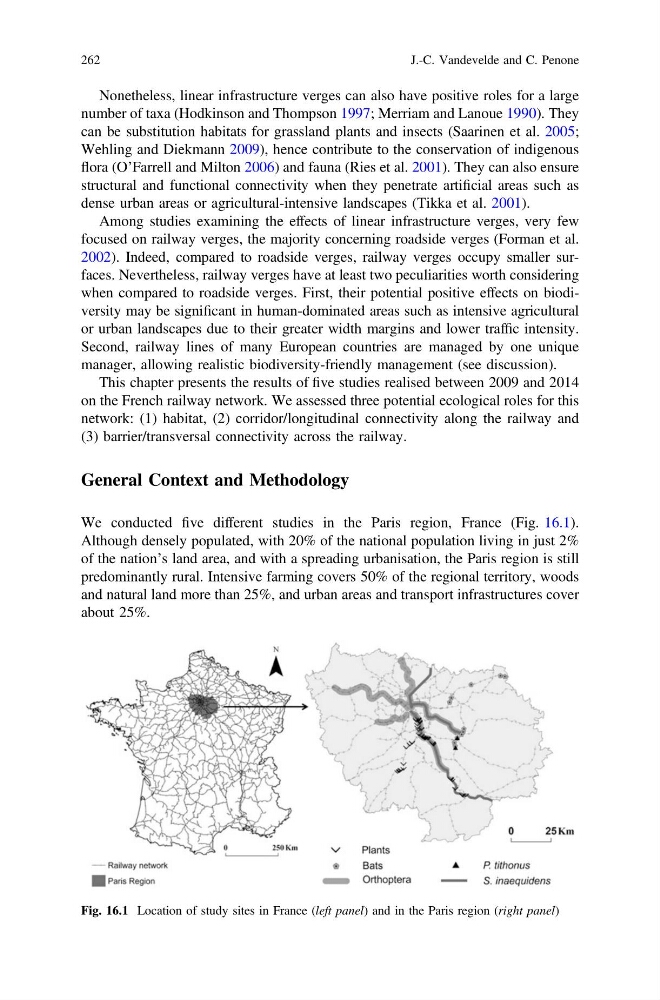
We conducted five different studies in the Paris region, France (Fig. 16.1).
Although densely populated, with 20% of the national population living in just 2%
of the nation’s land area, and with a spreading urbanisation, the Paris region is still
predominantly rural. Intensive farming covers 50% of the regional territory, woods
and natural land more than 25%, and urban areas and transport infrastructures cover
about 25%.
Fig. 16.1 Location of study sites in France (left panel) and in the Paris region (right panel)
262
J.-C. Vandevelde and C. Penone
number of taxa (Hodkinson and Thompson 1997; Merriam and Lanoue 1990). They
can be substitution habitats for grassland plants and insects (Saarinen et al. 2005;
Wehling and Diekmann 2009), hence contribute to the conservation of indigenous
flora (O’Farrell and Milton 2006) and fauna (Ries et al. 2001). They can also ensure
structural and functional connectivity when they penetrate artificial areas such as
dense urban areas or agricultural-intensive landscapes (Tikka et al. 2001).
Among studies examining the effects of linear infrastructure verges, very few
focused on railway verges, the majority concerning roadside verges (Forman et al.
2002). Indeed, compared to roadside verges, railway verges occupy smaller surfaces. Nevertheless, railway verges have at least two peculiarities worth considering
when compared to roadside verges. First, their potential positive effects on biodiversity may be significant in human-dominated areas such as intensive agricultural
or urban landscapes due to their greater width margins and lower traffic intensity.
Second, railway lines of many European countries are managed by one unique
manager, allowing realistic biodiversity-friendly management (see discussion).
This chapter presents the results of five studies realised between 2009 and 2014
on the French railway network. We assessed three potential ecological roles for this
network: (1) habitat, (2) corridor/longitudinal connectivity along the railway and
(3) barrier/transversal connectivity across the railway.
General Context and Methodology
We conducted five different studies in the Paris region, France (Fig. 16.1).
Although densely populated, with 20% of the national population living in just 2%
of the nation’s land area, and with a spreading urbanisation, the Paris region is still
predominantly rural. Intensive farming covers 50% of the regional territory, woods
and natural land more than 25%, and urban areas and transport infrastructures cover
about 25%.
Fig. 16.1 Location of study sites in France (left panel) and in the Paris region (right panel)
262
J.-C. Vandevelde and C. Penone