

(dzud) of 2009/2010 in western Mongolia (Kaczensky et al. 2011a), but no other
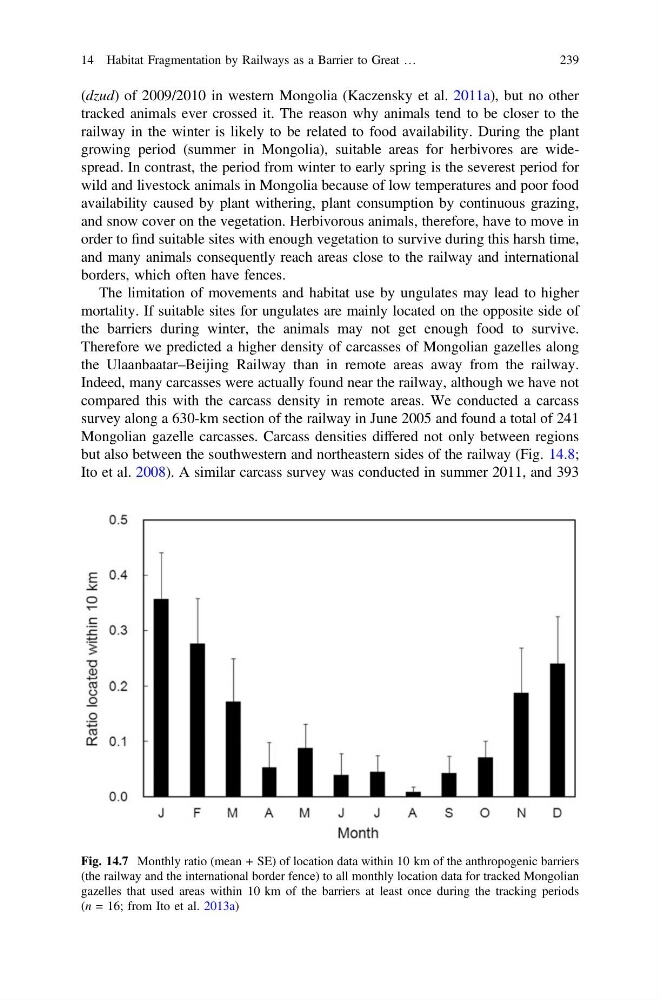
tracked animals ever crossed it. The reason why animals tend to be closer to the
railway in the winter is likely to be related to food availability. During the plant
growing period (summer in Mongolia), suitable areas for herbivores are widespread. In contrast, the period from winter to early spring is the severest period for
wild and livestock animals in Mongolia because of low temperatures and poor food
availability caused by plant withering, plant consumption by continuous grazing,
and snow cover on the vegetation. Herbivorous animals, therefore, have to move in
order to find suitable sites with enough vegetation to survive during this harsh time,
and many animals consequently reach areas close to the railway and international
borders, which often have fences.
The limitation of movements and habitat use by ungulates may lead to higher
mortality. If suitable sites for ungulates are mainly located on the opposite side of
the barriers during winter, the animals may not get enough food to survive.
Therefore we predicted a higher density of carcasses of Mongolian gazelles along
the Ulaanbaatar–Beijing Railway than in remote areas away from the railway.
Indeed, many carcasses were actually found near the railway, although we have not
compared this with the carcass density in remote areas. We conducted a carcass
survey along a 630-km section of the railway in June 2005 and found a total of 241
Mongolian gazelle carcasses. Carcass densities differed not only between regions
but also between the southwestern and northeastern sides of the railway (Fig. 14.8;
Ito et al. 2008). A similar carcass survey was conducted in summer 2011, and 393
Fig. 14.7 Monthly ratio (mean + SE) of location data within 10 km of the anthropogenic barriers
(the railway and the international border fence) to all monthly location data for tracked Mongolian
gazelles that used areas within 10 km of the barriers at least once during the tracking periods
(n = 16; from Ito et al. 2013a)
14 Habitat Fragmentation by Railways as a Barrier to Great …
239
tracked animals ever crossed it. The reason why animals tend to be closer to the
railway in the winter is likely to be related to food availability. During the plant
growing period (summer in Mongolia), suitable areas for herbivores are widespread. In contrast, the period from winter to early spring is the severest period for
wild and livestock animals in Mongolia because of low temperatures and poor food
availability caused by plant withering, plant consumption by continuous grazing,
and snow cover on the vegetation. Herbivorous animals, therefore, have to move in
order to find suitable sites with enough vegetation to survive during this harsh time,
and many animals consequently reach areas close to the railway and international
borders, which often have fences.
The limitation of movements and habitat use by ungulates may lead to higher
mortality. If suitable sites for ungulates are mainly located on the opposite side of
the barriers during winter, the animals may not get enough food to survive.
Therefore we predicted a higher density of carcasses of Mongolian gazelles along
the Ulaanbaatar–Beijing Railway than in remote areas away from the railway.
Indeed, many carcasses were actually found near the railway, although we have not
compared this with the carcass density in remote areas. We conducted a carcass
survey along a 630-km section of the railway in June 2005 and found a total of 241
Mongolian gazelle carcasses. Carcass densities differed not only between regions
but also between the southwestern and northeastern sides of the railway (Fig. 14.8;
Ito et al. 2008). A similar carcass survey was conducted in summer 2011, and 393
Fig. 14.7 Monthly ratio (mean + SE) of location data within 10 km of the anthropogenic barriers
(the railway and the international border fence) to all monthly location data for tracked Mongolian
gazelles that used areas within 10 km of the barriers at least once during the tracking periods
(n = 16; from Ito et al. 2013a)
14 Habitat Fragmentation by Railways as a Barrier to Great …
239