

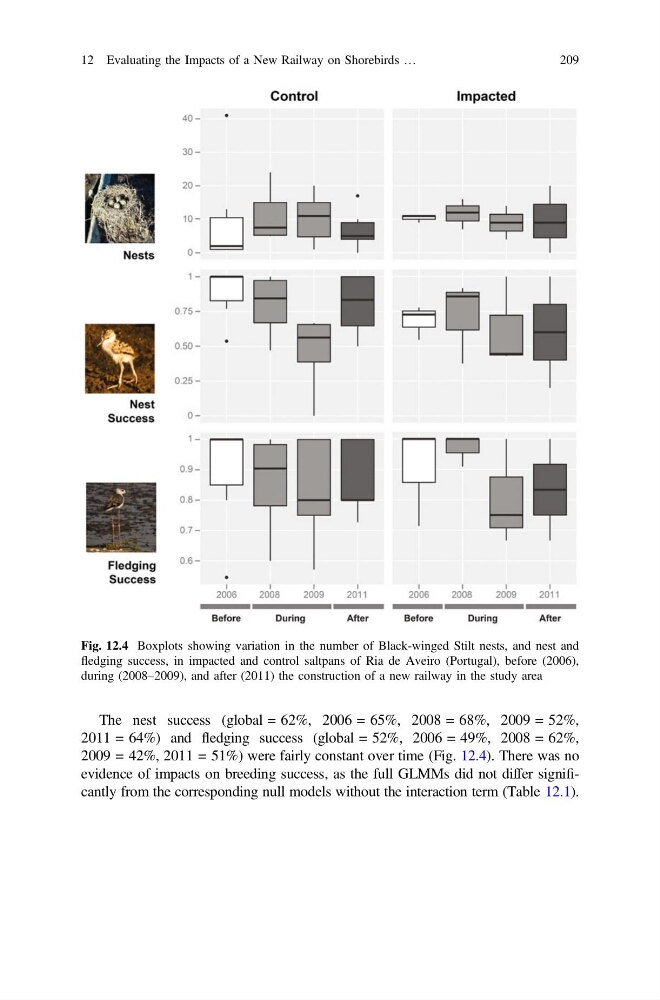
The nest success (global = 62%, 2006 = 65%, 2008 = 68%, 2009 = 52%,
2011 = 64%) and fledging success (global = 52%, 2006 = 49%, 2008 = 62%,
2009 = 42%, 2011 = 51%) were fairly constant over time (Fig. 12.4). There was no
evidence of impacts on breeding success, as the full GLMMs did not differ significantly from the corresponding null models without the interaction term (Table 12.1).
Fig. 12.4 Boxplots showing variation in the number of Black-winged Stilt nests, and nest and
fledging success, in impacted and control saltpans of Ria de Aveiro (Portugal), before (2006),
during (2008–2009), and after (2011) the construction of a new railway in the study area
12 Evaluating the Impacts of a New Railway on Shorebirds …
209
2011 = 64%) and fledging success (global = 52%, 2006 = 49%, 2008 = 62%,
2009 = 42%, 2011 = 51%) were fairly constant over time (Fig. 12.4). There was no
evidence of impacts on breeding success, as the full GLMMs did not differ significantly from the corresponding null models without the interaction term (Table 12.1).
Fig. 12.4 Boxplots showing variation in the number of Black-winged Stilt nests, and nest and
fledging success, in impacted and control saltpans of Ria de Aveiro (Portugal), before (2006),
during (2008–2009), and after (2011) the construction of a new railway in the study area
12 Evaluating the Impacts of a New Railway on Shorebirds …
209