

Black-winged Stilt, Kentish plover, and Little tern. A more detailed study was made
of the Black-winged Stilt, because it was the only species breeding on all saltpans in
reasonable numbers, and it was the only one amenable to reliable surveys while
minimizing disturbances, due to the relatively large size and conspicuousness of
nests and chicks. Therefore, besides abundance, for this species we estimated for
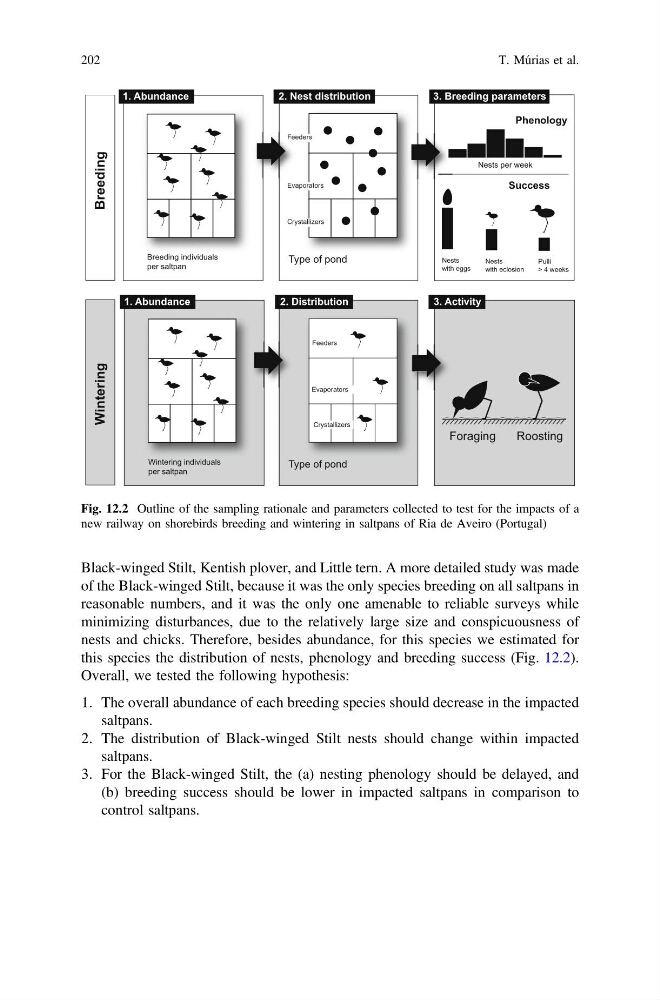
this species the distribution of nests, phenology and breeding success (Fig. 12.2).
Overall, we tested the following hypothesis:
1. The overall abundance of each breeding species should decrease in the impacted
saltpans.
2. The distribution of Black-winged Stilt nests should change within impacted
saltpans.
3. For the Black-winged Stilt, the (a) nesting phenology should be delayed, and
(b) breeding success should be lower in impacted saltpans in comparison to
control saltpans.
Nests per week
Success
Nests
with eggs
Nests
with eclosion
Pulli
> 4 weeks
Breeding individuals
per saltpan
Phenology
Type of pond
1. Abundance
2. Nest distribution
3. Breeding parameters
Feeders
Evaporators
Crystallizers
Foraging
Roosting
3. Activity
Wintering individuals
per saltpan
1. Abundance
Type of pond
Feeders
Evaporators
Crystallizers
2. Distribution
Breeding
Wintering
Fig. 12.2 Outline of the sampling rationale and parameters collected to test for the impacts of a
new railway on shorebirds breeding and wintering in saltpans of Ria de Aveiro (Portugal)
202
T. Múrias et al.
of the Black-winged Stilt, because it was the only species breeding on all saltpans in
reasonable numbers, and it was the only one amenable to reliable surveys while
minimizing disturbances, due to the relatively large size and conspicuousness of
nests and chicks. Therefore, besides abundance, for this species we estimated for
this species the distribution of nests, phenology and breeding success (Fig. 12.2).
Overall, we tested the following hypothesis:
1. The overall abundance of each breeding species should decrease in the impacted
saltpans.
2. The distribution of Black-winged Stilt nests should change within impacted
saltpans.
3. For the Black-winged Stilt, the (a) nesting phenology should be delayed, and
(b) breeding success should be lower in impacted saltpans in comparison to
control saltpans.
Nests per week
Success
Nests
with eggs
Nests
with eclosion
Pulli
> 4 weeks
Breeding individuals
per saltpan
Phenology
Type of pond
1. Abundance
2. Nest distribution
3. Breeding parameters
Feeders
Evaporators
Crystallizers
Foraging
Roosting
3. Activity
Wintering individuals
per saltpan
1. Abundance
Type of pond
Feeders
Evaporators
Crystallizers
2. Distribution
Breeding
Wintering
Fig. 12.2 Outline of the sampling rationale and parameters collected to test for the impacts of a
new railway on shorebirds breeding and wintering in saltpans of Ria de Aveiro (Portugal)
202
T. Múrias et al.