

with some of the few studies addressing the same issue (Owens 1977, and Chap. 16),
but in contrast with another study (Waterman et al. 2002).
Although our study had some limitations and potential shortcomings, it is
unlikely that they significantly affected our key conclusions. The main problem is
that no information on abundances and bird spatial distribution was available for the
period before the construction of the railway line. Because of this, it was impossible
to carry out a proper BACI study, which would be essential to fully demonstrate
whether or not there were any significant impacts (e.g. Tarr et al. 2010).
Nevertheless, our results are still useful to suggest that wetland bird abundances at
present are not lower at <500 m from the railway than elsewhere in the estuary,
though they cannot be used to make comparisons in relation to the situation before
the construction of the railway. Another problem is that our study focused only on
species richness and densities, although there might be more subtle impacts due, for
instance, to changes in vigilance and feeding activity close to the railway (e.g.
Yasué 2006). Although this issue was not dealt with in our study, non-systematic
observations of 55 individuals of 18 species did not provide any evidence that birds
are more alert close to than there are far from the railway. Finally, we considered a
relatively wide area to represent proximity to the railway (<500 m), although
exclusion effects may only be apparent at shorter distances from disturbance. This
was a constraint required to obtain sufficiently large sample sizes, but observations
during the study period suggest that this was not serious because large bird concentrations were often recorded very close to the railway.
The lack of obvious avoidance responses observed in our study may be a
consequence of wetland birds tolerating well or eventually adapting behaviourally
to human structures and vehicles such as circulating trains, and thus largely
ignoring these potential sources of disturbances when selecting foraging and
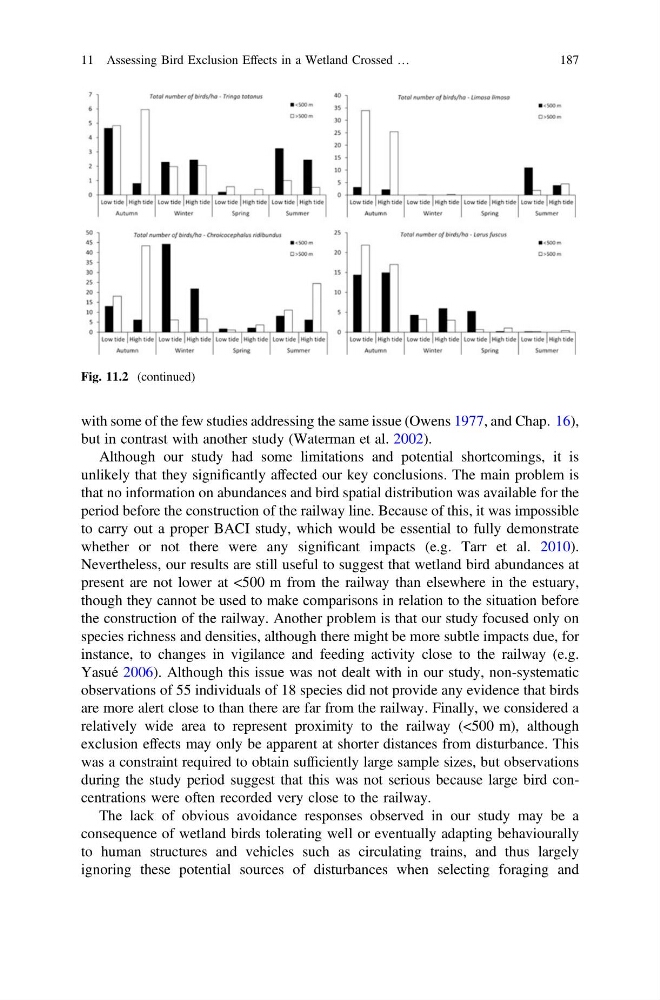
Fig. 11.2 (continued)
11 Assessing Bird Exclusion Effects in a Wetland Crossed …
187
but in contrast with another study (Waterman et al. 2002).
Although our study had some limitations and potential shortcomings, it is
unlikely that they significantly affected our key conclusions. The main problem is
that no information on abundances and bird spatial distribution was available for the
period before the construction of the railway line. Because of this, it was impossible
to carry out a proper BACI study, which would be essential to fully demonstrate
whether or not there were any significant impacts (e.g. Tarr et al. 2010).
Nevertheless, our results are still useful to suggest that wetland bird abundances at
present are not lower at <500 m from the railway than elsewhere in the estuary,
though they cannot be used to make comparisons in relation to the situation before
the construction of the railway. Another problem is that our study focused only on
species richness and densities, although there might be more subtle impacts due, for
instance, to changes in vigilance and feeding activity close to the railway (e.g.
Yasué 2006). Although this issue was not dealt with in our study, non-systematic
observations of 55 individuals of 18 species did not provide any evidence that birds
are more alert close to than there are far from the railway. Finally, we considered a
relatively wide area to represent proximity to the railway (<500 m), although
exclusion effects may only be apparent at shorter distances from disturbance. This
was a constraint required to obtain sufficiently large sample sizes, but observations
during the study period suggest that this was not serious because large bird concentrations were often recorded very close to the railway.
The lack of obvious avoidance responses observed in our study may be a
consequence of wetland birds tolerating well or eventually adapting behaviourally
to human structures and vehicles such as circulating trains, and thus largely
ignoring these potential sources of disturbances when selecting foraging and
Fig. 11.2 (continued)
11 Assessing Bird Exclusion Effects in a Wetland Crossed …
187