

On the other hand, our analysis of the flight initiation distance of different groups
of birds showed that they do not seem to respond to trains as if they were predators,
but rather human-associated elements (Møller et al. 2013; Neumann et al. 2013).
Thus, species that are more tolerant of people or even anthropophilic (e.g.,
passerines and pigeons) show flight initiation distances that are significantly shorter
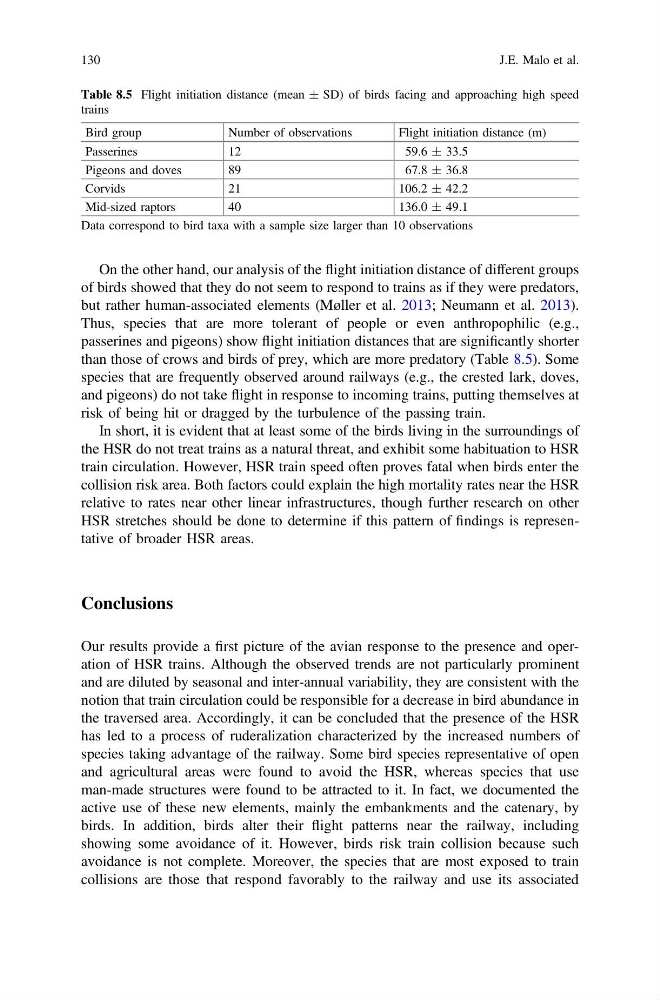
than those of crows and birds of prey, which are more predatory (Table 8.5). Some
species that are frequently observed around railways (e.g., the crested lark, doves,
and pigeons) do not take flight in response to incoming trains, putting themselves at
risk of being hit or dragged by the turbulence of the passing train.
In short, it is evident that at least some of the birds living in the surroundings of
the HSR do not treat trains as a natural threat, and exhibit some habituation to HSR
train circulation. However, HSR train speed often proves fatal when birds enter the
collision risk area. Both factors could explain the high mortality rates near the HSR
relative to rates near other linear infrastructures, though further research on other
HSR stretches should be done to determine if this pattern of findings is representative of broader HSR areas.
Conclusions
Our results provide a first picture of the avian response to the presence and operation of HSR trains. Although the observed trends are not particularly prominent
and are diluted by seasonal and inter-annual variability, they are consistent with the
notion that train circulation could be responsible for a decrease in bird abundance in
the traversed area. Accordingly, it can be concluded that the presence of the HSR
has led to a process of ruderalization characterized by the increased numbers of
species taking advantage of the railway. Some bird species representative of open
and agricultural areas were found to avoid the HSR, whereas species that use
man-made structures were found to be attracted to it. In fact, we documented the
active use of these new elements, mainly the embankments and the catenary, by
birds. In addition, birds alter their flight patterns near the railway, including
showing some avoidance of it. However, birds risk train collision because such
avoidance is not complete. Moreover, the species that are most exposed to train
collisions are those that respond favorably to the railway and use its associated
Table 8.5 Flight initiation distance (mean ± SD) of birds facing and approaching high speed
trains
Bird group
Number of observations
Flight initiation distance (m)
Passerines
12
59.6 ± 33.5
Pigeons and doves
89
67.8 ± 36.8
Corvids
21
106.2 ± 42.2
Mid-sized raptors
40
136.0 ± 49.1
Data correspond to bird taxa with a sample size larger than 10 observations
130
J.E. Malo et al.
of birds showed that they do not seem to respond to trains as if they were predators,
but rather human-associated elements (Møller et al. 2013; Neumann et al. 2013).
Thus, species that are more tolerant of people or even anthropophilic (e.g.,
passerines and pigeons) show flight initiation distances that are significantly shorter
than those of crows and birds of prey, which are more predatory (Table 8.5). Some
species that are frequently observed around railways (e.g., the crested lark, doves,
and pigeons) do not take flight in response to incoming trains, putting themselves at
risk of being hit or dragged by the turbulence of the passing train.
In short, it is evident that at least some of the birds living in the surroundings of
the HSR do not treat trains as a natural threat, and exhibit some habituation to HSR
train circulation. However, HSR train speed often proves fatal when birds enter the
collision risk area. Both factors could explain the high mortality rates near the HSR
relative to rates near other linear infrastructures, though further research on other
HSR stretches should be done to determine if this pattern of findings is representative of broader HSR areas.
Conclusions
Our results provide a first picture of the avian response to the presence and operation of HSR trains. Although the observed trends are not particularly prominent
and are diluted by seasonal and inter-annual variability, they are consistent with the
notion that train circulation could be responsible for a decrease in bird abundance in
the traversed area. Accordingly, it can be concluded that the presence of the HSR
has led to a process of ruderalization characterized by the increased numbers of
species taking advantage of the railway. Some bird species representative of open
and agricultural areas were found to avoid the HSR, whereas species that use
man-made structures were found to be attracted to it. In fact, we documented the
active use of these new elements, mainly the embankments and the catenary, by
birds. In addition, birds alter their flight patterns near the railway, including
showing some avoidance of it. However, birds risk train collision because such
avoidance is not complete. Moreover, the species that are most exposed to train
collisions are those that respond favorably to the railway and use its associated
Table 8.5 Flight initiation distance (mean ± SD) of birds facing and approaching high speed
trains
Bird group
Number of observations
Flight initiation distance (m)
Passerines
12
59.6 ± 33.5
Pigeons and doves
89
67.8 ± 36.8
Corvids
21
106.2 ± 42.2
Mid-sized raptors
40
136.0 ± 49.1
Data correspond to bird taxa with a sample size larger than 10 observations
130
J.E. Malo et al.