

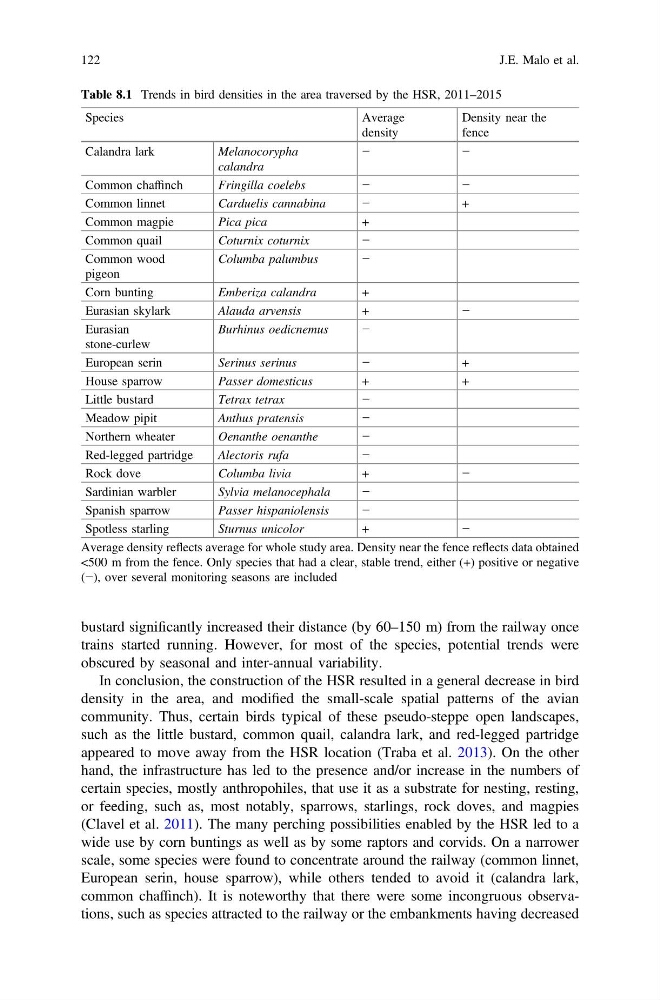
Table 8.1 Trends in bird densities in the area traversed by the HSR, 2011–2015
Species
Average
density
Density near the
fence
Calandra lark
Melanocorypha
calandra
−
−
Common chaffinch
Fringilla coelebs
−
−
Common linnet
Carduelis cannabina
−
+
Common magpie
Pica pica
+
Common quail
Coturnix coturnix
−
Common wood
pigeon
Columba palumbus
−
Corn bunting
Emberiza calandra
+
Eurasian skylark
Alauda arvensis
+
−
Eurasian
stone-curlew
Burhinus oedicnemus
−
European serin
Serinus serinus
−
+
House sparrow
Passer domesticus
+
+
Little bustard
Tetrax tetrax
−
Meadow pipit
Anthus pratensis
−
Northern wheater
Oenanthe oenanthe
−
Red-legged partridge
Alectoris rufa
−
Rock dove
Columba livia
+
−
Sardinian warbler
Sylvia melanocephala
−
Spanish sparrow
Passer hispaniolensis
−
Spotless starling
Sturnus unicolor
+
−
Average density reflects average for whole study area. Density near the fence reflects data obtained
<500 m from the fence. Only species that had a clear, stable trend, either (+) positive or negative
(−), over several monitoring seasons are included
bustard significantly increased their distance (by 60–150 m) from the railway once
trains started running. However, for most of the species, potential trends were
obscured by seasonal and inter-annual variability.
In conclusion, the construction of the HSR resulted in a general decrease in bird
density in the area, and modified the small-scale spatial patterns of the avian
community. Thus, certain birds typical of these pseudo-steppe open landscapes,
such as the little bustard, common quail, calandra lark, and red-legged partridge
appeared to move away from the HSR location (Traba et al. 2013). On the other
hand, the infrastructure has led to the presence and/or increase in the numbers of
certain species, mostly anthropohiles, that use it as a substrate for nesting, resting,
or feeding, such as, most notably, sparrows, starlings, rock doves, and magpies
(Clavel et al. 2011). The many perching possibilities enabled by the HSR led to a
wide use by corn buntings as well as by some raptors and corvids. On a narrower
scale, some species were found to concentrate around the railway (common linnet,
European serin, house sparrow), while others tended to avoid it (calandra lark,
common chaffinch). It is noteworthy that there were some incongruous observations, such as species attracted to the railway or the embankments having decreased
122
J.E. Malo et al.
Species
Average
density
Density near the
fence
Calandra lark
Melanocorypha
calandra
−
−
Common chaffinch
Fringilla coelebs
−
−
Common linnet
Carduelis cannabina
−
+
Common magpie
Pica pica
+
Common quail
Coturnix coturnix
−
Common wood
pigeon
Columba palumbus
−
Corn bunting
Emberiza calandra
+
Eurasian skylark
Alauda arvensis
+
−
Eurasian
stone-curlew
Burhinus oedicnemus
−
European serin
Serinus serinus
−
+
House sparrow
Passer domesticus
+
+
Little bustard
Tetrax tetrax
−
Meadow pipit
Anthus pratensis
−
Northern wheater
Oenanthe oenanthe
−
Red-legged partridge
Alectoris rufa
−
Rock dove
Columba livia
+
−
Sardinian warbler
Sylvia melanocephala
−
Spanish sparrow
Passer hispaniolensis
−
Spotless starling
Sturnus unicolor
+
−
Average density reflects average for whole study area. Density near the fence reflects data obtained
<500 m from the fence. Only species that had a clear, stable trend, either (+) positive or negative
(−), over several monitoring seasons are included
bustard significantly increased their distance (by 60–150 m) from the railway once
trains started running. However, for most of the species, potential trends were
obscured by seasonal and inter-annual variability.
In conclusion, the construction of the HSR resulted in a general decrease in bird
density in the area, and modified the small-scale spatial patterns of the avian
community. Thus, certain birds typical of these pseudo-steppe open landscapes,
such as the little bustard, common quail, calandra lark, and red-legged partridge
appeared to move away from the HSR location (Traba et al. 2013). On the other
hand, the infrastructure has led to the presence and/or increase in the numbers of
certain species, mostly anthropohiles, that use it as a substrate for nesting, resting,
or feeding, such as, most notably, sparrows, starlings, rock doves, and magpies
(Clavel et al. 2011). The many perching possibilities enabled by the HSR led to a
wide use by corn buntings as well as by some raptors and corvids. On a narrower
scale, some species were found to concentrate around the railway (common linnet,
European serin, house sparrow), while others tended to avoid it (calandra lark,
common chaffinch). It is noteworthy that there were some incongruous observations, such as species attracted to the railway or the embankments having decreased
122
J.E. Malo et al.