

Most of the birds (94.6%) were found in Section 1, where we recorded 5.89
birds/km/10 survey days, while in Sections 2 and 3 we recorded 0.43
birds/km/10 days and 0.40 birds/km/10 days, respectively (Table 7.1). Within
Section 1, we found 76.4% of the birds in the two sectors crossing the Sado River
(n = 59) and the São Martinho stream (n = 9) (Table 7.1). These two sectors were
responsible for all mortality of strictly aquatic species, and for 80% of the white
storks killed. Most bird mortality was recorded in the autumn (37.2%) and winter
(33.0%), with much lower values in the spring (16.0%) and summer (13.8%). The
group of aquatic birds and white stork were recorded in each season except winter.
Bridge Crossing by Birds
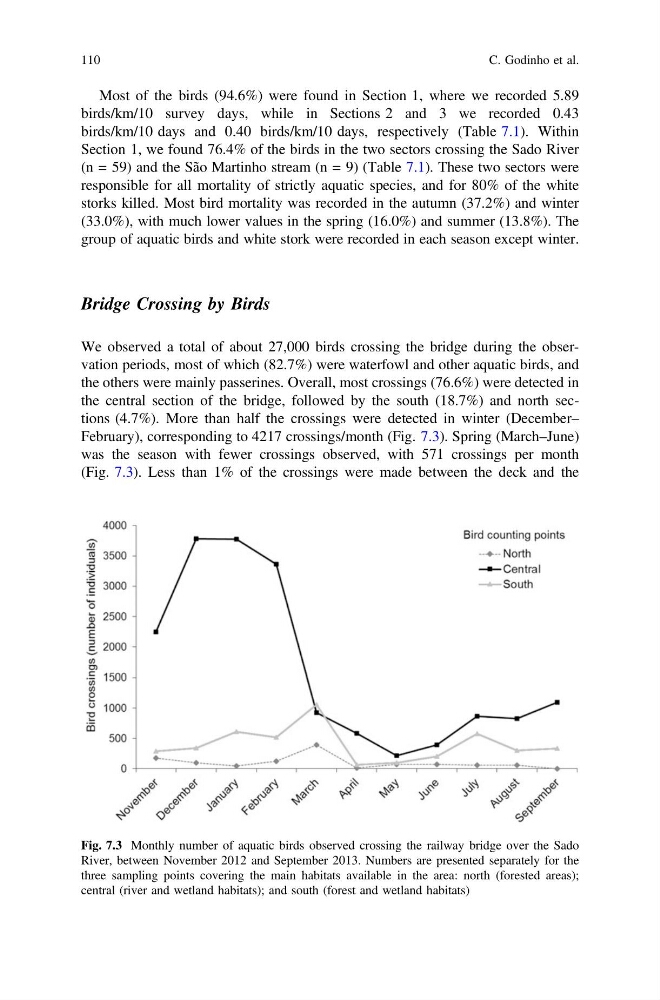
We observed a total of about 27,000 birds crossing the bridge during the observation periods, most of which (82.7%) were waterfowl and other aquatic birds, and
the others were mainly passerines. Overall, most crossings (76.6%) were detected in
the central section of the bridge, followed by the south (18.7%) and north sections (4.7%). More than half the crossings were detected in winter (December–
February), corresponding to 4217 crossings/month (Fig. 7.3). Spring (March–June)
was the season with fewer crossings observed, with 571 crossings per month
(Fig. 7.3). Less than 1% of the crossings were made between the deck and the
Fig. 7.3 Monthly number of aquatic birds observed crossing the railway bridge over the Sado
River, between November 2012 and September 2013. Numbers are presented separately for the
three sampling points covering the main habitats available in the area: north (forested areas);
central (river and wetland habitats); and south (forest and wetland habitats)
110
C. Godinho et al.
birds/km/10 survey days, while in Sections 2 and 3 we recorded 0.43
birds/km/10 days and 0.40 birds/km/10 days, respectively (Table 7.1). Within
Section 1, we found 76.4% of the birds in the two sectors crossing the Sado River
(n = 59) and the São Martinho stream (n = 9) (Table 7.1). These two sectors were
responsible for all mortality of strictly aquatic species, and for 80% of the white
storks killed. Most bird mortality was recorded in the autumn (37.2%) and winter
(33.0%), with much lower values in the spring (16.0%) and summer (13.8%). The
group of aquatic birds and white stork were recorded in each season except winter.
Bridge Crossing by Birds
We observed a total of about 27,000 birds crossing the bridge during the observation periods, most of which (82.7%) were waterfowl and other aquatic birds, and
the others were mainly passerines. Overall, most crossings (76.6%) were detected in
the central section of the bridge, followed by the south (18.7%) and north sections (4.7%). More than half the crossings were detected in winter (December–
February), corresponding to 4217 crossings/month (Fig. 7.3). Spring (March–June)
was the season with fewer crossings observed, with 571 crossings per month
(Fig. 7.3). Less than 1% of the crossings were made between the deck and the
Fig. 7.3 Monthly number of aquatic birds observed crossing the railway bridge over the Sado
River, between November 2012 and September 2013. Numbers are presented separately for the
three sampling points covering the main habitats available in the area: north (forested areas);
central (river and wetland habitats); and south (forest and wetland habitats)
110
C. Godinho et al.