

negative effects on biodiversity, the effectiveness has not yet been evaluated for a
few other measures. Here, we describe the commonly used measures to reduce or
minimize the impacts of railway disturbance for noise and vibration effects, and soil
pollution and erosion that are found in the literature.
Noise and Vibration
In general, there are two approaches to minimizing rail traffic noise and vibration:
(1) reduce the noise at the source, and (2) reduce its propagation (Lakušić and Ahac
2012; Tiwari et al. 2013). The reduction of noise levels can be achieved by
decreasing the speed of rail vehicles and reducing the intensity of the radiated sound
through regular maintenance in order to keep smooth rails and wheels (Lakušić and
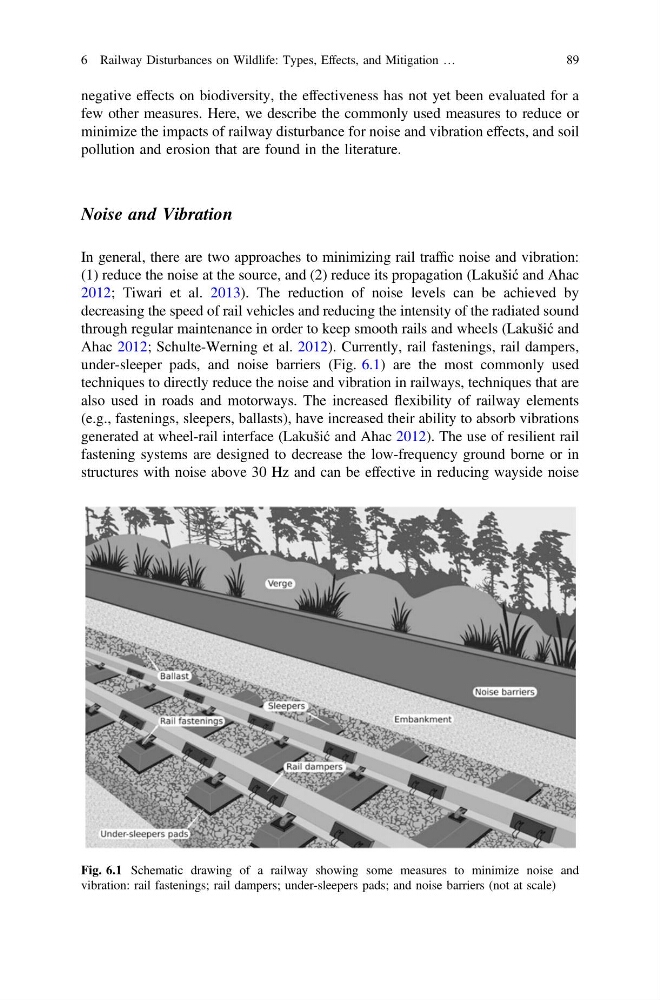
Ahac 2012; Schulte-Werning et al. 2012). Currently, rail fastenings, rail dampers,
under-sleeper pads, and noise barriers (Fig. 6.1) are the most commonly used
techniques to directly reduce the noise and vibration in railways, techniques that are
also used in roads and motorways. The increased flexibility of railway elements
(e.g., fastenings, sleepers, ballasts), have increased their ability to absorb vibrations
generated at wheel-rail interface (Lakušić and Ahac 2012). The use of resilient rail
fastening systems are designed to decrease the low-frequency ground borne or in
structures with noise above 30 Hz and can be effective in reducing wayside noise
Fig. 6.1 Schematic drawing of a railway showing some measures to minimize noise and
vibration: rail fastenings; rail dampers; under-sleepers pads; and noise barriers (not at scale)
6 Railway Disturbances on Wildlife: Types, Effects, and Mitigation …
89
few other measures. Here, we describe the commonly used measures to reduce or
minimize the impacts of railway disturbance for noise and vibration effects, and soil
pollution and erosion that are found in the literature.
Noise and Vibration
In general, there are two approaches to minimizing rail traffic noise and vibration:
(1) reduce the noise at the source, and (2) reduce its propagation (Lakušić and Ahac
2012; Tiwari et al. 2013). The reduction of noise levels can be achieved by
decreasing the speed of rail vehicles and reducing the intensity of the radiated sound
through regular maintenance in order to keep smooth rails and wheels (Lakušić and
Ahac 2012; Schulte-Werning et al. 2012). Currently, rail fastenings, rail dampers,
under-sleeper pads, and noise barriers (Fig. 6.1) are the most commonly used
techniques to directly reduce the noise and vibration in railways, techniques that are
also used in roads and motorways. The increased flexibility of railway elements
(e.g., fastenings, sleepers, ballasts), have increased their ability to absorb vibrations
generated at wheel-rail interface (Lakušić and Ahac 2012). The use of resilient rail
fastening systems are designed to decrease the low-frequency ground borne or in
structures with noise above 30 Hz and can be effective in reducing wayside noise
Fig. 6.1 Schematic drawing of a railway showing some measures to minimize noise and
vibration: rail fastenings; rail dampers; under-sleepers pads; and noise barriers (not at scale)
6 Railway Disturbances on Wildlife: Types, Effects, and Mitigation …
89