

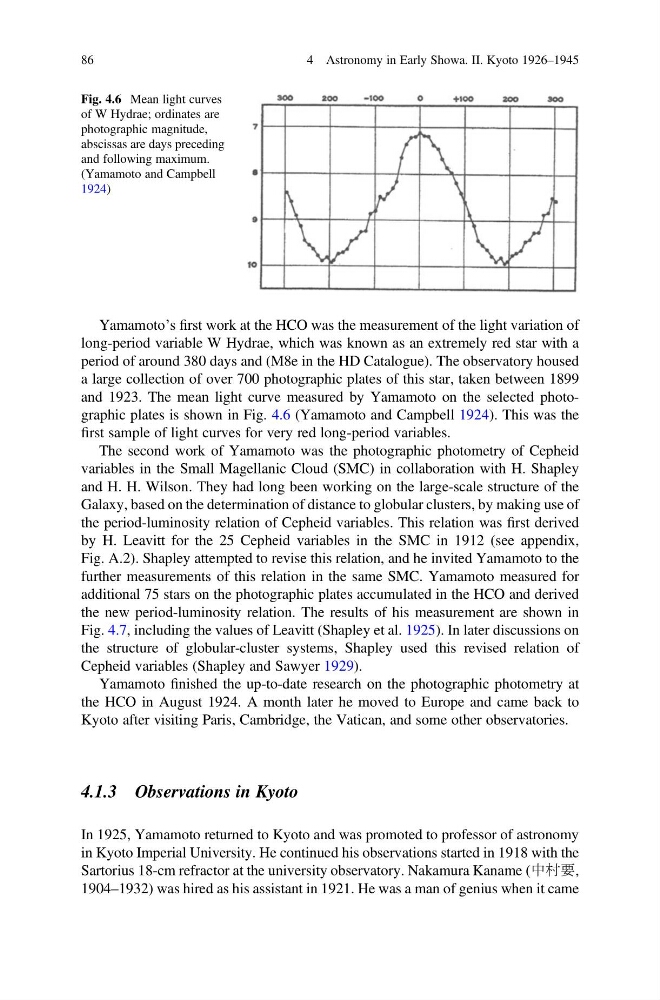
Yamamoto’s first work at the HCO was the measurement of the light variation of
long-period variable W Hydrae, which was known as an extremely red star with a
period of around 380 days and (M8e in the HD Catalogue). The observatory housed
a large collection of over 700 photographic plates of this star, taken between 1899
and 1923. The mean light curve measured by Yamamoto on the selected photographic plates is shown in Fig. 4.6 (Yamamoto and Campbell 1924). This was the
first sample of light curves for very red long-period variables.
The second work of Yamamoto was the photographic photometry of Cepheid
variables in the Small Magellanic Cloud (SMC) in collaboration with H. Shapley
and H. H. Wilson. They had long been working on the large-scale structure of the
Galaxy, based on the determination of distance to globular clusters, by making use of
the period-luminosity relation of Cepheid variables. This relation was first derived
by H. Leavitt for the 25 Cepheid variables in the SMC in 1912 (see appendix,
Fig. A.2). Shapley attempted to revise this relation, and he invited Yamamoto to the
further measurements of this relation in the same SMC. Yamamoto measured for
additional 75 stars on the photographic plates accumulated in the HCO and derived
the new period-luminosity relation. The results of his measurement are shown in
Fig. 4.7, including the values of Leavitt (Shapley et al. 1925). In later discussions on
the structure of globular-cluster systems, Shapley used this revised relation of
Cepheid variables (Shapley and Sawyer 1929).
Yamamoto finished the up-to-date research on the photographic photometry at
the HCO in August 1924. A month later he moved to Europe and came back to
Kyoto after visiting Paris, Cambridge, the Vatican, and some other observatories.
4.1.3 Observations in Kyoto
In 1925, Yamamoto returned to Kyoto and was promoted to professor of astronomy
in Kyoto Imperial University. He continued his observations started in 1918 with the
Sartorius 18-cm refractor at the university observatory. Nakamura Kaname (中村要,
1904–1932) was hired as his assistant in 1921. He was a man of genius when it came
Fig. 4.6 Mean light curves
of W Hydrae; ordinates are
photographic magnitude,
abscissas are days preceding
and following maximum.
(Yamamoto and Campbell
1924)
86
4 Astronomy in Early Showa. II. Kyoto 1926–1945
long-period variable W Hydrae, which was known as an extremely red star with a
period of around 380 days and (M8e in the HD Catalogue). The observatory housed
a large collection of over 700 photographic plates of this star, taken between 1899
and 1923. The mean light curve measured by Yamamoto on the selected photographic plates is shown in Fig. 4.6 (Yamamoto and Campbell 1924). This was the
first sample of light curves for very red long-period variables.
The second work of Yamamoto was the photographic photometry of Cepheid
variables in the Small Magellanic Cloud (SMC) in collaboration with H. Shapley
and H. H. Wilson. They had long been working on the large-scale structure of the
Galaxy, based on the determination of distance to globular clusters, by making use of
the period-luminosity relation of Cepheid variables. This relation was first derived
by H. Leavitt for the 25 Cepheid variables in the SMC in 1912 (see appendix,
Fig. A.2). Shapley attempted to revise this relation, and he invited Yamamoto to the
further measurements of this relation in the same SMC. Yamamoto measured for
additional 75 stars on the photographic plates accumulated in the HCO and derived
the new period-luminosity relation. The results of his measurement are shown in
Fig. 4.7, including the values of Leavitt (Shapley et al. 1925). In later discussions on
the structure of globular-cluster systems, Shapley used this revised relation of
Cepheid variables (Shapley and Sawyer 1929).
Yamamoto finished the up-to-date research on the photographic photometry at
the HCO in August 1924. A month later he moved to Europe and came back to
Kyoto after visiting Paris, Cambridge, the Vatican, and some other observatories.
4.1.3 Observations in Kyoto
In 1925, Yamamoto returned to Kyoto and was promoted to professor of astronomy
in Kyoto Imperial University. He continued his observations started in 1918 with the
Sartorius 18-cm refractor at the university observatory. Nakamura Kaname (中村要,
1904–1932) was hired as his assistant in 1921. He was a man of genius when it came
Fig. 4.6 Mean light curves
of W Hydrae; ordinates are
photographic magnitude,
abscissas are days preceding
and following maximum.
(Yamamoto and Campbell
1924)
86
4 Astronomy in Early Showa. II. Kyoto 1926–1945