

successively observed the novae in Gemini (1913) and in Lacerta (1914). After
being appointed research assistant in the Department of Physics in 1914, he spent
2 years at the International Latitude Observatory, Mizusawa, studying positional
astronomy. Thereafter he concentrated his work in Kyoto on the observations of
variable stars. For photometric observations he used the unaided eye and binoculars,
while for spectroscopic observations, he used an objective prism with a 13
apex
attached to the Sartorius 18-cm refractor at the Kyoto University Observatory.
On June 9, 1918, a solar eclipse occurred at Torishima (鳥島, St. Peter’s Island)
in the Northwest Pacific Ocean. Although the eclipse was obstructed by clouds,
Yamamoto discovered by chance a new star (Nova Aquilae No. 3) during the night
of June 11. From that time he and his group conducted ongoing observations of this
nova until December 7, 1918 (Yamamoto et al. 1919, Yamamoto 1919b). The light
curve and some of the spectrograms are shown in Figs. 4.2 and 4.3. Yamamoto
noticed that this nova declined rather rapidly and entered swiftly to the nebular stage,
showing broad emission lines, in early July, as shown in Fig. 4.3.
Based on his observations of several novae, Yamamoto summarized the general
properties of nova phenomena as follows (Yamamoto 1919a):
(a) After the maximum light, novae rapidly decline with periodic fluctuations to
some degree in the light curves and gradually return to being original faint stars.
(b) In the spectroscopic variations of novae, some regularity can be seen in the order
from a B-type star at the light maximum to an F-type in the declining phase, and
then to the phase of emission-line stars.
(c) Emission lines generally demonstrate juxtapositions of bright and dark components in the red and violet sides, respectively. This indicates the existence of
expanding atmospheres around the novae.
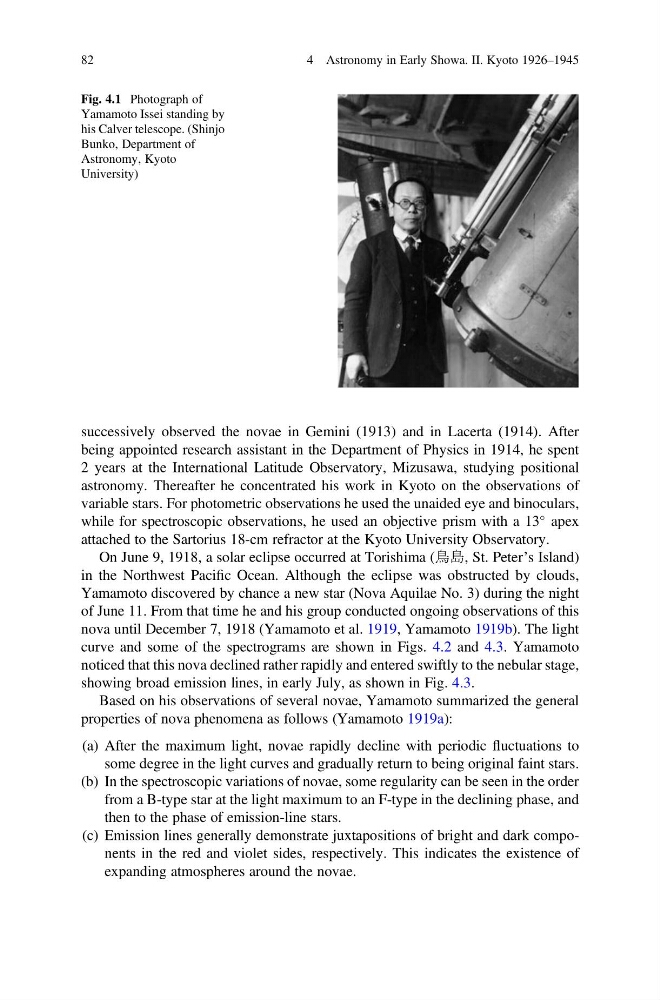
Fig. 4.1 Photograph of
Yamamoto Issei standing by
his Calver telescope. (Shinjo
Bunko, Department of
Astronomy, Kyoto
University)
82
4 Astronomy in Early Showa. II. Kyoto 1926–1945
being appointed research assistant in the Department of Physics in 1914, he spent
2 years at the International Latitude Observatory, Mizusawa, studying positional
astronomy. Thereafter he concentrated his work in Kyoto on the observations of
variable stars. For photometric observations he used the unaided eye and binoculars,
while for spectroscopic observations, he used an objective prism with a 13
apex
attached to the Sartorius 18-cm refractor at the Kyoto University Observatory.
On June 9, 1918, a solar eclipse occurred at Torishima (鳥島, St. Peter’s Island)
in the Northwest Pacific Ocean. Although the eclipse was obstructed by clouds,
Yamamoto discovered by chance a new star (Nova Aquilae No. 3) during the night
of June 11. From that time he and his group conducted ongoing observations of this
nova until December 7, 1918 (Yamamoto et al. 1919, Yamamoto 1919b). The light
curve and some of the spectrograms are shown in Figs. 4.2 and 4.3. Yamamoto
noticed that this nova declined rather rapidly and entered swiftly to the nebular stage,
showing broad emission lines, in early July, as shown in Fig. 4.3.
Based on his observations of several novae, Yamamoto summarized the general
properties of nova phenomena as follows (Yamamoto 1919a):
(a) After the maximum light, novae rapidly decline with periodic fluctuations to
some degree in the light curves and gradually return to being original faint stars.
(b) In the spectroscopic variations of novae, some regularity can be seen in the order
from a B-type star at the light maximum to an F-type in the declining phase, and
then to the phase of emission-line stars.
(c) Emission lines generally demonstrate juxtapositions of bright and dark components in the red and violet sides, respectively. This indicates the existence of
expanding atmospheres around the novae.
Fig. 4.1 Photograph of
Yamamoto Issei standing by
his Calver telescope. (Shinjo
Bunko, Department of
Astronomy, Kyoto
University)
82
4 Astronomy in Early Showa. II. Kyoto 1926–1945