

axes are nearly parallel to each other extending from the second to fourth quadrants,
as seen in Fig. 3.13. Higher-velocity stars indicate a larger-velocity ellipsoid with a
higher mean motion with respect to the Sun, and the ellipsoids extend toward the
third quadrant.
Kaburagi thus demonstrated that the velocity distribution of stars in the solar
vicinity had remarkable asymmetries, which may be related to the structure of the
Galaxy.
3.7 Osawa Kiyoteru and Stellar Physics
3.7.1 Life and Works
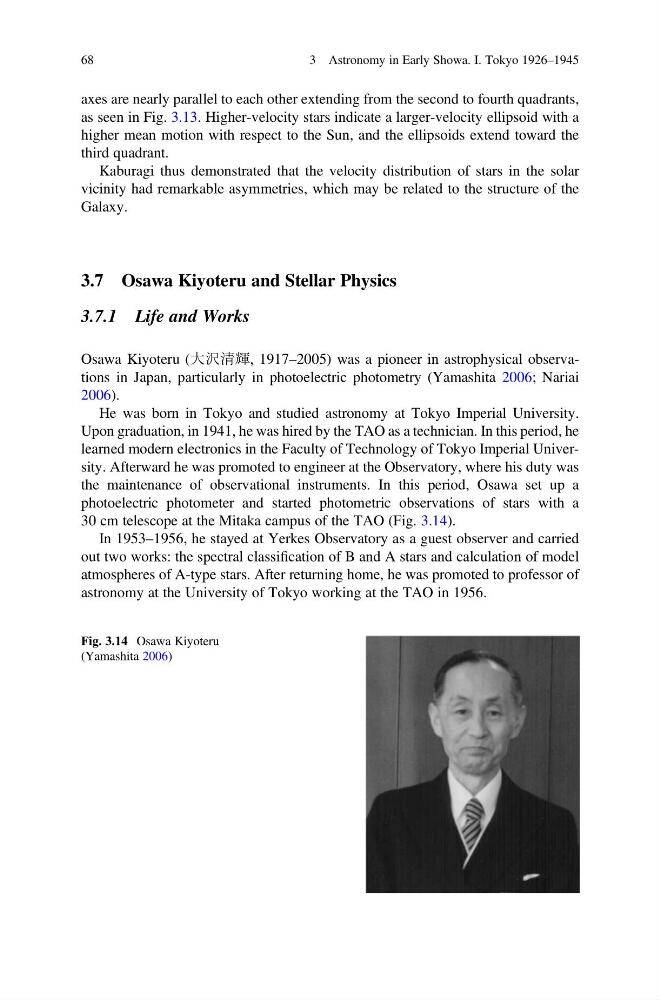
Osawa Kiyoteru (大沢清輝, 1917–2005) was a pioneer in astrophysical observations in Japan, particularly in photoelectric photometry (Yamashita 2006; Nariai
2006).
He was born in Tokyo and studied astronomy at Tokyo Imperial University.
Upon graduation, in 1941, he was hired by the TAO as a technician. In this period, he
learned modern electronics in the Faculty of Technology of Tokyo Imperial University. Afterward he was promoted to engineer at the Observatory, where his duty was
the maintenance of observational instruments. In this period, Osawa set up a
photoelectric photometer and started photometric observations of stars with a
30 cm telescope at the Mitaka campus of the TAO (Fig. 3.14).
In 1953–1956, he stayed at Yerkes Observatory as a guest observer and carried
out two works: the spectral classification of B and A stars and calculation of model
atmospheres of A-type stars. After returning home, he was promoted to professor of
astronomy at the University of Tokyo working at the TAO in 1956.
Fig. 3.14 Osawa Kiyoteru
(Yamashita 2006)
68
3 Astronomy in Early Showa. I. Tokyo 1926–1945
as seen in Fig. 3.13. Higher-velocity stars indicate a larger-velocity ellipsoid with a
higher mean motion with respect to the Sun, and the ellipsoids extend toward the
third quadrant.
Kaburagi thus demonstrated that the velocity distribution of stars in the solar
vicinity had remarkable asymmetries, which may be related to the structure of the
Galaxy.
3.7 Osawa Kiyoteru and Stellar Physics
3.7.1 Life and Works
Osawa Kiyoteru (大沢清輝, 1917–2005) was a pioneer in astrophysical observations in Japan, particularly in photoelectric photometry (Yamashita 2006; Nariai
2006).
He was born in Tokyo and studied astronomy at Tokyo Imperial University.
Upon graduation, in 1941, he was hired by the TAO as a technician. In this period, he
learned modern electronics in the Faculty of Technology of Tokyo Imperial University. Afterward he was promoted to engineer at the Observatory, where his duty was
the maintenance of observational instruments. In this period, Osawa set up a
photoelectric photometer and started photometric observations of stars with a
30 cm telescope at the Mitaka campus of the TAO (Fig. 3.14).
In 1953–1956, he stayed at Yerkes Observatory as a guest observer and carried
out two works: the spectral classification of B and A stars and calculation of model
atmospheres of A-type stars. After returning home, he was promoted to professor of
astronomy at the University of Tokyo working at the TAO in 1956.
Fig. 3.14 Osawa Kiyoteru
(Yamashita 2006)
68
3 Astronomy in Early Showa. I. Tokyo 1926–1945