

(d) Massive stars evolved much faster than in Schwarzschild and Spitzer’s case,
accompanying the production of heavy elements during their later stage of
evolution, and those massive stars ended up as white dwarfs.
(e) The enrichment of heavy metals in the interstellar medium is the result of heavy
metals ejected from massive stars mixed with primordial interstellar matter.
(f) Population I stars were formed from the mixed interstellar matter.
(g) As a consequence, a galaxy is composed of four types of objects: interstellar
matter, Population I and II stars, and white dwarfs.
3.4.4.2 Evolution of Galaxies
Galaxies are generally classified by Hubble type as elliptical (E) to spiral (S), barred
spiral (SB), and irregular (Ir).
Hatanaka and his group considered the formation of galaxies in the Hubble
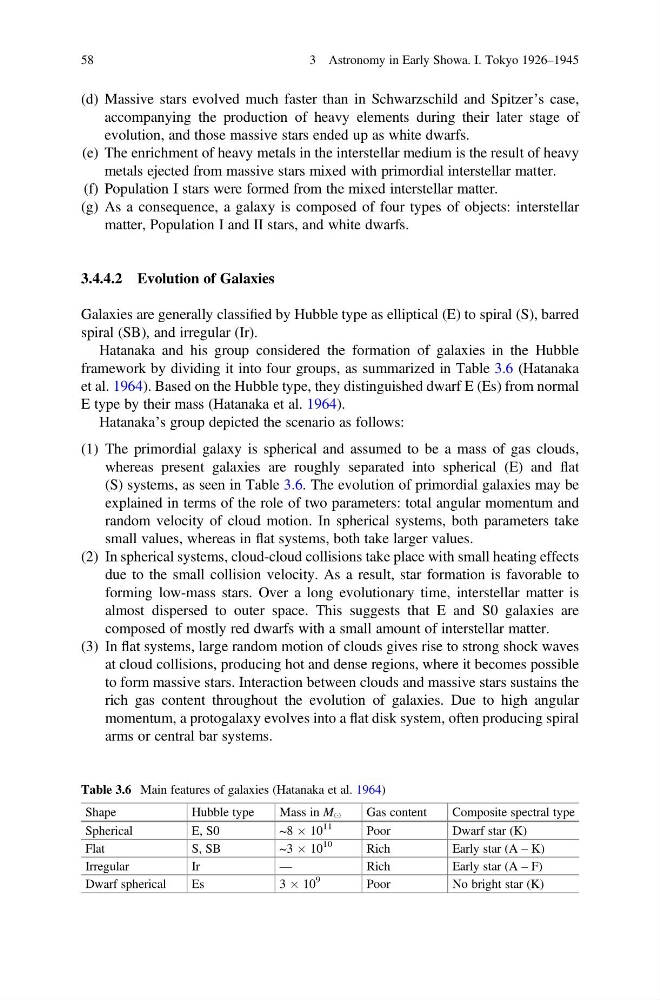
framework by dividing it into four groups, as summarized in Table 3.6 (Hatanaka
et al. 1964). Based on the Hubble type, they distinguished dwarf E (Es) from normal
E type by their mass (Hatanaka et al. 1964).
Hatanaka’s group depicted the scenario as follows:
(1) The primordial galaxy is spherical and assumed to be a mass of gas clouds,
whereas present galaxies are roughly separated into spherical (E) and flat
(S) systems, as seen in Table 3.6. The evolution of primordial galaxies may be
explained in terms of the role of two parameters: total angular momentum and
random velocity of cloud motion. In spherical systems, both parameters take
small values, whereas in flat systems, both take larger values.
(2) In spherical systems, cloud-cloud collisions take place with small heating effects
due to the small collision velocity. As a result, star formation is favorable to
forming low-mass stars. Over a long evolutionary time, interstellar matter is
almost dispersed to outer space. This suggests that E and S0 galaxies are
composed of mostly red dwarfs with a small amount of interstellar matter.
(3) In flat systems, large random motion of clouds gives rise to strong shock waves
at cloud collisions, producing hot and dense regions, where it becomes possible
to form massive stars. Interaction between clouds and massive stars sustains the
rich gas content throughout the evolution of galaxies. Due to high angular
momentum, a protogalaxy evolves into a flat disk system, often producing spiral
arms or central bar systems.
Table 3.6 Main features of galaxies (Hatanaka et al. 1964)
Shape
Hubble type
Mass in M ☉
Gas content
Composite spectral type
Spherical
E, S0
~8 Â 10
11
Poor
Dwarf star (K)
Flat
S, SB
~3 Â 10
10
Rich
Early star (A – K)
Irregular
Ir
—
Rich
Early star (A – F)
Dwarf spherical
Es
3 Â 10
9
Poor
No bright star (K)
58
3 Astronomy in Early Showa. I. Tokyo 1926–1945
accompanying the production of heavy elements during their later stage of
evolution, and those massive stars ended up as white dwarfs.
(e) The enrichment of heavy metals in the interstellar medium is the result of heavy
metals ejected from massive stars mixed with primordial interstellar matter.
(f) Population I stars were formed from the mixed interstellar matter.
(g) As a consequence, a galaxy is composed of four types of objects: interstellar
matter, Population I and II stars, and white dwarfs.
3.4.4.2 Evolution of Galaxies
Galaxies are generally classified by Hubble type as elliptical (E) to spiral (S), barred
spiral (SB), and irregular (Ir).
Hatanaka and his group considered the formation of galaxies in the Hubble
framework by dividing it into four groups, as summarized in Table 3.6 (Hatanaka
et al. 1964). Based on the Hubble type, they distinguished dwarf E (Es) from normal
E type by their mass (Hatanaka et al. 1964).
Hatanaka’s group depicted the scenario as follows:
(1) The primordial galaxy is spherical and assumed to be a mass of gas clouds,
whereas present galaxies are roughly separated into spherical (E) and flat
(S) systems, as seen in Table 3.6. The evolution of primordial galaxies may be
explained in terms of the role of two parameters: total angular momentum and
random velocity of cloud motion. In spherical systems, both parameters take
small values, whereas in flat systems, both take larger values.
(2) In spherical systems, cloud-cloud collisions take place with small heating effects
due to the small collision velocity. As a result, star formation is favorable to
forming low-mass stars. Over a long evolutionary time, interstellar matter is
almost dispersed to outer space. This suggests that E and S0 galaxies are
composed of mostly red dwarfs with a small amount of interstellar matter.
(3) In flat systems, large random motion of clouds gives rise to strong shock waves
at cloud collisions, producing hot and dense regions, where it becomes possible
to form massive stars. Interaction between clouds and massive stars sustains the
rich gas content throughout the evolution of galaxies. Due to high angular
momentum, a protogalaxy evolves into a flat disk system, often producing spiral
arms or central bar systems.
Table 3.6 Main features of galaxies (Hatanaka et al. 1964)
Shape
Hubble type
Mass in M ☉
Gas content
Composite spectral type
Spherical
E, S0
~8 Â 10
11
Poor
Dwarf star (K)
Flat
S, SB
~3 Â 10
10
Rich
Early star (A – K)
Irregular
Ir
—
Rich
Early star (A – F)
Dwarf spherical
Es
3 Â 10
9
Poor
No bright star (K)
58
3 Astronomy in Early Showa. I. Tokyo 1926–1945