

2.5.2 Study of Astrophysics at Yerkes Observatory
In September 1905, Ichinohe arrived at Yerkes Observatory. Edwin Brant Frost
(1868–1935), its second director after G. E. Hale, welcomed the first young astronomer from Japan. He recognized that Ichinohe had no training in astrophysical
observations, so Frost set up two research programs for Ichinohe to pursue at the
Yerkes Observatory.
The first was photometric observations of the long-period variable star Omicron
Ceti (o Ceti) (named Mira, Latin for wonderful or astonishing, by Johannes
Hevelius in his 1662 work Historiola Mirae Stellae). He observed Mira using the
finder of a 30-cm refractor, opera glass, and the naked eye. Standard stars were
selected from the Bonn Photographic Catalogue and the Photometric Catalogue of
the Harvard College Observatory. The result of his observations is shown in
Fig. 2.15, where epoch of maximum light in December 1906 and somewhat irregular
light curve are indicated (Ichinohe 1907a). From 1906 to 1907, he observed seven
other variable stars and derived their light curves.
The second research project assigned to Ichinohe was the spectroscopic analysis
of close binaries (Ichinohe 1907b). He analyzed spectrograms obtained with a
101-cm refractor for three stars in the constellations Sagittarius, Cancer, and
Virgo, all showing marked absorption lines in hydrogen, helium, and ionized
calcium. Among them, Fig. 2.16 illustrates the radial velocity curve of μ Sagittae.
Based on this curve, Ichinohe derived the orbital elements: orbital period 180.2 days,
orbital eccentricity 0.441, and total mass of primary and its companion 13.5 M ⦿ /
sin
3 i, where M ⦿ and i denote the solar mass and the angle of orbital inclination,
respectively.
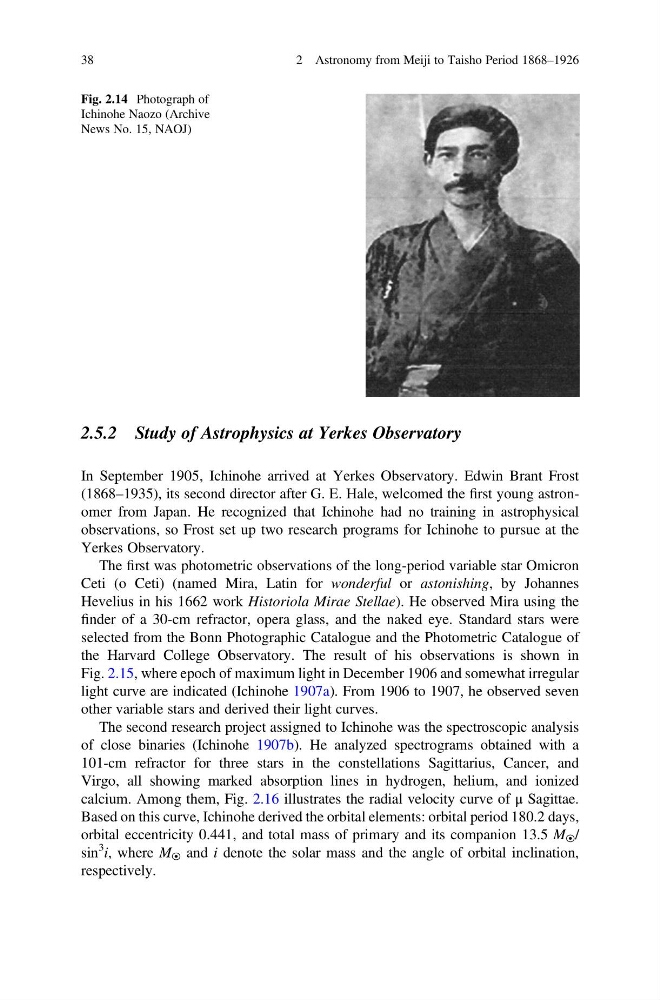
Fig. 2.14 Photograph of
Ichinohe Naozo (Archive
News No. 15, NAOJ)
38
2 Astronomy from Meiji to Taisho Period 1868–1926
In September 1905, Ichinohe arrived at Yerkes Observatory. Edwin Brant Frost
(1868–1935), its second director after G. E. Hale, welcomed the first young astronomer from Japan. He recognized that Ichinohe had no training in astrophysical
observations, so Frost set up two research programs for Ichinohe to pursue at the
Yerkes Observatory.
The first was photometric observations of the long-period variable star Omicron
Ceti (o Ceti) (named Mira, Latin for wonderful or astonishing, by Johannes
Hevelius in his 1662 work Historiola Mirae Stellae). He observed Mira using the
finder of a 30-cm refractor, opera glass, and the naked eye. Standard stars were
selected from the Bonn Photographic Catalogue and the Photometric Catalogue of
the Harvard College Observatory. The result of his observations is shown in
Fig. 2.15, where epoch of maximum light in December 1906 and somewhat irregular
light curve are indicated (Ichinohe 1907a). From 1906 to 1907, he observed seven
other variable stars and derived their light curves.
The second research project assigned to Ichinohe was the spectroscopic analysis
of close binaries (Ichinohe 1907b). He analyzed spectrograms obtained with a
101-cm refractor for three stars in the constellations Sagittarius, Cancer, and
Virgo, all showing marked absorption lines in hydrogen, helium, and ionized
calcium. Among them, Fig. 2.16 illustrates the radial velocity curve of μ Sagittae.
Based on this curve, Ichinohe derived the orbital elements: orbital period 180.2 days,
orbital eccentricity 0.441, and total mass of primary and its companion 13.5 M ⦿ /
sin
3 i, where M ⦿ and i denote the solar mass and the angle of orbital inclination,
respectively.
Fig. 2.14 Photograph of
Ichinohe Naozo (Archive
News No. 15, NAOJ)
38
2 Astronomy from Meiji to Taisho Period 1868–1926