

2.4.2.3 Stellar Evolution
The basic assumption of Shinjo’s theory of stellar evolution is to regard the Sun as a
variable star (Shinjo 1922b, 1931). He claimed that sunspot phenomena and the
equatorial acceleration of solar rotation were the results of falling meteors on the
surface. The high-speed impact of meteors gave rise to acceleration in equatorial gas
flow, where sunspots were formed by the effects of its turbulent motion.
Shinjo compared solar phenomena with other types of variable stars such as
Cepheids and long-period variables, which were, according to his view, in an earlier
stage of stellar evolution. By extending his meteoroid hypothesis on variable stars,
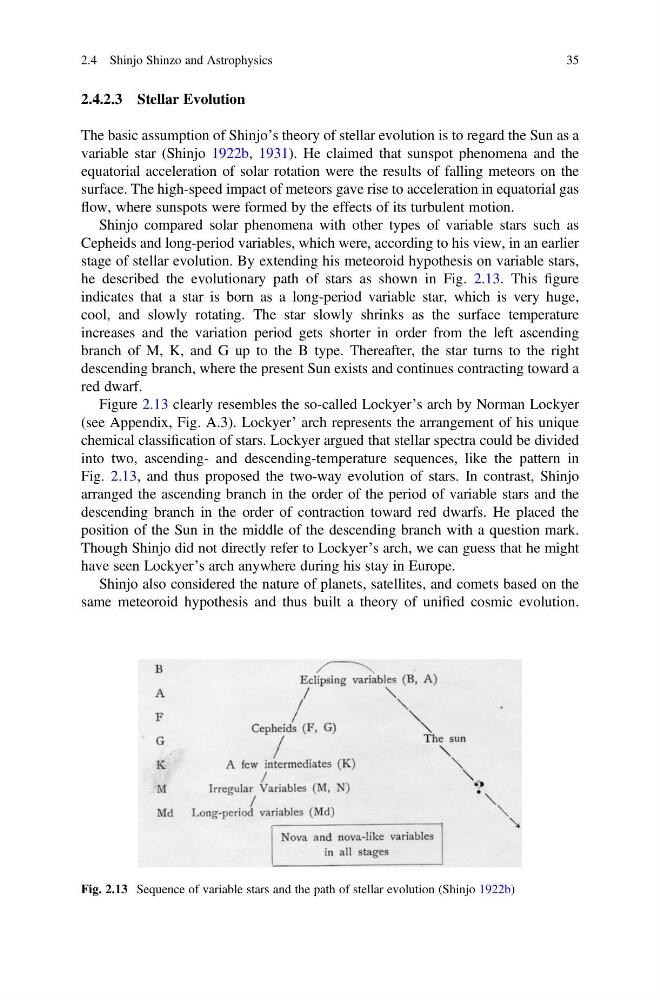
he described the evolutionary path of stars as shown in Fig. 2.13. This figure
indicates that a star is born as a long-period variable star, which is very huge,
cool, and slowly rotating. The star slowly shrinks as the surface temperature
increases and the variation period gets shorter in order from the left ascending
branch of M, K, and G up to the B type. Thereafter, the star turns to the right
descending branch, where the present Sun exists and continues contracting toward a
red dwarf.
Figure 2.13 clearly resembles the so-called Lockyer’s arch by Norman Lockyer
(see Appendix, Fig. A.3). Lockyer’ arch represents the arrangement of his unique
chemical classification of stars. Lockyer argued that stellar spectra could be divided
into two, ascending- and descending-temperature sequences, like the pattern in
Fig. 2.13, and thus proposed the two-way evolution of stars. In contrast, Shinjo
arranged the ascending branch in the order of the period of variable stars and the
descending branch in the order of contraction toward red dwarfs. He placed the
position of the Sun in the middle of the descending branch with a question mark.
Though Shinjo did not directly refer to Lockyer’s arch, we can guess that he might
have seen Lockyer’s arch anywhere during his stay in Europe.
Shinjo also considered the nature of planets, satellites, and comets based on the
same meteoroid hypothesis and thus built a theory of unified cosmic evolution.
Fig. 2.13 Sequence of variable stars and the path of stellar evolution (Shinjo 1922b)
2.4 Shinjo Shinzo and Astrophysics
35
The basic assumption of Shinjo’s theory of stellar evolution is to regard the Sun as a
variable star (Shinjo 1922b, 1931). He claimed that sunspot phenomena and the
equatorial acceleration of solar rotation were the results of falling meteors on the
surface. The high-speed impact of meteors gave rise to acceleration in equatorial gas
flow, where sunspots were formed by the effects of its turbulent motion.
Shinjo compared solar phenomena with other types of variable stars such as
Cepheids and long-period variables, which were, according to his view, in an earlier
stage of stellar evolution. By extending his meteoroid hypothesis on variable stars,
he described the evolutionary path of stars as shown in Fig. 2.13. This figure
indicates that a star is born as a long-period variable star, which is very huge,
cool, and slowly rotating. The star slowly shrinks as the surface temperature
increases and the variation period gets shorter in order from the left ascending
branch of M, K, and G up to the B type. Thereafter, the star turns to the right
descending branch, where the present Sun exists and continues contracting toward a
red dwarf.
Figure 2.13 clearly resembles the so-called Lockyer’s arch by Norman Lockyer
(see Appendix, Fig. A.3). Lockyer’ arch represents the arrangement of his unique
chemical classification of stars. Lockyer argued that stellar spectra could be divided
into two, ascending- and descending-temperature sequences, like the pattern in
Fig. 2.13, and thus proposed the two-way evolution of stars. In contrast, Shinjo
arranged the ascending branch in the order of the period of variable stars and the
descending branch in the order of contraction toward red dwarfs. He placed the
position of the Sun in the middle of the descending branch with a question mark.
Though Shinjo did not directly refer to Lockyer’s arch, we can guess that he might
have seen Lockyer’s arch anywhere during his stay in Europe.
Shinjo also considered the nature of planets, satellites, and comets based on the
same meteoroid hypothesis and thus built a theory of unified cosmic evolution.
Fig. 2.13 Sequence of variable stars and the path of stellar evolution (Shinjo 1922b)
2.4 Shinjo Shinzo and Astrophysics
35