

His first work was to establish the Tokyo School of Science (now Tokyo
University of Science, 東京理科大学) and served as the first rector of the school.
The following year, however, Terao was appointed professor of astronomy at Tokyo
Imperial University as Henry Paul’s successor. In 1888, he was also appointed
Director of Tokyo Astronomical Observatory (TAO), serving until 1919. Among
his students, Hirayama Kiyotsugu (平山清次), Kimura Hisashi (木村栄), Sotome
Kiyofusa (早乙女清房), and Hirayama Shin (平山信) played important roles in the
history of modern astronomy in Japan. Terao measured latitude by making use of a
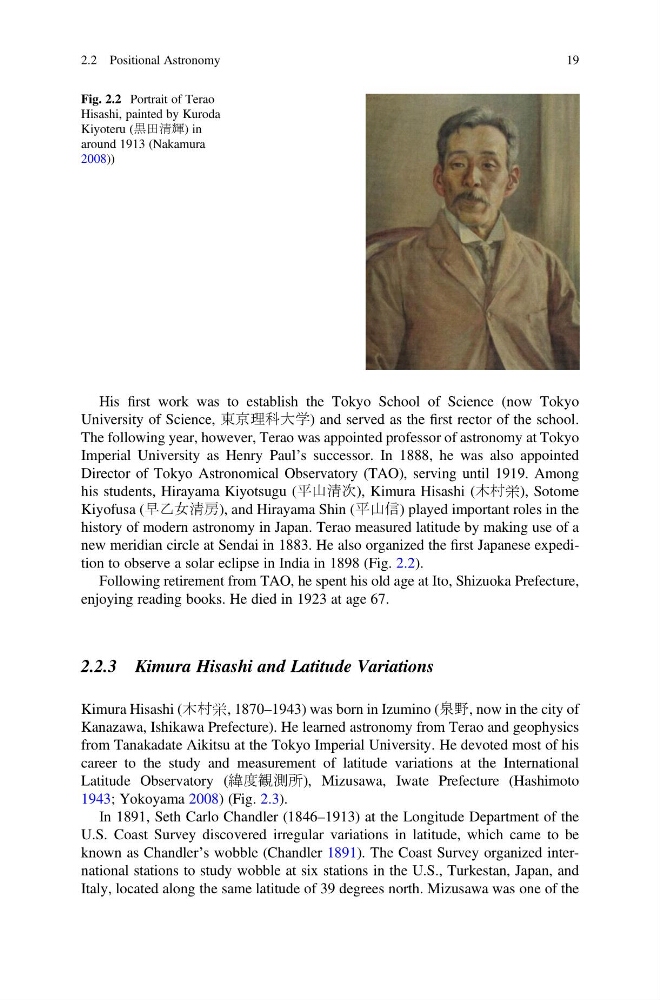
new meridian circle at Sendai in 1883. He also organized the first Japanese expedition to observe a solar eclipse in India in 1898 (Fig. 2.2).
Following retirement from TAO, he spent his old age at Ito, Shizuoka Prefecture,
enjoying reading books. He died in 1923 at age 67.
2.2.3 Kimura Hisashi and Latitude Variations
Kimura Hisashi (木村栄, 1870–1943) was born in Izumino (泉野, now in the city of
Kanazawa, Ishikawa Prefecture). He learned astronomy from Terao and geophysics
from Tanakadate Aikitsu at the Tokyo Imperial University. He devoted most of his
career to the study and measurement of latitude variations at the International
Latitude Observatory (緯度観測所), Mizusawa, Iwate Prefecture (Hashimoto
1943; Yokoyama 2008) (Fig. 2.3).
In 1891, Seth Carlo Chandler (1846–1913) at the Longitude Department of the
U.S. Coast Survey discovered irregular variations in latitude, which came to be
known as Chandler’s wobble (Chandler 1891). The Coast Survey organized international stations to study wobble at six stations in the U.S., Turkestan, Japan, and
Italy, located along the same latitude of 39 degrees north. Mizusawa was one of the
Fig. 2.2 Portrait of Terao
Hisashi, painted by Kuroda
Kiyoteru (黒田清輝) in
around 1913 (Nakamura
2008))
2.2 Positional Astronomy
19
University of Science, 東京理科大学) and served as the first rector of the school.
The following year, however, Terao was appointed professor of astronomy at Tokyo
Imperial University as Henry Paul’s successor. In 1888, he was also appointed
Director of Tokyo Astronomical Observatory (TAO), serving until 1919. Among
his students, Hirayama Kiyotsugu (平山清次), Kimura Hisashi (木村栄), Sotome
Kiyofusa (早乙女清房), and Hirayama Shin (平山信) played important roles in the
history of modern astronomy in Japan. Terao measured latitude by making use of a
new meridian circle at Sendai in 1883. He also organized the first Japanese expedition to observe a solar eclipse in India in 1898 (Fig. 2.2).
Following retirement from TAO, he spent his old age at Ito, Shizuoka Prefecture,
enjoying reading books. He died in 1923 at age 67.
2.2.3 Kimura Hisashi and Latitude Variations
Kimura Hisashi (木村栄, 1870–1943) was born in Izumino (泉野, now in the city of
Kanazawa, Ishikawa Prefecture). He learned astronomy from Terao and geophysics
from Tanakadate Aikitsu at the Tokyo Imperial University. He devoted most of his
career to the study and measurement of latitude variations at the International
Latitude Observatory (緯度観測所), Mizusawa, Iwate Prefecture (Hashimoto
1943; Yokoyama 2008) (Fig. 2.3).
In 1891, Seth Carlo Chandler (1846–1913) at the Longitude Department of the
U.S. Coast Survey discovered irregular variations in latitude, which came to be
known as Chandler’s wobble (Chandler 1891). The Coast Survey organized international stations to study wobble at six stations in the U.S., Turkestan, Japan, and
Italy, located along the same latitude of 39 degrees north. Mizusawa was one of the
Fig. 2.2 Portrait of Terao
Hisashi, painted by Kuroda
Kiyoteru (黒田清輝) in
around 1913 (Nakamura
2008))
2.2 Positional Astronomy
19