

engaged in the promulgation of a yearly calendar edited based on the Tenpo calendar
(天保暦), a lunisolar calendar.
In the fall of the same year, 1870, the main office of astronomy was moved to Tokyo
and renamed the Seigaku Kyoku (星学局, Bureau of Astronomy) for the purpose of
calendar reform. The Meiji government expedited reform to showcase to the world
Japan’s modernity. The Gregorian calendar was abruptly promulgated by changing the
day from December 3, 1872 to January 1, 1873. This sudden change impacted the
year’s regular events, which elicited strong reactions.
2.1.2 Construction of a New Observatory
The Bureau of Astronomy in the Ministry of Education planned to build a new
astronomical observatory with three functions: (i) yearly calendar making,
(ii) keeping time and time information, and (iii) determination of latitude and
longitude. During the same time, the Ministry of Interior Affairs and the Ministry
of the Navy had different plans for the new observatory and saw it serving different
purposes, so that confusion surrounding it lasted several years (Tokyo University
1987).
Finally, after negotiation within the government, the TAO was established in
1887. It was an attached institute of the College of Science, Imperial University,
which managed all three of the aforementioned functions. The observatory was first
located on the campus of the Imperial University in Hongo, Bunkyo-ku, and then
moved to Azabu, Minato-ku, both in Tokyo, in 1893.
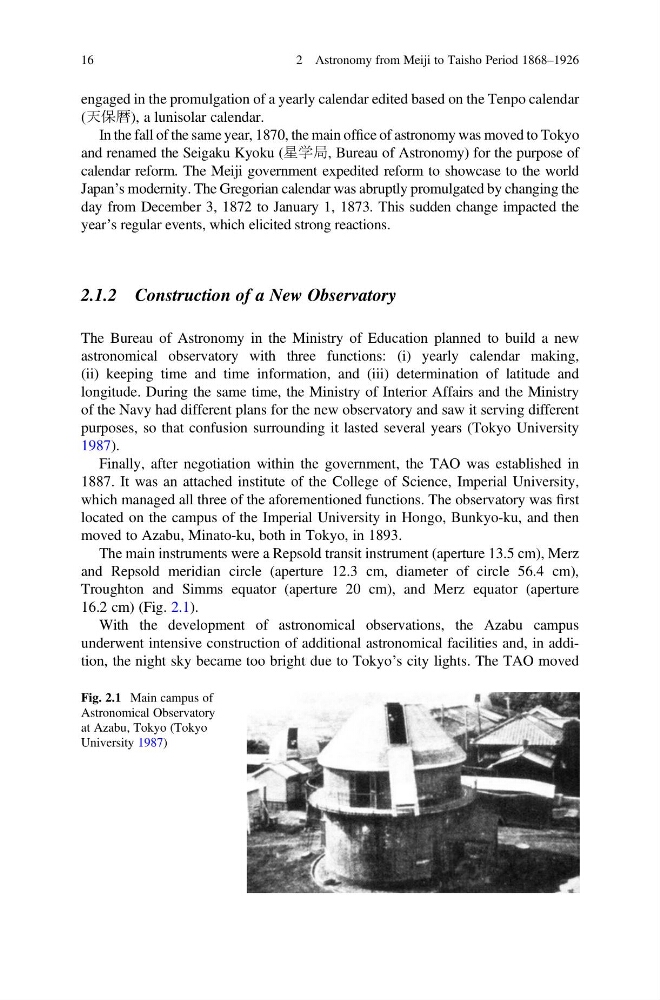
The main instruments were a Repsold transit instrument (aperture 13.5 cm), Merz
and Repsold meridian circle (aperture 12.3 cm, diameter of circle 56.4 cm),
Troughton and Simms equator (aperture 20 cm), and Merz equator (aperture
16.2 cm) (Fig. 2.1).
With the development of astronomical observations, the Azabu campus
underwent intensive construction of additional astronomical facilities and, in addition, the night sky became too bright due to Tokyo’s city lights. The TAO moved
Fig. 2.1 Main campus of
Astronomical Observatory
at Azabu, Tokyo (Tokyo
University 1987)
16
2 Astronomy from Meiji to Taisho Period 1868–1926
(天保暦), a lunisolar calendar.
In the fall of the same year, 1870, the main office of astronomy was moved to Tokyo
and renamed the Seigaku Kyoku (星学局, Bureau of Astronomy) for the purpose of
calendar reform. The Meiji government expedited reform to showcase to the world
Japan’s modernity. The Gregorian calendar was abruptly promulgated by changing the
day from December 3, 1872 to January 1, 1873. This sudden change impacted the
year’s regular events, which elicited strong reactions.
2.1.2 Construction of a New Observatory
The Bureau of Astronomy in the Ministry of Education planned to build a new
astronomical observatory with three functions: (i) yearly calendar making,
(ii) keeping time and time information, and (iii) determination of latitude and
longitude. During the same time, the Ministry of Interior Affairs and the Ministry
of the Navy had different plans for the new observatory and saw it serving different
purposes, so that confusion surrounding it lasted several years (Tokyo University
1987).
Finally, after negotiation within the government, the TAO was established in
1887. It was an attached institute of the College of Science, Imperial University,
which managed all three of the aforementioned functions. The observatory was first
located on the campus of the Imperial University in Hongo, Bunkyo-ku, and then
moved to Azabu, Minato-ku, both in Tokyo, in 1893.
The main instruments were a Repsold transit instrument (aperture 13.5 cm), Merz
and Repsold meridian circle (aperture 12.3 cm, diameter of circle 56.4 cm),
Troughton and Simms equator (aperture 20 cm), and Merz equator (aperture
16.2 cm) (Fig. 2.1).
With the development of astronomical observations, the Azabu campus
underwent intensive construction of additional astronomical facilities and, in addition, the night sky became too bright due to Tokyo’s city lights. The TAO moved
Fig. 2.1 Main campus of
Astronomical Observatory
at Azabu, Tokyo (Tokyo
University 1987)
16
2 Astronomy from Meiji to Taisho Period 1868–1926