

proper motion in M 101, and the nature of extragalactic nebulae became widely
recognized.
In 1915, Vesto Melvin Sligher (1875–1969) at Lowell Observatory in Flagstaff,
Arizona, found large line-of-sight velocities for 15 spiral nebulae in a wide range of
À300 km s
À1 (Andromeda Nebula) up to +1100 km s
À1 (M 104). Inspired by
Sligher’s observations, Edwin Hubble (1889–1953) measured the radial velocities
of spiral nebulae with the 250-cm telescope at the Mt. Wilson Observatory and
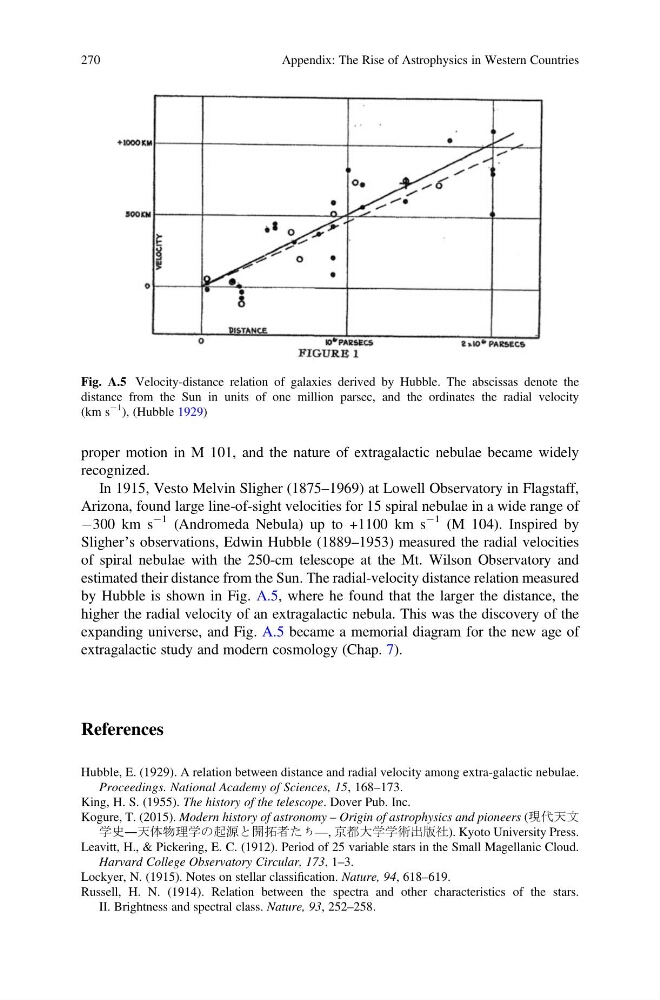
estimated their distance from the Sun. The radial-velocity distance relation measured
by Hubble is shown in Fig. A.5, where he found that the larger the distance, the
higher the radial velocity of an extragalactic nebula. This was the discovery of the
expanding universe, and Fig. A.5 became a memorial diagram for the new age of
extragalactic study and modern cosmology (Chap. 7).
References
Hubble, E. (1929). A relation between distance and radial velocity among extra-galactic nebulae.
Proceedings. National Academy of Sciences, 15, 168–173.
King, H. S. (1955). The history of the telescope. Dover Pub. Inc.
Kogure, T. (2015). Modern history of astronomy – Origin of astrophysics and pioneers (現代天文
学史―天体物理学の起源と開拓者たち—, 京都大学学術出版社). Kyoto University Press.
Leavitt, H., & Pickering, E. C. (1912). Period of 25 variable stars in the Small Magellanic Cloud.
Harvard College Observatory Circular, 173, 1–3.
Lockyer, N. (1915). Notes on stellar classification. Nature, 94, 618–619.
Russell, H. N. (1914). Relation between the spectra and other characteristics of the stars.
II. Brightness and spectral class. Nature, 93, 252–258.
Fig. A.5 Velocity-distance relation of galaxies derived by Hubble. The abscissas denote the
distance from the Sun in units of one million parsec, and the ordinates the radial velocity
(km s
À1
), (Hubble 1929)
270
Appendix: The Rise of Astrophysics in Western Countries
recognized.
In 1915, Vesto Melvin Sligher (1875–1969) at Lowell Observatory in Flagstaff,
Arizona, found large line-of-sight velocities for 15 spiral nebulae in a wide range of
À300 km s
À1 (Andromeda Nebula) up to +1100 km s
À1 (M 104). Inspired by
Sligher’s observations, Edwin Hubble (1889–1953) measured the radial velocities
of spiral nebulae with the 250-cm telescope at the Mt. Wilson Observatory and
estimated their distance from the Sun. The radial-velocity distance relation measured
by Hubble is shown in Fig. A.5, where he found that the larger the distance, the
higher the radial velocity of an extragalactic nebula. This was the discovery of the
expanding universe, and Fig. A.5 became a memorial diagram for the new age of
extragalactic study and modern cosmology (Chap. 7).
References
Hubble, E. (1929). A relation between distance and radial velocity among extra-galactic nebulae.
Proceedings. National Academy of Sciences, 15, 168–173.
King, H. S. (1955). The history of the telescope. Dover Pub. Inc.
Kogure, T. (2015). Modern history of astronomy – Origin of astrophysics and pioneers (現代天文
学史―天体物理学の起源と開拓者たち—, 京都大学学術出版社). Kyoto University Press.
Leavitt, H., & Pickering, E. C. (1912). Period of 25 variable stars in the Small Magellanic Cloud.
Harvard College Observatory Circular, 173, 1–3.
Lockyer, N. (1915). Notes on stellar classification. Nature, 94, 618–619.
Russell, H. N. (1914). Relation between the spectra and other characteristics of the stars.
II. Brightness and spectral class. Nature, 93, 252–258.
Fig. A.5 Velocity-distance relation of galaxies derived by Hubble. The abscissas denote the
distance from the Sun in units of one million parsec, and the ordinates the radial velocity
(km s
À1
), (Hubble 1929)
270
Appendix: The Rise of Astrophysics in Western Countries