

Japanese educational system. Thus, the Course of Study was largely revised in 1955,
but the basic aim of social studies remained as it was in this case.
This attitude toward education underwent a significant overhaul in the 1958
edition. In that edition, systematic understanding of science was emphasized in
every school, rather than morals and civics, to expand students’ scientific and
technological understanding.
The decade of the 1960s was a period of rapid economic growth and technological progress. To keep pace with the times, the Course of Study were revised for the
elementary schools in1968, the secondary schools in 1969, and the high schools in
1972. The basic aims of this revision were twofold: first, to reorient the curricula to
reflect the rapidly changing and increasingly complex social structure and, second, to
redesign the curricula to foster the acquisition of basic knowledge and technical
skills and to foster the development of creativity, emotional intelligence, and will.
In 1977, the Course of Study was again largely changed, with the adoption of
Yutori education, where Yutori (ゆとり) means an attitude of giving more free time
designed to take pressure off children. Class hours were noticeably reduced. Thus,
the level of achievement declined in every subject, particularly in mathematics and
science.
In 1989, the Course of Study was revised again, and Yutori education was
abandoned, so that the systematic study of school subjects was revived. This basic
principle was followed in the revision of 2003 and thereafter.
Science in schools is generally divided into three divisions: A (life and the
environment), B (materials and energy), and C (Earth and space). Astronomical
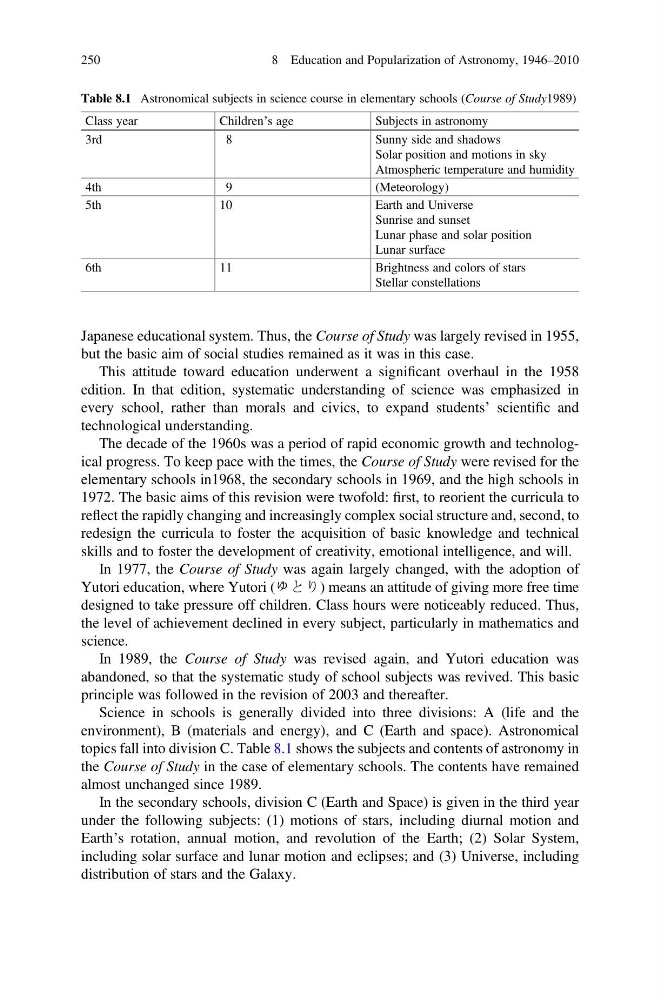
topics fall into division C. Table 8.1 shows the subjects and contents of astronomy in
the Course of Study in the case of elementary schools. The contents have remained
almost unchanged since 1989.
In the secondary schools, division C (Earth and Space) is given in the third year
under the following subjects: (1) motions of stars, including diurnal motion and
Earth’s rotation, annual motion, and revolution of the Earth; (2) Solar System,
including solar surface and lunar motion and eclipses; and (3) Universe, including
distribution of stars and the Galaxy.
Table 8.1 Astronomical subjects in science course in elementary schools (Course of Study1989)
Class year
Children’s age
Subjects in astronomy
3rd
8
Sunny side and shadows
Solar position and motions in sky
Atmospheric temperature and humidity
4th
9
(Meteorology)
5th
10
Earth and Universe
Sunrise and sunset
Lunar phase and solar position
Lunar surface
6th
11
Brightness and colors of stars
Stellar constellations
250
8 Education and Popularization of Astronomy, 1946–2010
but the basic aim of social studies remained as it was in this case.
This attitude toward education underwent a significant overhaul in the 1958
edition. In that edition, systematic understanding of science was emphasized in
every school, rather than morals and civics, to expand students’ scientific and
technological understanding.
The decade of the 1960s was a period of rapid economic growth and technological progress. To keep pace with the times, the Course of Study were revised for the
elementary schools in1968, the secondary schools in 1969, and the high schools in
1972. The basic aims of this revision were twofold: first, to reorient the curricula to
reflect the rapidly changing and increasingly complex social structure and, second, to
redesign the curricula to foster the acquisition of basic knowledge and technical
skills and to foster the development of creativity, emotional intelligence, and will.
In 1977, the Course of Study was again largely changed, with the adoption of
Yutori education, where Yutori (ゆとり) means an attitude of giving more free time
designed to take pressure off children. Class hours were noticeably reduced. Thus,
the level of achievement declined in every subject, particularly in mathematics and
science.
In 1989, the Course of Study was revised again, and Yutori education was
abandoned, so that the systematic study of school subjects was revived. This basic
principle was followed in the revision of 2003 and thereafter.
Science in schools is generally divided into three divisions: A (life and the
environment), B (materials and energy), and C (Earth and space). Astronomical
topics fall into division C. Table 8.1 shows the subjects and contents of astronomy in
the Course of Study in the case of elementary schools. The contents have remained
almost unchanged since 1989.
In the secondary schools, division C (Earth and Space) is given in the third year
under the following subjects: (1) motions of stars, including diurnal motion and
Earth’s rotation, annual motion, and revolution of the Earth; (2) Solar System,
including solar surface and lunar motion and eclipses; and (3) Universe, including
distribution of stars and the Galaxy.
Table 8.1 Astronomical subjects in science course in elementary schools (Course of Study1989)
Class year
Children’s age
Subjects in astronomy
3rd
8
Sunny side and shadows
Solar position and motions in sky
Atmospheric temperature and humidity
4th
9
(Meteorology)
5th
10
Earth and Universe
Sunrise and sunset
Lunar phase and solar position
Lunar surface
6th
11
Brightness and colors of stars
Stellar constellations
250
8 Education and Popularization of Astronomy, 1946–2010