

Eddington Medal from the Royal Astronomical Society in 1970, the Kyoto Prize (京
都賞) from the Inamori Foundation (1995), and the Bruce Medal of the Astronomical Society of the Pacific (2004). He died from pneumonia at a hospital in 2010 at
age 89 (Osaki 2008a, b; Matsuda et al. 2010; Sato 2015).
7.2.2 Chemical Evolution in Early Universe
On the origin of chemical elements in the early phase of Big Bang cosmology, Ralph
Alpher, Hans Bethe, and George Gamow (1948) (known as αβγ theory) supposed
that primordial matter was composed solely of neutrons under extremely high
temperature. As the Universe expanded with rapid cooling, elementary particles
such as protons and deuterons were successively produced.
In 1950, Hayashi pointed out the importance of the Urca process at this stage. He
showed that electron-positron pair production also occurred at high temperatures in
the very early Universe. Taking into account the Urca process and pair production,
Hayashi derived a proton-neutron concentration ratio of about 1∶4. This value was a
marked revision for the neutron model in the αβγ theory (Hayashi 1950).
Based on this proton-neutron ratio, Hayashi and Nishida Minoru (1956) considered the formation of light elements in the expanding universe. In the αβγ theory,
under the original assumption of pure neutrons as the constituents of primordial
matter, it was difficult to explain the successive building-up process of heavy
elements, since there are “crevasses” at mass numbers 5 (boron) and 8 (oxygen).
This difficulty could be overcome by the existence of an appreciable amount of
original protons, which increased the probabilities of proton capture by light nuclei.
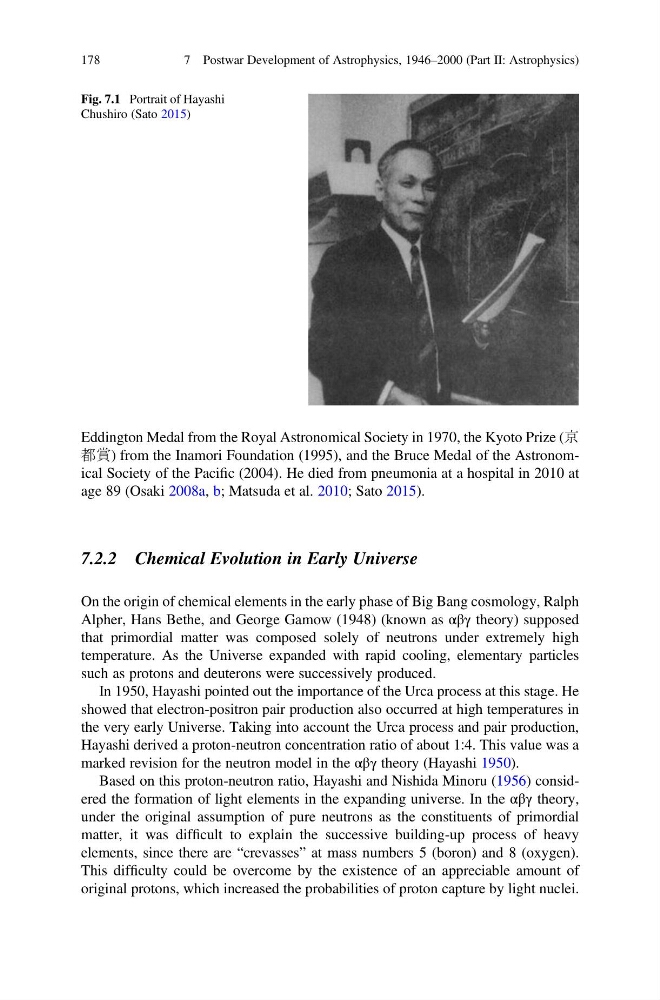
Fig. 7.1 Portrait of Hayashi
Chushiro (Sato 2015)
178
7 Postwar Development of Astrophysics, 1946–2000 (Part II: Astrophysics)
都賞) from the Inamori Foundation (1995), and the Bruce Medal of the Astronomical Society of the Pacific (2004). He died from pneumonia at a hospital in 2010 at
age 89 (Osaki 2008a, b; Matsuda et al. 2010; Sato 2015).
7.2.2 Chemical Evolution in Early Universe
On the origin of chemical elements in the early phase of Big Bang cosmology, Ralph
Alpher, Hans Bethe, and George Gamow (1948) (known as αβγ theory) supposed
that primordial matter was composed solely of neutrons under extremely high
temperature. As the Universe expanded with rapid cooling, elementary particles
such as protons and deuterons were successively produced.
In 1950, Hayashi pointed out the importance of the Urca process at this stage. He
showed that electron-positron pair production also occurred at high temperatures in
the very early Universe. Taking into account the Urca process and pair production,
Hayashi derived a proton-neutron concentration ratio of about 1∶4. This value was a
marked revision for the neutron model in the αβγ theory (Hayashi 1950).
Based on this proton-neutron ratio, Hayashi and Nishida Minoru (1956) considered the formation of light elements in the expanding universe. In the αβγ theory,
under the original assumption of pure neutrons as the constituents of primordial
matter, it was difficult to explain the successive building-up process of heavy
elements, since there are “crevasses” at mass numbers 5 (boron) and 8 (oxygen).
This difficulty could be overcome by the existence of an appreciable amount of
original protons, which increased the probabilities of proton capture by light nuclei.
Fig. 7.1 Portrait of Hayashi
Chushiro (Sato 2015)
178
7 Postwar Development of Astrophysics, 1946–2000 (Part II: Astrophysics)