

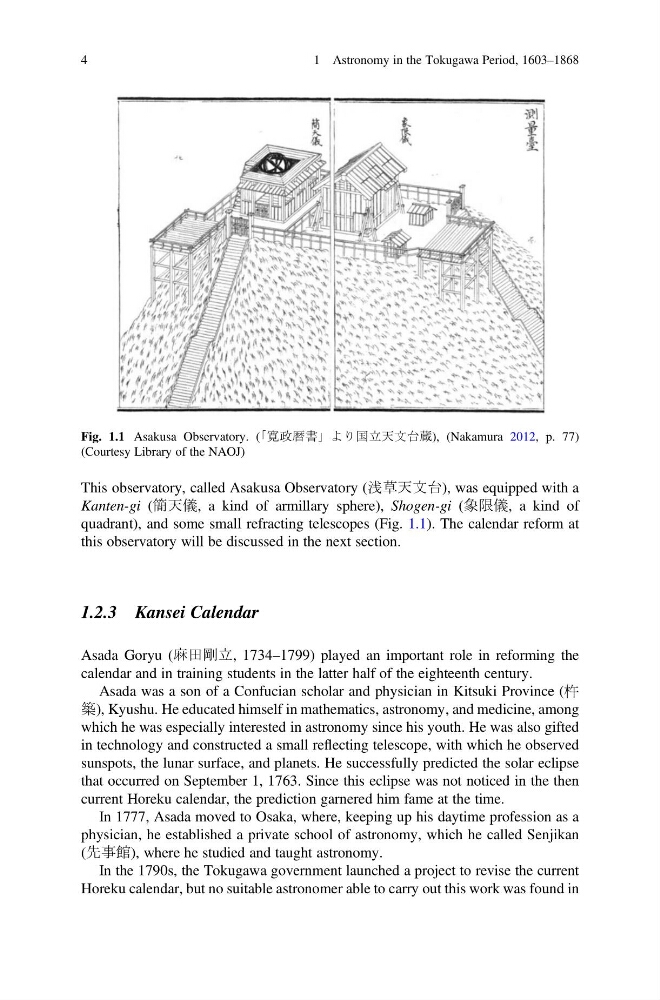
This observatory, called Asakusa Observatory (浅草天文台), was equipped with a
Kanten-gi (簡天儀, a kind of armillary sphere), Shogen-gi (象限儀, a kind of
quadrant), and some small refracting telescopes (Fig. 1.1). The calendar reform at
this observatory will be discussed in the next section.
1.2.3 Kansei Calendar
Asada Goryu (麻田剛立, 1734–1799) played an important role in reforming the
calendar and in training students in the latter half of the eighteenth century.
Asada was a son of a Confucian scholar and physician in Kitsuki Province (杵
築), Kyushu. He educated himself in mathematics, astronomy, and medicine, among
which he was especially interested in astronomy since his youth. He was also gifted
in technology and constructed a small reflecting telescope, with which he observed
sunspots, the lunar surface, and planets. He successfully predicted the solar eclipse
that occurred on September 1, 1763. Since this eclipse was not noticed in the then
current Horeku calendar, the prediction garnered him fame at the time.
In 1777, Asada moved to Osaka, where, keeping up his daytime profession as a
physician, he established a private school of astronomy, which he called Senjikan
(先事館), where he studied and taught astronomy.
In the 1790s, the Tokugawa government launched a project to revise the current
Horeku calendar, but no suitable astronomer able to carry out this work was found in
Fig. 1.1 Asakusa Observatory. (
「寛政暦書」より国立天文台蔵), (Nakamura 2012, p. 77)
(Courtesy Library of the NAOJ)
4
1 Astronomy in the Tokugawa Period, 1603–1868
Kanten-gi (簡天儀, a kind of armillary sphere), Shogen-gi (象限儀, a kind of
quadrant), and some small refracting telescopes (Fig. 1.1). The calendar reform at
this observatory will be discussed in the next section.
1.2.3 Kansei Calendar
Asada Goryu (麻田剛立, 1734–1799) played an important role in reforming the
calendar and in training students in the latter half of the eighteenth century.
Asada was a son of a Confucian scholar and physician in Kitsuki Province (杵
築), Kyushu. He educated himself in mathematics, astronomy, and medicine, among
which he was especially interested in astronomy since his youth. He was also gifted
in technology and constructed a small reflecting telescope, with which he observed
sunspots, the lunar surface, and planets. He successfully predicted the solar eclipse
that occurred on September 1, 1763. Since this eclipse was not noticed in the then
current Horeku calendar, the prediction garnered him fame at the time.
In 1777, Asada moved to Osaka, where, keeping up his daytime profession as a
physician, he established a private school of astronomy, which he called Senjikan
(先事館), where he studied and taught astronomy.
In the 1790s, the Tokugawa government launched a project to revise the current
Horeku calendar, but no suitable astronomer able to carry out this work was found in
Fig. 1.1 Asakusa Observatory. (
「寛政暦書」より国立天文台蔵), (Nakamura 2012, p. 77)
(Courtesy Library of the NAOJ)
4
1 Astronomy in the Tokugawa Period, 1603–1868