

5.3.2 Stellar Model
In 1926, A. S. Eddington considered the theory of stellar pulsation for Cepheid and
Mira types, based on the subatomic energy source operating in the central part of the
stars. He showed that if the rate of energy generation, ε, is proportional to the nth
power of gas density, ρ, the central region of the stellar core enters a state of
overstability when n is larger than 5/3. This suggests that the amplitude of a small
disturbance in the central region gradually rises up and propagates to the stellar
surface. This large value of n is the condition of the maintenance of pulsation
phenomena.
Hitotuyanagi’s work in 1934 on the interior structure of stars began with an
examination of star stability against the pulsation (Hitotuyanagi 1934). He accepted
the annihilation hypothesis for the generation of stellar energy and assumed that the
rate of energy generation ε was proportional to the square of gas density, ρ. Based on
these assumptions, he calculated anew the stellar model making use of H. A.
Kramers’ absorption coefficient and S. Rosseland’s theory for the stellar structure.
Hitotuyanagi made numerical calculations for a star of 6.4 solar mass and 290 solar
luminosities (1.1 Â 10
36 erg s
À1 ), which corresponds to around a B5 main-sequence
star, and he found that this star had a stable state for pulsation, contrary to
Eddington’s theory, according to which this star should be a pulsation star by its
large value of n ¼ 2. On this disagreement, Hitotuyanagi supposed that one of the
reasons might be the assumption of the mass annihilation at the stellar center, but this
was inconclusive in the days of the early 1930s.
.
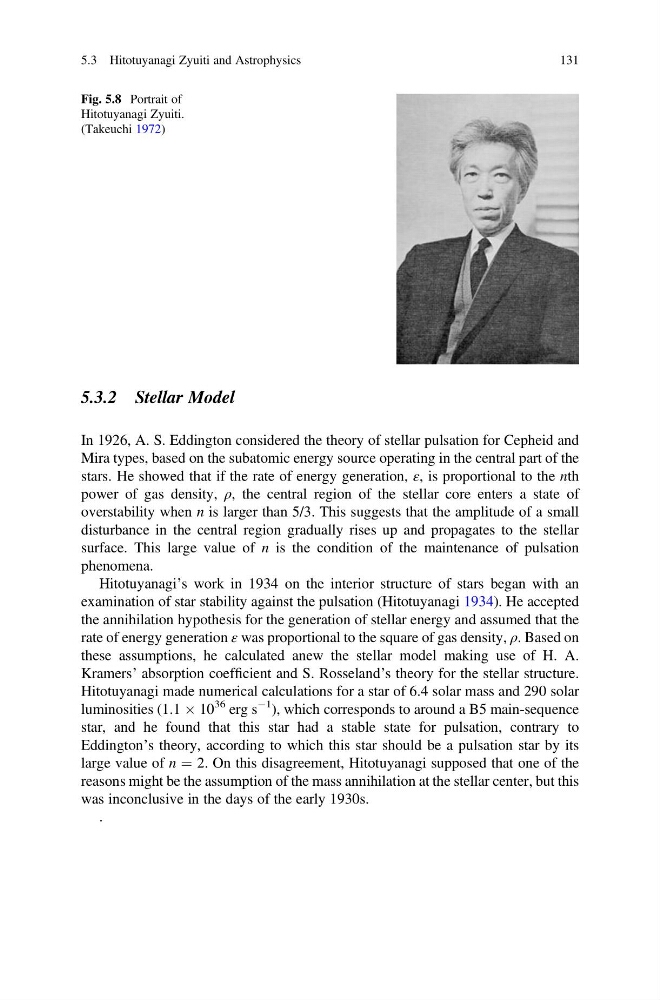
Fig. 5.8 Portrait of
Hitotuyanagi Zyuiti.
(Takeuchi 1972)
5.3 Hitotuyanagi Zyuiti and Astrophysics
131
In 1926, A. S. Eddington considered the theory of stellar pulsation for Cepheid and
Mira types, based on the subatomic energy source operating in the central part of the
stars. He showed that if the rate of energy generation, ε, is proportional to the nth
power of gas density, ρ, the central region of the stellar core enters a state of
overstability when n is larger than 5/3. This suggests that the amplitude of a small
disturbance in the central region gradually rises up and propagates to the stellar
surface. This large value of n is the condition of the maintenance of pulsation
phenomena.
Hitotuyanagi’s work in 1934 on the interior structure of stars began with an
examination of star stability against the pulsation (Hitotuyanagi 1934). He accepted
the annihilation hypothesis for the generation of stellar energy and assumed that the
rate of energy generation ε was proportional to the square of gas density, ρ. Based on
these assumptions, he calculated anew the stellar model making use of H. A.
Kramers’ absorption coefficient and S. Rosseland’s theory for the stellar structure.
Hitotuyanagi made numerical calculations for a star of 6.4 solar mass and 290 solar
luminosities (1.1 Â 10
36 erg s
À1 ), which corresponds to around a B5 main-sequence
star, and he found that this star had a stable state for pulsation, contrary to
Eddington’s theory, according to which this star should be a pulsation star by its
large value of n ¼ 2. On this disagreement, Hitotuyanagi supposed that one of the
reasons might be the assumption of the mass annihilation at the stellar center, but this
was inconclusive in the days of the early 1930s.
.
Fig. 5.8 Portrait of
Hitotuyanagi Zyuiti.
(Takeuchi 1972)
5.3 Hitotuyanagi Zyuiti and Astrophysics
131